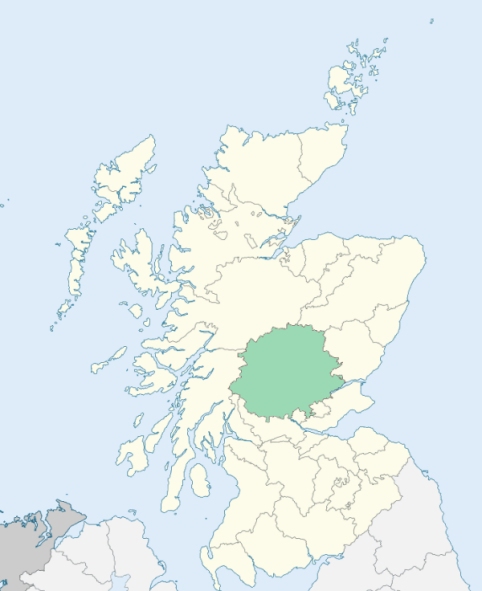
Weem is a parish in the north-west of Perthshire. The parish lies dispersed in separate and far distant portions, over nearly a fourth of Perthshire, from near the head of Glenlochy on the west, to the vicinity of Strathbran on the east, and from 3 miles south of Loch Tummel on the north, to the vicinity of Loch Earn on the south. Its districts are eight in number, all mutually detached, all intermixed with wings and detachments of Logierait, Dull, Fortingall, Kenmore, Killin, Comrie, and Little Dunkeld. Weem proper, or the district in which the church is situated, lies in Strathtay, along the left bank of the river, opposite the village of Aberfeldy. Districts: Weem, Murthly, Sticks, Auchmore, Glenqueich, Crannich, Glenlyon, and Glenlochy. (1867: The Imperial Gazetteer of Scotland, by John Marius Wilson).
Balnasuin, Balwahanaid, Caolvalloch, Cragganester, Craggantoul, Kirkton, Tombreck, Weem
Derculich, Edradyntate, Killiechassie, Menzies
The parish of Weem had eleven detached parts:
No. 1. Bridge of Lochy, north-west of Killin village
No. 2. Achmore, on the south shore of Loch Tay at its west end
No. 3. Duncroisk, in Glenlochay, north-west of Killin village
No. 4. Extending from Balnahanaid, in Glenlyon, to Balnasuim, on Loch Tay
No. 5. Comrie Castle, north of Kenmore village
No. 6. Newhall, east of Taymouth Castle
No. 7. Stix, east of Taymouth Castle
No. 8. Leachan, north of the River Quaich and south-east of Kenmore village
No. 9. Extending from Lochs, in Glenlyon, southwards to Kenknock, in Glenlochay
No. 10. Duntaggart, east of Aberfeldy
No. 11. Coalvellich, on the south side of the River Quaich
(a.) Detached parts Nos. 5, 6, 7, 8, and 11 of Weem were transferred to the parish of Dull.
(b.) Those parts of Weem detached No. 4 and of Weem detached No. 9 which lay in the basin of the River Lyon were transferred to the parish of Fortingall.
(c.) Weem detached No. 2 was transferred to the parish of Kenmore, and the part of Weem detached No. 4 which lay in the drainage area of Loch Tay was also transferred to the parish of Kenmore.
(d.) Weem detached No. 1 and Weem detached No. 3 were transferred to the parish of Killin, and the part of Weem detached No. 9 which lay in the basin of the River Lochay was also transferred to the parish of Killin.
(e.) Weem detached No. 10 was transferred to the parish of Logierait.
(f.) The part of Dull which lay in the basin of the Tay, on the left bank of that river and east of the main portion of the parish of Weem, was annexed to Weem.
(g.) Logierait detached No. 1, Logierait detached No. 2, and the part of Logierait detached No. 5 which lay on the north of the River Tay were annexed to Weem.
See affected properties and landholders. (1892: Boundary of counties and parishes in Scotland as settled by the Boundary Commissioners under the Local Government Act, 1889, by Hay Shennan)
PRE-REFORMATION GOVERNANCE:
POST-REFORMATION GOVERNANCE:
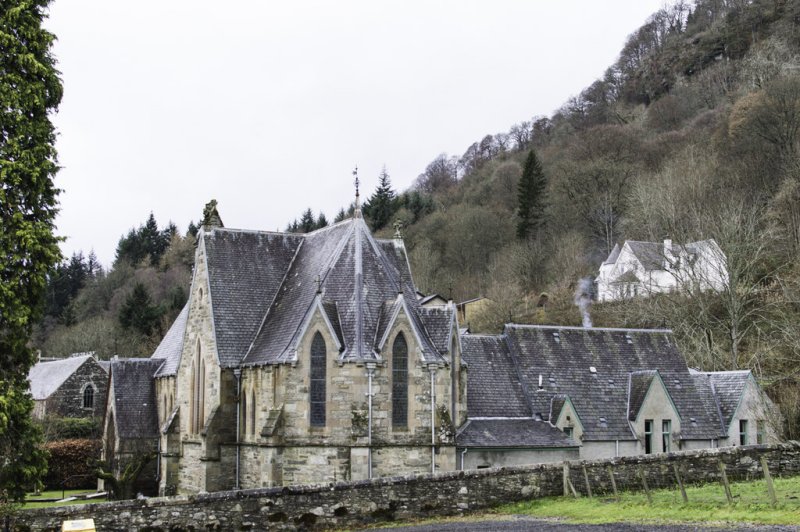
The church of Weem was dedicated to St Cuthbert, and beside it was St Cuthbert's Well. Besides the church, there was at Weem a famous Chapel of St David, a local hermit, whose cave and holy well were frequented by pilgrims. The yearly tryst of Weem was called in his honour, Feill Dhaidh (David's Fair). On 5 July 1921 a decree transporting the church to a building formerly used as an Episcopal Chapel was pronounced by the Court of Teinds.
Disjoined Quoad Sacra Parishes:
Amulree. The name of this parish, Ath Mhalruibh (the ford of Malrubh), commemorates an ancient chapel of St Malrubh, which stooe here, beside the ford of the River Braan. Amulree was disjoined from Dull, Fowlis Wester, Kenmore, Little Dunkeld, Monzie, Weem, and Crieff on 15 July 1871. The church was begun in 1743, but owing to the (Jacobite) Rebellion in 1745, was not completed until 1752.
Glenlyon. Called of old Killinlynar, and in recent times Innerwick, or Inverbhaic. The church of Glenlyon was dedicated to St Kinnera. In 1585 this parish was united to Fortingal and Kilchonain in Rannoch, but was proposed to be again disjoined by the General Assembly, and was referred by Parliament, 11 September 1639, to the Commission to be granted for the Plantation of Kirks. It was erected as a parliamentary charge in 1829, and the parish was disjoined from Fortingal and Weem, 11 June 1845. At Kerrowmore in Glenlyon there was a chapel of St Breandan.
Includes ministers, licentiates, assistants, readers, and clerks.
Weem (QO)
Amulree (QS)
Glenlyon (QS)
(1928: Fasti Ecclesiæ Scoticanæ, by Hew Scott, D. D.)
Parish registers turned over to the Registrar-General, as a result of the Registration of Births, Deaths, and Marriages (Scotland) Act of 1854. The letters B. D. and M. indicate Births (or Baptisms), Deaths (or Burials), and Marriages (or Proclamations of Banns) respectively. Numbers indicate separate volumes or books. Note: These records are by no means complete or without damage; consult the Detailed List of the Old Parochial Registers of Scotland (1872) to learn more about the condition of the records.
| OPR and RD Numbers | |||
|---|---|---|---|
| Date Range | Name | Number | Type |
| 1692-1854 | Weem | 398 | OPR |
| 1855-1961 | Weem | 398 | RD |
| 1962-1971 | Aberfeldy, Dull and Weem | 324 | RD |
| 1972-2003 | Aberfeldy, Dull and Weem | 385 | RD |
| 2009 | Perth and Kinross, Aberfeldy | 385 | RD |
| 2026 | Perth and Kinross Council; Aberfeldy Community Council Dull and Weem Community Council | ||
(2009: Parishes and Registration Districts of Scotland - Old and New, National Records of Scotland)
Local community councils (2026) are provided as a potential source of additional information for settlements within the original boundaries of the parish. (Source)
Statistics from informal and official censuses
Anderson, Beale, Cameron, Campbell, Irvine, Leslie, Menzies, Robertson, Scott, Stewart
Note: Names appearing in research materials, other than censuses. Simple names (First name, surname only) have been omitted unless they appear associated with large properties. All women's names, and men's names with occupations, military ranks, or peerage titles are included.
By the Reverend Mr James M'Diarmed.
"There are at present 1352 in the parish, of whom 632 are males, and 720 females. There are 108 farmers, 50 crofters, 120 cottagers, 3 smiths, 10 wrights, 6 wheel-wrights, 6 coopers, 24 weavers, 10 flax-dressers, 3 wool-combers, 6 tailors, and 4 millers.
Few or none have emigrated beyond seas from this parish; but whole troops of boys and girls go annually to the low country for service, and of late to the cotton-works, many of whom settle there.
There is only one inn in the parish, and five ale-houses, or whisky-houses. These last are very little frequented but at weddings, markets, and other public meetings. The Gaelic language is that commonly spoken, but English, of the Scottish dialect, is generally understood."
(This section contains excerpts, at times restructured or paraphrased, from an article appearing in Statistical Account of Scotland, Sir John Sinclair, 1791-1799)
Primary Sources:
Statistical Account of Scotland (1791-1799), Volume 12, p. 130
New Statistical Account of Scotland (1834-1845), Volume 10, p. 702
See Parish Page Sources for all source information and links.