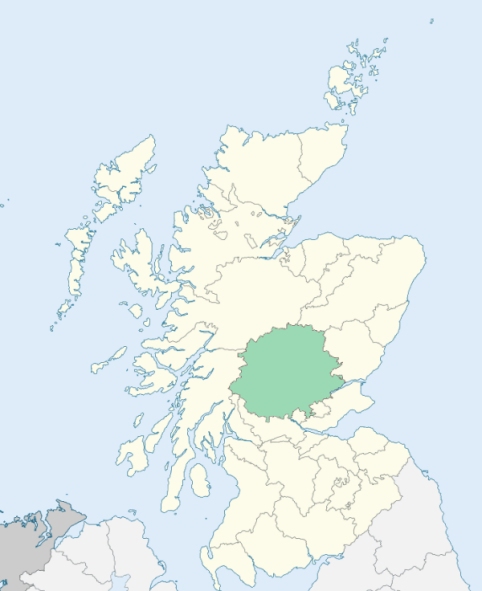
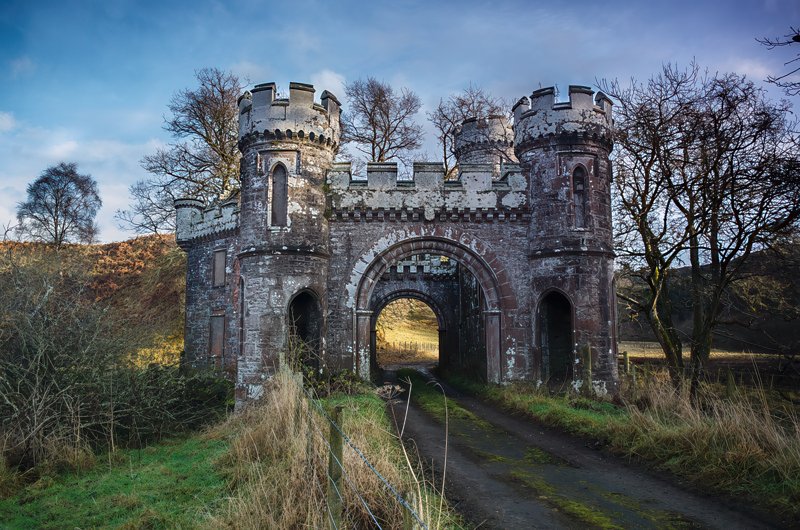
Monzie is a parish in the Glenalmond district of Perthshire. The parish is bounded by Kenmore, Weem, Dull, Fowlis Wester, Crieff, Monzievaird, and Comrie. (1867: The Imperial Gazetteer of Scotland, by John Marius Wilson).
Chapelhill, Cultoquhey, Gilmerton, Knowhead, Monzie
Collerie, Craiglea, Innerpeffray, Logiealmond, Lynedoch, Monzie, Ochtertyre, Strathord, The Cairnies
The parish of Monzie had three detached parts:
No. 1. Innerpeffray, south-east of Crieff
No. 2. Auchnafree, north of the parish of Monzievaird & Strowan
No. 3 Logiealmond, in the Glen-almond, north of the parish of Methven
The effect of the alterations on the area of Monzie is to transfer the parish centre to the part of the new parish which was the centre of population and of wealth. The new parish of Monzie is now situated in Logiealmond, and does not differ greatly in extent from the quoad sacra parish of Logiealmond.
(a.) Monzie detached No. 1 at Innerpeffray, and also the part of the parish in which the parish church is situated, were transferred to the parish of Crieff.
(b.) The part of Monzie detached No. 3, which lay south of the Almond, was transferred to the parish of Methven.
(c.) Monzie detached No. 2 at Auchnafree was transferred to Monzievaird & Strowan.
(d.) The part of Auchtergaven which lay to the west and south-west of the boundary there described was transferred to Monzie. The area thus dealt with is the southern prat of the tongue of Auchtergaven which lay between the detached part of Methven and the detached part of Redgorton.
(e.) The detached part of Redgorton at Mullion was annexed to Monzie.
(f.) The part of Fowlis Wester which lay north of the River Almond and in the basin of the Almond was annexed to Monzie. The area thus dealt with lies south of the part of Fowlis Wester transferred to Little Dunkeld and north of The Cairnies.
See affected properties and landholders. (1892: Boundary of counties and parishes in Scotland as settled by the Boundary Commissioners under the Local Government Act, 1889, by Hay Shennan)
PRE-REFORMATION GOVERNANCE:
POST-REFORMATION GOVERNANCE:
A fair of St Laurence was held at Monzie, and it is believed that the parish church was dedicated to him. Monzie was a prebend of Dunblane. In September, on Our Lady Day in Harvest, a fair of St Mary was held here. In this parish are still to be seen the ruins of the collegiate church of St Mary at Innerpeffray. That church was built before 1342. Its collegiate foundation was granted by John, first Lord Drummond, in 1508. There are ancient burial-grounds in the parish of Monzie at Tomanbowie and at Stuck. In both there were chapels of old, but these have long since fallen down.
Disjoined Quoad Sacra Parishes:
Amulree. The name of this parish, Ath Mhalruibh (the ford of Malrubh), commemorates an ancient chapel of St Malrubh, which stood here beside the ford of the River Braan. Amulree was disjoined from Dull, Fowlis Wester, Kenmore, Little Dunkeld, Monzie, Weem, and Crieff on 15 July 1871. The church was begun in 1743, but owing to the (Jacobite) Rebellion in 1745, was not completed until 1752.
Includes ministers, licentiates, assistants, readers, and clerks.
Monzie (QO)
Amulree (QS)
(1928: Fasti Ecclesiæ Scoticanæ, by Hew Scott, D. D.)
Parish registers turned over to the Registrar-General, as a result of the Registration of Births, Deaths, and Marriages (Scotland) Act of 1854. The letters B. D. and M. indicate Births (or Baptisms), Deaths (or Burials), and Marriages (or Proclamations of Banns) respectively. Numbers indicate separate volumes or books. Note: These records are by no means complete or without damage; consult the Detailed List of the Old Parochial Registers of Scotland (1872) to learn more about the condition of the records.
| OPR and RD Numbers | |||
|---|---|---|---|
| Date Range | Name | Number | Type |
| 1700-1854 | Monzie | 382 | OPR |
| 1855-1891 | Monzie | 382 | RD |
| 2009 | Perth and Kinross, Crieff | 394 | RD |
| 2026 | Perth and Kinross Council; East Strathearn Community Council | ||
(2009: Parishes and Registration Districts of Scotland - Old and New, National Records of Scotland)
Local community councils (2026) are provided as a potential source of additional information for settlements within the original boundaries of the parish. (Source)
Statistics from informal and official censuses
Campbell, Drummond, Murray, Peddie, Robertson, Russell, Stalker, Stewart, Taylor, Wilson
Note: Names appearing in research materials, other than censuses. Simple names (First name, surname only) have been omitted unless they appear associated with large properties. All women's names, and men's names with occupations, military ranks, or peerage titles are included.
By the Reverend Mr George Erskine, Minister.
"The number of souls in 1792 was 1136. Of these there were 703 examinable persons, and 433 children under that age. There were 112 inhabitants in the village. All the inhabitants of this parish are either proprietors, farmers, tradesmen, or day-labourers. The great part of the farming work, is done by the farmers themselves, their wives, their sons, and their daughters.
There are in the parish 54 weavers, 4 coopers, 8 fleshers, 8 wrights, 6 sawyers of wood, 10 shoemakers, 12 tailors, 2 gardeners, 4 blacksmiths, 2 masons, 4 millers, 7 licensed ale-sellers, 81 farmers, 61 pendiclers, 86 cottagers, and 116 servants. All the inhabitants are of the established church, excepting 1 Berean, 5 Episcopalians, and 30 Antiburgher Seceders. There are no Roman Catholics.
This parish being situated on the borders of the Highlands, and having much intercourse and connection with the natives, we need not be surprised to find that the Gaelic is spoken in the back part of it, and the old Scotch dialect in the fore part, pronounced with the Gaelic tone and accent. There are, however, very few persons in the whole parish, who do not either speak or understand Gaelic.
The people of this parish may be said to answer the general character of the Scotch; for they are sober, honest, humane, industrious, and respectful to their superiors. They have a reasonable measure of the comforts and conveniences of life, are contented with their lot, attend most regularly upon public worship, and behave with a becoming decency in the house of God. Not one instance of suicide, or of any person belonging to this parish being judicially convicted of any crime, has occurred these 40 years.
In general, they dress better than formerly. They meet together at times, and make merry. Their chief amusement at public meetings is dancing; and upon these occasions, there is a pleasing cheerfulness and innocence among them. They are not however entirely free of superstition. Lucky and unlucky days and feet are still attended to, especially about the end and beginning of the year. No person will be proclaimed for marriage in the end of one year, or even quarter of one year, and be married in the beginning of the next. The power of an evil eye, too, is still believed, although the faith of the people in witchcraft is much enfeebled. The people have nothing remarkable in their size, strength, or features. They are generally of the middle size and of a dusky complexion. There are some, however, 6 feet in height."
(This section contains excerpts, at times restructured or paraphrased, from an article appearing in Statistical Account of Scotland, Sir John Sinclair, 1791-1799)
Primary Sources:
Statistical Account of Scotland (1791-1799), Volume 15, p. 241
New Statistical Account of Scotland (1834-1845), Volume 10, p. 262
See Parish Page Sources for all source information and links.