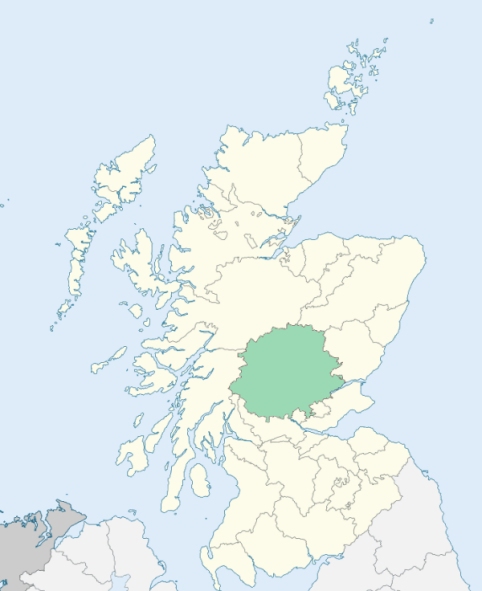
Little Dunkeld is a parish a little northeast of the centre of Perthshire. It is bounded by the parishes of Dull, Logierait, Dunkeld and Dowally, Caputh, Kinclaven, Auchtergaven, Monzie, and Weem. (1867: The Imperial Gazetteer of Scotland, by John Marius Wilson)
Amulree, Balinrich, Balmacneil, Balnamuir, Balnagard, Birnam, Charleston, Dalguise, Gillyburn, Inver, Kincraigie, Little Dunkeld, Middleton
The part of the parish of Fowlis Wester which lay in the basin of the River Bran was transferred to the parish of Little Dunkeld. See affected properties and landholders. (1892: Boundary of counties and parishes in Scotland as settled by the Boundary Commissioners under the Local Government Act, 1889, by Hay Shennan)
PRE-REFORMATION GOVERNANCE:
POST-REFORMATION GOVERNANCE:
The parishes of Little Dunkeld and Laggan-Allochie were united early in the seventeenth century.
Little Dunkeld. This parish formed a prebend belonging to the Archdeacon of Dunkeld. The property in the parish called Katherine's Lands is believed to have formed an endowment of St Katherine's Altar in Dunkeld Cathdral.
Laggan-Allochie, or Inismogranachan. The church of Laggan-Allochie was a prebend of Dunkeld. It was dedicated to St Kellach.
Disjoined Quoad Sacra Parishes:
Amulree. The name of this parish, Ath Mhalruibh (the ford of Malrubh), commemorates an ancient chapel of St Malrubh, which stood here beside the ford of the River Braan. Amulree was disjoined from Dull, Fowlis Wester, Kenmore, Little Dunkeld, Monzie, Weem, and Crieff on 15 July 1871. The church was begun in 1743, but owing to the (Jacobite) Rebellion in 1745, was not completed until 1752.
Grantully. The parish of Grantully was disjoined from Little Dunkeld and Dull on 12 March 1883. At Pitcairn, within the bounds, stands a chapel built in 1533 by Alexander Stewart of Grantully, part of which is now used as a burial vault by that family. It was dedicated to St Mary, St Andrew, St Adamnan, and St Bean.
Murthly. A mission chapel was built here in 1913. The parish of Murthly was disjoined from Little Dunkeld on 12 June 1914. Near Murthly Castle, within the bounds, are the remains of an ancient chapel of St Anthony.
Includes ministers, licentiates, assistants, readers, and clerks.
Little Dunkeld (QO)
Laggan-Allochie (QO)
Amulree (QS)
Grantully (QS)
Murthly (QS)
(1928: Fasti Ecclesiæ Scoticanæ, by Hew Scott, D. D.)
Parish registers turned over to the Registrar-General, as a result of the Registration of Births, Deaths, and Marriages (Scotland) Act of 1854. The letters B. D. and M. indicate Births (or Baptisms), Deaths (or Burials), and Marriages (or Proclamations of Banns) respectively. Numbers indicate separate volumes or books. Note: These records are by no means complete or without damage; consult the Detailed List of the Old Parochial Registers of Scotland (1872) to learn more about the condition of the records.
| OPR and RD Numbers | |||
|---|---|---|---|
| Date Range | Name | Number | Type |
| 1759-1854 | Little Dunkeld | 373 | OPR |
| 1855-1931 | Little Dunkeld | 373 | RD |
| 2009 | Perth and Kinross, Dunkeld | 388 | RD |
| 2026 | Perth and Kinross Council; Dunkeld and Birnam Community Council | ||
(2009: Parishes and Registration Districts of Scotland - Old and New, National Records of Scotland)
Local community councils (2026) are provided as a potential source of additional information for settlements within the original boundaries of the parish. (Source)
Statistics from informal and official censuses
Anderson, Cameron, Campbell, Crichton, Forbes, Menzies, Reid, Robertson, Scott, Stewart
Note: Names appearing in research materials, other than censuses. Simple names (First name, surname only) have been omitted unless they appear associated with large properties. All women's names, and men's names with occupations, military ranks, or peerage titles are included.
By the Reverend Mr John Robertson.
"The number of souls in 1792 was 2705. There were 160 weavers, 10 masons, 31 wrights, 35 tailors, 31 shoemakers, 11 smiths, 64 men servants, 101 maid servants, 6 livery servants, 3 schoolmasters, 23 flax-dressers, 43 day labourers, 6 fishermen and 5 gardeners.
In that part of the parish which is below Invar, the people speak the Scottish dialect of the English, and are not distinguished by any perceptible shade of character from the inhabitants of the low country parishes around them. The rest of the inhabitants (more than three fourths) are Highlanders, who speak a dialect, not perhaps the purest, of the Gaelic. They have all a strong attachment to their native tongue; many speak English with tolerable ease, and the youth, by means of the charity schools, can write it with rather more propriety, and copiousness than those of the low country part of this parish, who are very ill situated with respect to schools.
In their persons few of them are above middle stature, but of a shapely firm make. To the attributes of temperance, industry, probity and content, all the inhabitants are justly entitled, with very few exceptions. They are very sensible of the advantages they enjoy under a free constitution, and firmly attached to their rights, both civil and religious."
(This section contains excerpts, at times restructured or paraphrased, from an article appearing in Statistical Account of Scotland, Sir John Sinclair, 1791-1799)
Primary Sources:
Statistical Account of Scotland (1791-1799), Volume 6, p. 354
New Statistical Account of Scotland (1834-1845), Volume 10, p. 1005
See Parish Page Sources for all source information and links.