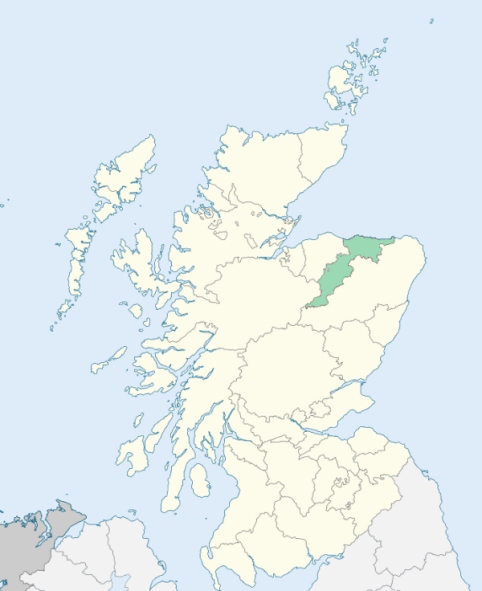
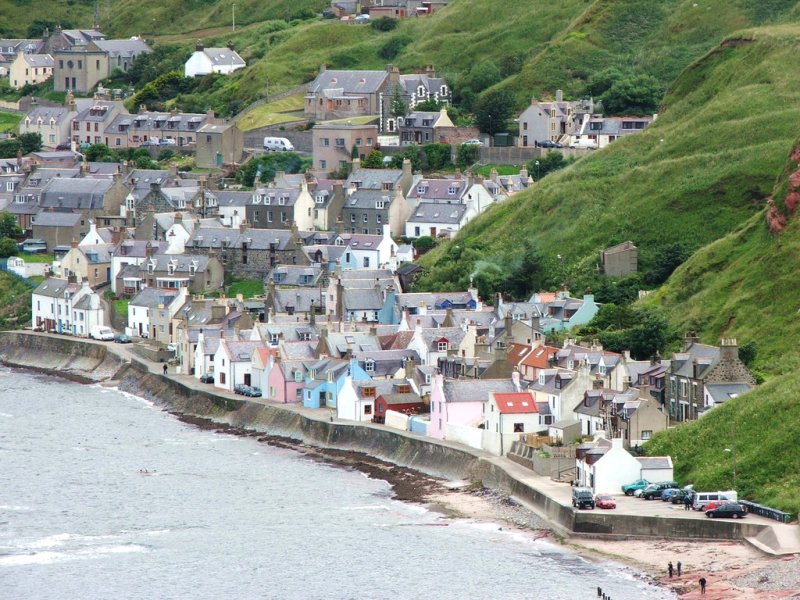
Gamrie is a parish on the coast of Banffshire. It lies in the district of Buchan, and is connected only for a brief space, opposite the town of Banff, with the main body of Banffshire. It is bounded on the north by the Moray Firth, on the east by Aberdour, on the south by King Edward, and on the west by King Edward, Alvah, and Banff. (1867: The Imperial Gazetteer of Scotland, by John Marius Wilson).
Crovie, Cushnie, Doune or Down, Dubford, Dubston, Findon, Gamrie, Gardenstown, Glenrinnes, Longmanhill, Macduff, Protstownhill, Troup
Transferred from the County of Aberdeen to the County of Banff: The parishes of Alvah, Gamrie, Inverkeithny, and Rothiemay. (1892: Boundary of counties and parishes in Scotland as settled by the Boundary Commissioners under the Local Government Act, 1889, by Hay Shennan)
PRE-REFORMATION GOVERNANCE:
POST-REFORMATION GOVERNANCE:
Gamrie. The old church of Gamrie was dedicated to St John the Evangelist. It belonged to the Abbey of Arbroath. A decree of the Court of Teinds dated 23 January 1817, authorised the removal of the parish church to a new site near Gardenstown. There is a Well of St John at Gamrie.
Glenrinnes. Glenrinnes became a station under the Royal Bounty Committee in 1725. Disjoined from Mortlach and Aberlour and erected a parish quoad sacra, 15 March 1865.
Disjoined Quoad Sacra Parishes:
Gardenstown. The village of Gardenstown was founded in 1720 by Alexander Garden of Troup. A church was built in 1875. The parish of Gardenstown was disjoined from Gamrie 16 March 1885.
Macduff. In 1768 James, Earl of Fife, built a chapel at the village of Down, which was afterwards called Macduff. The parish of Macduff was disjoined from Gamrie on 18 July 1866. A new church built by Alexander, Earl of Fife, in 1805 was enlarged in 1865.
Includes ministers, licentiates, assistants, readers, and clerks.
Gamrie (QO)
Glenrinnes (QO)
Gardenstown (QS)
Macduff (QS)
(1928: Fasti Ecclesiæ Scoticanæ, by Hew Scott, D. D.)
Parish registers turned over to the Registrar-General, as a result of the Registration of Births, Deaths, and Marriages (Scotland) Act of 1854. The letters B. D. and M. indicate Births (or Baptisms), Deaths (or Burials), and Marriages (or Proclamations of Banns) respectively. Numbers indicate separate volumes or books. Note: These records are by no means complete or without damage; consult the Detailed List of the Old Parochial Registers of Scotland (1872) to learn more about the condition of the records.
| OPR and RD Numbers | ||||
|---|---|---|---|---|
| Date Range | Name | Number | Type | |
| 1704-1854 | Gamrie | 155a | OPR | |
| 1725-1854 | Glenrinnes | 155b | OPR | |
| 1855-1865 | Gamrie | 155 | RD | |
| 1866-1881 | Gamrie | 155a | RD | |
| 1866-1967 | Glenrinnes | 155b | RD | |
| 1882-1954 | Gamrie | 155a-1 | RD | |
| 1882-1854 | Macduff | 155a-2 | RD | |
| 2009 | (Gamrie) Aberdeenshire, Banff | 293 | RD | |
| 2009 | (Glenrinnes) | Moray | 297 | RD |
| 2009 | (Macduff) Aberdeenshire, Banff | 293 | RD | |
| 2026 | (Gamrie) Aberdeenshire Council; King Edward and Gamrie Community Council | |||
| 2026 | (Glenrinnes) Moray Council; Dufftown & District Community Council | |||
| 2026 | (Macduff) Aberdeenshire Council; Banff and Macduff Community Council | |||
(2009: Parishes and Registration Districts of Scotland - Old and New, National Records of Scotland)
Local community councils (2026) are provided as a potential source of additional information for settlements within the original boundaries of the parish. (Source)
Statistics from informal and official censuses
Ingram, Lyall, Morrison, Nicol, Paterson, Smith, Watt, West, Wilson, Wiseman
Note: Names appearing in research materials, other than censuses. Simple names (First name, surname only) have been omitted unless they appear associated with large properties. All women's names, and men's names with occupations, military ranks, or peerage titles are included.
By the Reverend Mr Thomas Wilson.
"The population of the parish is nearly double since the year 1732. At the above period the parish contained 1600 souls, and now nearly 3000. The principal causes of the increase of population are, the number of fishing towns on the coast, the breaking of large farms into smaller ones, the encouragement given by the heritors to improve waste ground, and their endeavouring to introduce a better mode of culture. The language spoken in this parish is the Scottish, with an accent peculiar to the north country. There is no Erse."
(This section contains excerpts, at times restructured or paraphrased, from an article appearing in Statistical Account of Scotland, Sir John Sinclair, 1791-1799)
Primary Sources:
Statistical Account of Scotland (1791-1799), Volume 1, p. 469
New Statistical Account of Scotland (1834-1845), Volume 13, Section I, p. 271
See Parish Page Sources for all source information and links.