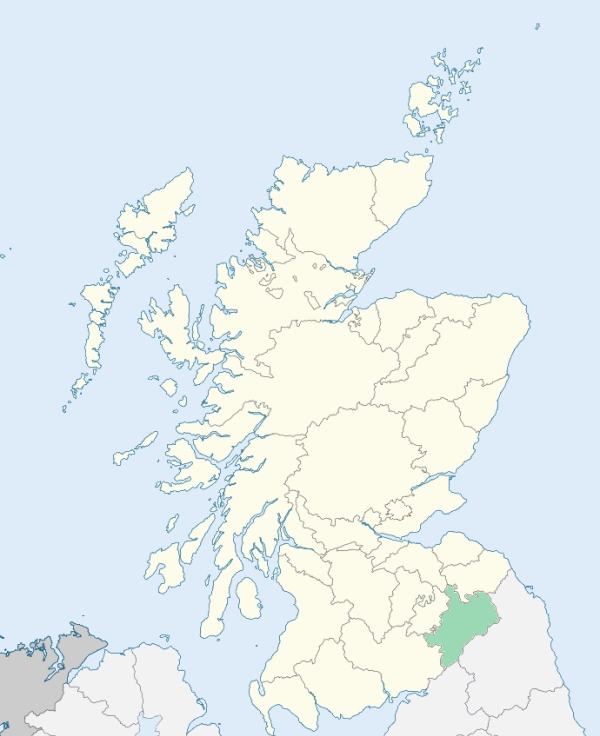
Cavers is a parish in Roxburghshire. It formerly consisted of two parts, separated from each other by Hawick and Kirkton parishes - the one part lying on the southern border of the county, contiguous to England and Liddesdale, and the other lying nearly in the centre of Teviotdale. The former was recently erected into the separate parish of Teviothead, and only the latter constitutes the present parish of Cavers. This is bounded by the parishes of Hawick, Kirkton, Hobkirk, Bedrule, Minto, and Wilton. (1867: The Imperial Gazetteer of Scotland, by John Marius Wilson).
Caerlanrig, Cogsmill, Denholm
PRE-REFORMATION GOVERNANCE:
POST-REFORMATION GOVERNANCE:
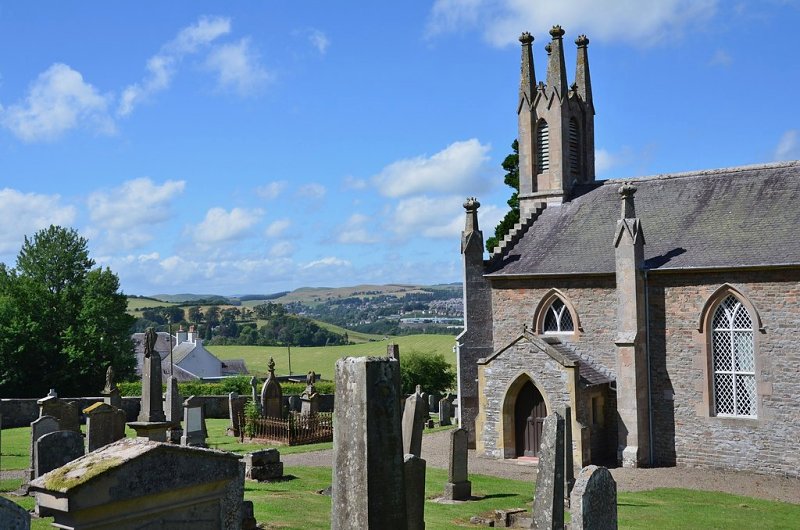
Mention of the church of Cavers is made in the Inquisitio of David I in 1116; it was then the property of the church of Glasgow. In 1358 William, first Earl of Douglas, granted to the monks of Melrose "the whole right of advowson of the Church of Great Cavers," with all its pertinents. A church erected in 1663 is still standing. A new church was built in 1822. Teviothead was disjoined from this parish in 1850.
Includes ministers, licentiates, assistants, readers, and clerks.
(1928: Fasti Ecclesiæ Scoticanæ, by Hew Scott, D. D.)
Parish registers turned over to the Registrar-General, as a result of the Registration of Births, Deaths, and Marriages (Scotland) Act of 1854. The letters B. D. and M. indicate Births (or Baptisms), Deaths (or Burials), and Marriages (or Proclamations of Banns) respectively. Numbers indicate separate volumes or books. Note: These records are by no means complete or without damage; consult the Detailed List of the Old Parochial Registers of Scotland (1872) to learn more about the condition of the records.
| OPR and RD Numbers | |||
|---|---|---|---|
| Date Range | Name | Number | Type |
| 1694-1854 | Cavers | 785 | OPR |
| 1855-1895 | Cavers | 785 | RD |
| 1896-1967 | Cavers | 785-1 | RD |
| 1896-1967 | Kirkton | 785-2 | RD |
| 2009 | Scottish Borders, Hawick | 823 | RD |
| 2026 | Scottish Borders Council; Denholm and District Community Council | ||
(2009: Parishes and Registration Districts of Scotland - Old and New, National Records of Scotland)
Local community councils (2026) are provided as a potential source of additional information for settlements within the original boundaries of the parish. (Source)
Statistics from informal and official censuses
Brown, Davidson, Elliot, Hogg, Little, Oliver, Robson, Scott, Turnbull, Wilson
Note: Names appearing in research materials, other than censuses. Simple names (First name, surname only) have been omitted unless they appear associated with large properties. All women's names, and men's names with occupations, military ranks, or peerage titles are included.
By the Reverend Mr Thomas Elliot, Minister.
"The number of inhabitants at present (1794) is about 1300. The number of souls, in 1755, was 993."
(This section contains excerpts, at times restructured or paraphrased, from an article appearing in Statistical Account of Scotland, Sir John Sinclair, 1791-1799)
Primary Sources:
Statistical Account of Scotland (1791-1799), Volume 17, p. 89
New Statistical Account of Scotland (1834-1845), Volume 3, Section I, p. 425
See Parish Page Sources for all source information and links.