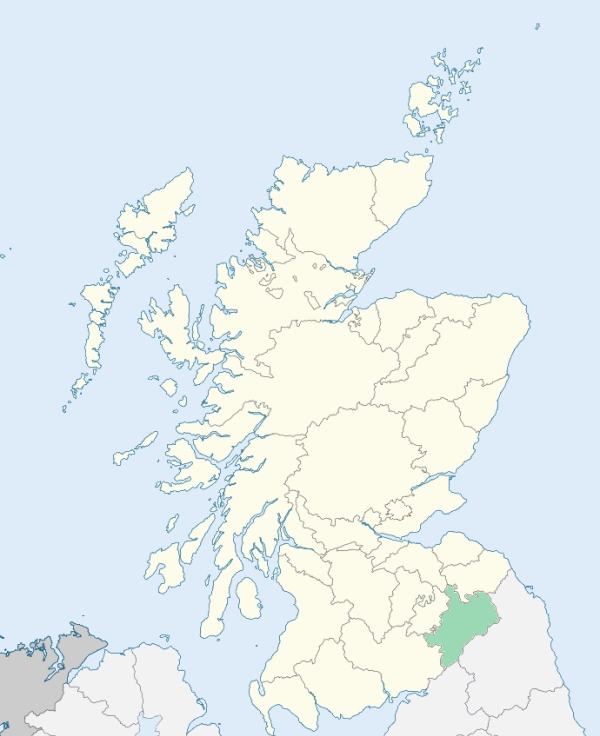
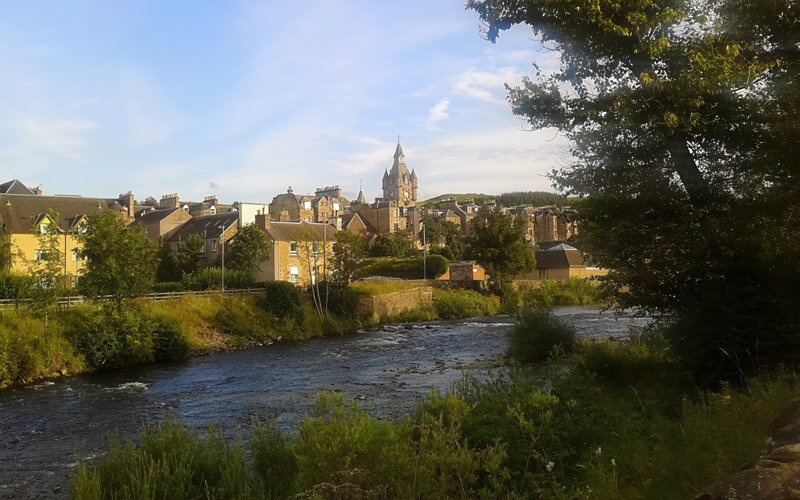
Hawick is a parish in the south-west of Roxburghshire. It is bounded by Roberton, Wilton, Cavers, Kirkton, and Teviothead. (1867: The Imperial Gazetteer of Scotland, by John Marius Wilson).
Branxholme, Bucklands, Burnfoot, Burnhead, Cauld, Forkings, Hawick, Lynnwood, Newmill, Newton, Pilmuir
The parish of Wilton had a small detached part situated within the burgh of Hawick and on the Hawick side of the River Teviot. An exchange of territory was effected between these two parishes, whereby the detached part of Wilton was transferred to Hawick, and the portion of Hawick parish was transferred to Wilton. See affected properties and landholders. (1892: Boundary of counties and parishes in Scotland as settled by the Boundary Commissioners under the Local Government Act, 1889, by Hay Shennan)
PRE-REFORMATION GOVERNANCE:
POST-REFORMATION GOVERNANCE:
There was a church here in 1183. The church was dedicated to St Mary, by Adam, Bishop of Caithness, 29 May 1214. In 1844 a new church for the parish was erected at the expense of Walter Francis, Duke of Buccleuch.
Disjoined Quoad Sacra Parishes:
St John's. Disjoined from the parish of Hawick and the quoad sacra parish of St Mary's, and erected into a parish quoad sacra by the Court of Teinds, 17 May 1881.
St Margaret's. The church was built in 1886. The parish was disjoined from Wilton, and erected by the Court of Teinds, 29 May 1896.
St Mary's. The church built in 1763 was the parish church of Hawick till 1844. Disjoined from the parish of Hawick, and erected into a parish by the Court of Teinds, 14 March 1860.
Includes ministers, licentiates, assistants, readers, and clerks.
Hawick (QO)
St John's (QS)
St Margaret's (QS)
St Mary's (QS)
(1928: Fasti Ecclesiæ Scoticanæ, by Hew Scott, D. D.)
Parish registers turned over to the Registrar-General, as a result of the Registration of Births, Deaths, and Marriages (Scotland) Act of 1854. The letters B. D. and M. indicate Births (or Baptisms), Deaths (or Burials), and Marriages (or Proclamations of Banns) respectively. Numbers indicate separate volumes or books. Note: These records are by no means complete or without damage; consult the Detailed List of the Old Parochial Registers of Scotland (1872) to learn more about the condition of the records.
| OPR and RD Numbers | |||
|---|---|---|---|
| Date Range | Name | Number | Type |
| 1634-1854 | Hawick | 789 | OPR |
| 1855-1895 | Hawick | 789 | RD |
| 1896-1904 | Hawick | 789-1 | RD |
| 1896-1904 | Wilton | 789-2 | RD |
| 1905-1971 | Hawick | 789 | RD |
| 1972-2006 | Hawick | 823 | RD |
| 2007-2009 | Scottish Borders, Hawick | 823 | RD |
| 2026 | Scottish Borders Council; Hawick Community Council Burnfoot Community Council | ||
(2009: Parishes and Registration Districts of Scotland - Old and New, National Records of Scotland)
Local community councils (2026) are provided as a potential source of additional information for settlements within the original boundaries of the parish. (Source)
Statistics from informal and official censuses
Anderson, Bell, Douglas, Elliot, Murray, Oliver, Richardson, Scott, Turnbull, Wilson
Note: Names appearing in research materials, other than censuses. Simple names (First name, surname only) have been omitted unless they appear associated with large properties. All women's names, and men's names with occupations, military ranks, or peerage titles are included.
By the Reverend Mr Robert Gillan.
"The number of souls in this parish, from an accurate survery are, 2320 in the town of Hawick, 608 in the country. Of these there are 1378 males and 1550 females; 600 are persons under 10 years of age.
Manufactures are carried on here with considerable spirit and success. Several branches are now established; but the most considerable are carpets, inkle*, cloth, and stockings. The number of people employed in the carpet manufacture, last year, seems to have been 362. The number of people employed in the inkle manufacture may amount to 65. The number of people employed in the stocking manufacture are thus: 13 male framework knitters, 42 female spinners, 9 seamers, doublers, and twiners, and 1 foreman. The numbers employed in the cloth manufacture is 5 weavers, 12 spinners occasionally employed, 4 dyers, 6 carders, and 4 persons employed in machinery in the shop.
In this parish there are two nurseries, containing all kinds of fruit and forest trees, flower plants, and roots, and flowering shrubs, that are naturalized to this country; besides a great collection of exotic plants. At some seasons, there are 50 people employed in the nursery grounds; but, at an average, 30 are employed the whole season.
Although individuals in this parish, as in other places of the same extent, are given to the vices usual in these times, yet the inhabitants, in general, are honest, sober, and industrious. Their industry is not the violent exertion of a moment; but steady, calm, and persevering."
*Inkle: A narrow, linen tape or braid woven on a loom.
(This section contains excerpts, at times restructured or paraphrased, from an article appearing in Statistical Account of Scotland, Sir John Sinclair, 1791-1799)
Primary Sources:
Statistical Account of Scotland (1791-1799), Volume 8, p. 521
New Statistical Account of Scotland (1834-1845), Volume 3, Section I, p. 379
See Parish Page Sources for all source information and links.