Baisleac, St Mirin's
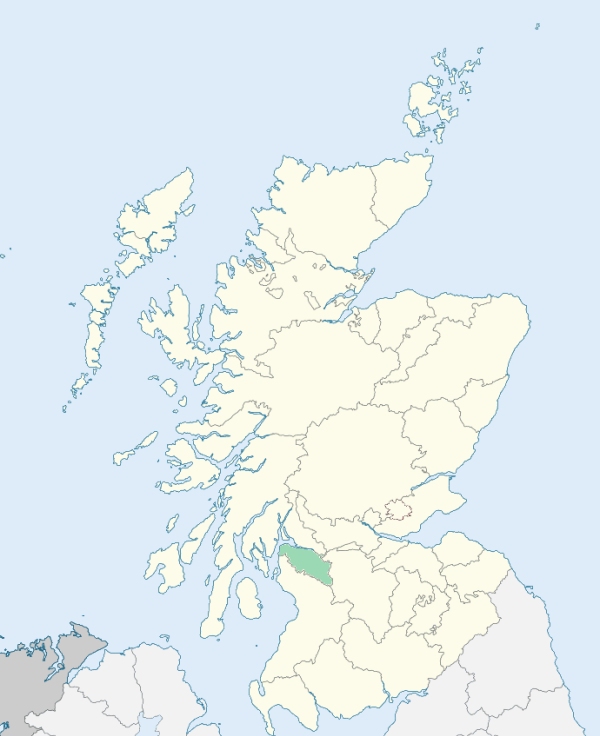
Abbey is a parish of northeast Renfrewshire, including part of the town of Paisley, while completely surrounding the burgh parishes. It is bounded on the north by Renfrew parish; on the northeast by Govan in Lanarkshire; on the east by Eastwood parish; on the southeast and south by Neilston; on the west by Lochwinnoch; and on the northwest by Kilbarchan. (1892-6: Ordnance Gazetteer of Scotland, by Francis H. Groome)
Cardonald Mills, Corsemill or Crossmill, Dovecothall, Elderslie, Househill Muir, Hurlet, Inkerman, Millikenpark, Nitshill, Quarrelton, Thorn
Barshaw, Blakhall, Brabloch, Brediland, Cardonald, Crookston, Hawkhead, Househill, Ingliston, Ralston
The parish of Paisley had a detached part separated from the main portion of the parish by a narrow strip of Abbey parish. Again, within this detached part of the parish of Paisley was a detached part of Abbey parish. The detached part of Paisley parish was united to the main portion of Paisley parish by the annexation to it of the small portion of Abbey parish at the River Cart, and the detached part of Abbey parish was then transferred to the Paisley parish. See affected properties and landholders. (1892: Boundary of counties and parishes in Scotland as settled by the Boundary Commissioners under the Local Government Act, 1889, by Hay Shennan)
PRE-REFORMATION GOVERNANCE:
POST-REFORMATION GOVERNANCE:
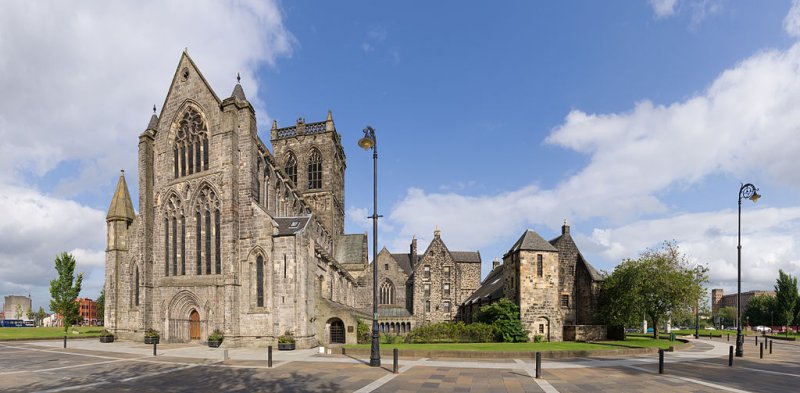
Where the Abbey Church of Paisley now stands, there was from a very early time a church dedicated to St Mirin. Around that church this parish arose. From the church, too, the place got its name of Baisleac or Paisley, meaning a large or notable church. When the Monastery of Paisley was founded as a Cluniac Priory in 1169, the parish church of St Mirin was granted to it. At that time the founder, Walter, first High Steward of Scotland, transferred to Paisley a monastic community which he had set up at Renfrew in 1163. In 1219 Paisley was raised to the rank of an abbey. In 1307 it as burned by an English army. A restoration was begun, and by 1459 the abbey buildings were complete again. The abbey was suppressed in 1560, and the Abbey Church soon became the parish church of Paisley. Renovation was undertaken in 1862, and a further restoration near the end of the nineteenth century. Yearly fairs were held at Paisley in honour of St Mirin, St James, and St Marnoch.
Disjoined Quoad Sacra Parishes:
Cardonald. The parish was disjoined from the Abbey parish of Paisley and Govan by the Court of Teinds, 14 July 1890.
Elderslie. The General Assembly granted a constitution to a chapel here on 27 May 1839. The parish was disjoined from that of Abbey of Paisley by the Court of Teinds, 17 December 1862.
Greenlaw. The church was built in 1889. The parish was disjoined from Paisley Abbey by the Court of Teinds, 13 March 1896.
Levern. A church was opened here on 23 March 1835. On 30 May 1836 a chapel constitution was granted to it, and a definite district given it. The parish of Levern was disjoined from the parishes of the Abbey of Paisley and Eastwood, 17 January 1866.
Linwood. The parish was disjoined from Kilbarchan and the Abbey Parish of Paisley by the Court of Teinds, 19 January 1880.
Includes ministers, licentiates, assistants, readers, and clerks.
Abbey (QO)
Cardonald (QS)
Elderslie (QS)
Greenlaw (QS)
Levern (QS)
Linwood (QS)
Martyrs Parish (QS)
South Parish (QS)
(1928: Fasti Ecclesiæ Scoticanæ, by Hew Scott, D. D.)
Parish registers turned over to the Registrar-General, as a result of the Registration of Births, Deaths, and Marriages (Scotland) Act of 1854. The letters B. D. and M. indicate Births (or Baptisms), Deaths (or Burials), and Marriages (or Proclamations of Banns) respectively. Numbers indicate separate volumes or books. Note: These records are by no means complete or without damage; consult the Detailed List of the Old Parochial Registers of Scotland (1872) to learn more about the condition of the records.
| OPR and RD Numbers | |||
|---|---|---|---|
| Date Range | Name | Number | Type |
| 1670-1854 | Abbey | 559 | OPR |
| 1855-1878 | Abbey Burgh | 559-1 | RD |
| 1855-1878 | Abbey Landward | 559-2 | RD |
| 1855-1896 | Johnstone | 559-3 | RD |
| 1897-1897 | Johnstone and Elderslie | 559a | RD |
| 1897-1930 | Bridge of Weir | 559b | RD |
| 1931-1963 | Bridge of Weir | 559 | RD |
| 2009 | (Abbey) Renfrewshire, Paisley | 646 | RD |
| 2009 | (Bridge of Weir) Renfrewshire, Johnstone | 644 | RD |
| 2026 | (Abbey) Renfrewshire Council; Paisley East and Whitehaugh Community Council | ||
| 2026 | (Bridge of Weir) Renfrewshire Council; Bridge of Weir Community Council | ||
(2009: Parishes and Registration Districts of Scotland - Old and New, National Records of Scotland)
Local community councils (2026) are provided as a potential source of additional information for settlements within the original boundaries of the parish. (Source)
Statistics from informal and official censuses
Brown, Campbell, Hamilton, Reid, Robertson, Smith, Stevenson, Stewart, Thomson, Wilson
By the Reverend Mr Robert Boog.
"In 1791, the population was 2255 families, and 10792 souls. Of this number, there are 5259 males, and 5533 females.
The number of farmers in the parish is about 140. Though the rise of rents has been great, most of them having been doubled within the last 30 years, yet the farmers are more independent; they pay their rents more regularly, live better, and are better clothed than formerly, the effect, no doubt, of a more vigorous and successful husbandry. Still, however, they are far, very far from enjoying the comforts of life in the degree to which such an industrious and valuable order of men are entitled.
The manufactures carried on in this parish are, the weaving of silk gauze, muslins, lawns, cotton stuffs, and thread gauze, in all their varieties; thread making, cotton spinning, bleaching, calico printing; the making of candles, white soap, black soap and starch. In the various weaving branches there were employed at Whitsunday 1791, 2494 employed in the town. The number of persons, young and old, at present employed in both cotton mills is 660. The bleaching business employs about 300 persons, of whom 240 are women, who are hired for the season."
(This section contains excerpts, at times restructured or paraphrased, from an article appearing in Statistical Account of Scotland, Sir John Sinclair, 1791-1799)
Primary Sources:
Statistical Account of Scotland (1791-1799), Volume 7, p. 74
New Statistical Account of Scotland (1834-1845), Volume 7, Section I, p. 135
See Parish Page Sources for all source information and links.