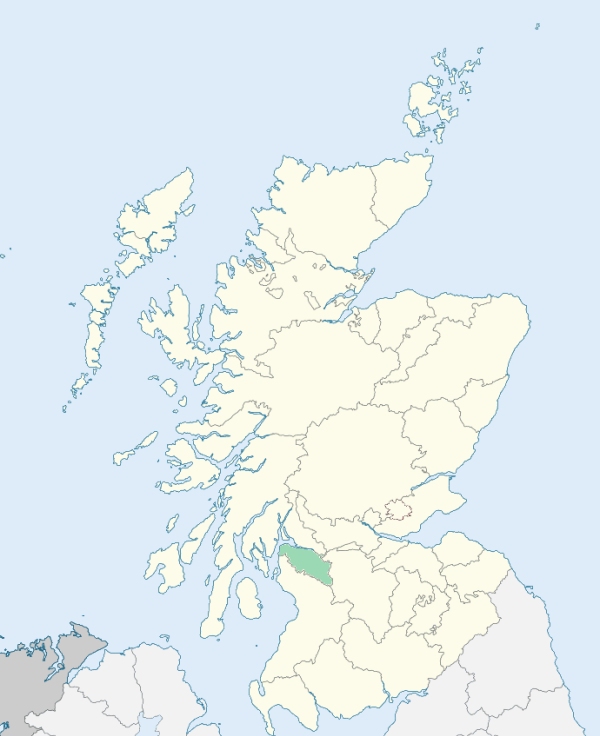
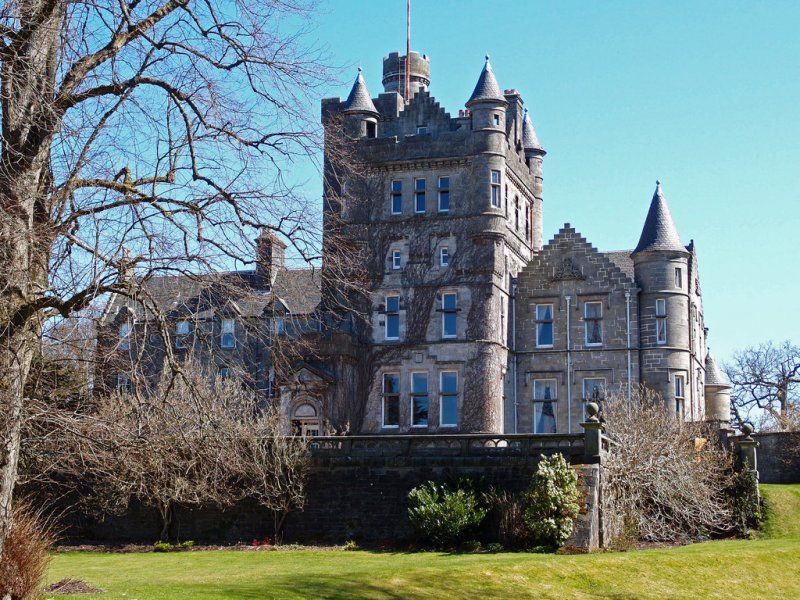
Houston is a parish near the centre of Renfrewshire. It is bounded on the south by the River Gryfe, which separates it from Kilbarchan, on the west by Kilmacolm, and on the north and east by Erskine. (1867: The Imperial Gazetteer of Scotland, by John Marius Wilson).
Barochan Mill, Bridge of Weir, Crosslee, Houston
Barochan
PRE-REFORMATION GOVERNANCE:
POST-REFORMATION GOVERNANCE:
The parishes of Houston and Killellan were united on 28 February 1759.
Houston, or Kilpeter. The vicarage of Houston belonged to the Abbey of Paisley. Its church, dedicated to St Peter, has been rebuilt in modern times. Near the church are St Peter's Well and St Peter's Burn. On St Peter's Day, the 29th of June, Petermas Fair was held at Houston. The Parish Church at Houston was rebuilt in 1874 by Mrs Ellice of Invergarry in memory of her son, Captain Archibald Alexander Speirs of Elderslie, M.P.
Killellan. The church of Killellan, which now stands ruined in the churchyard, was dedicated to St Fillan. It belonged to the Abbey of Paisley. Near it is the old manse, a residence of the seventeenth century. Beside the church, in times of old, St Fillan's Fair was held annually.
Disjoined Quoad Sacra Parishes:
Bridge of Weir. The parish of Bridge of Weir was disjoined from Kilbarchan and Houston by the Court of Teinds, 14 March 1887.
Includes ministers, licentiates, assistants, readers, and clerks.
Houston, or Kilpeter (QO)
Killellan (QO)
Bridge of Weir (QS)
(1928: Fasti Ecclesiæ Scoticanæ, by Hew Scott, D. D.)
Parish registers turned over to the Registrar-General, as a result of the Registration of Births, Deaths, and Marriages (Scotland) Act of 1854. The letters B. D. and M. indicate Births (or Baptisms), Deaths (or Burials), and Marriages (or Proclamations of Banns) respectively. Numbers indicate separate volumes or books. Note: These records are by no means complete or without damage; consult the Detailed List of the Old Parochial Registers of Scotland (1872) to learn more about the condition of the records.
| OPR and RD Numbers | |||
|---|---|---|---|
| Date Range | Name | Number | Type |
| 1759-1854 | Houston and Killellan | 565 | OPR |
| 1855-1963 | Houston and Killellan | 565 | RD |
| 1970-1971 | Johnstone | 565 | RD |
| 2007 | Houston, Renfrewshire | 644 | RD |
| 2007 | Johnstone, Renfrewshire | 644 | RD |
| 2009 | (Houston) Renfrewshire, Johnstone | 644 | RD |
| 2009 | (Johnstone) Renfrewshire, Johnstone | 644 | RD |
| 2026 | (Houston) Renfrewshire Council; Houston Community Council | ||
| 2026 | (Johnstone) Renfrewshire Council; Johnstone Community Council | ||
(2009: Parishes and Registration Districts of Scotland - Old and New, National Records of Scotland)
Local community councils (2026) are provided as a potential source of additional information for settlements within the original boundaries of the parish. (Source)
Statistics from informal and official censuses
Barr, Cameron, Campbell, Houston, Kerr, Laird, Lang, Scott, Whyte, Wilson
Note: Names appearing in research materials, other than censuses. Simple names (First name, surname only) have been omitted unless they appear associated with large properties. All women's names, and men's names with occupations, military ranks, or peerage titles are included.
By the Reverend Mr John Menteath.
"Upon a survey lately made there are 185 families, of whom 510 are males and 524 are females. There are 159 servants, and 69 Seceders. The principal trade in the village is weaving. There are 42 looms, most of which are employed in weaving cotton, muslin, lawn, and silk gauze: There are also a few carpenters, tailors, and shoemakers. Near the village, there is a large bleachfield.
The inhabitants of this parish are generally sober, and regular in attending public worship. The farmers are very industrious. They are decently clothed, especially the women. About 40 years ago, the finest dress of the women, old and young, was brown or blue cloaks, and caps; to which scarlet ones succeeded. Scarlet is now worn by the lowest and poorest people. The women generally wear black silk cloaks, bonnets of various shapes, and high crowned hats, and riding habits. The young men appear at kirk and market dressed in English cloth, and good linens. They wear hats, and bonnets are now rarely seen."
(This section contains excerpts, at times restructured or paraphrased, from an article appearing in Statistical Account of Scotland, Sir John Sinclair, 1791-1799)
Statistical Account of Scotland (1791-1799), Volume 1, p. 315
New Statistical Account of Scotland (1834-1845), Volume 7, Section I, p. 46
See Parish Page Sources for all source information and links.