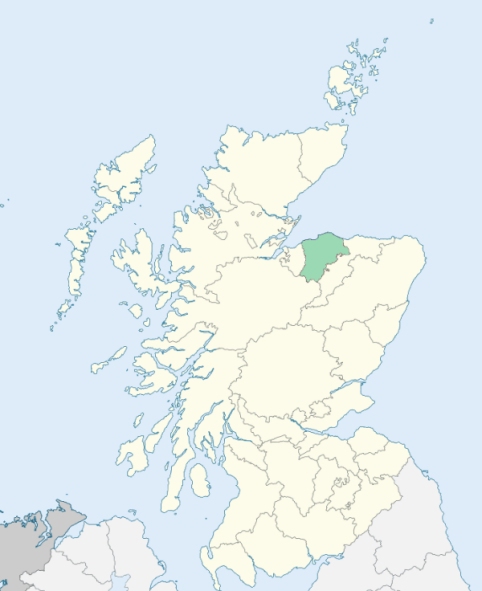
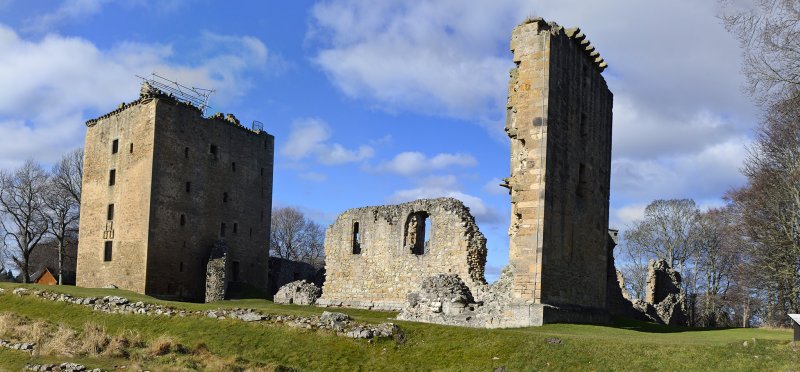
Spynie (Called New Spynie after 1735)
New Spynie is a parish in Morayshire. It is bounded by Duffus, Drainie, St Andrews Lhanbryde, Elgin, and Alves. (1867: The Imperial Gazetteer of Scotland, by John Marius Wilson).
Bishopmill, Findrassie, Morriston
Findrassie
PRE-REFORMATION GOVERNANCE:
POST-REFORMATION GOVERNANCE:
The church of Spynie was dedicated to the Holy Trinity, and a fair was held there on Trinity Sunday. In 1735 the church was removed from Spynie to Quarrywood, now called New Spynie. (1928: Fasti Ecclesiæ Scoticanæ, by Hew Scott, D. D.)
Includes ministers, licentiates, assistants, readers, and clerks.
(1928: Fasti Ecclesiæ Scoticanæ, by Hew Scott, D. D.)
Parish registers turned over to the Registrar-General, as a result of the Registration of Births, Deaths, and Marriages (Scotland) Act of 1854. The letters B. D. and M. indicate Births (or Baptisms), Deaths (or Burials), and Marriages (or Proclamations of Banns) respectively. Numbers indicate separate volumes or books. Note: These records are by no means complete or without damage; consult the Detailed List of the Old Parochial Registers of Scotland (1872) to learn more about the condition of the records.
| OPR and RD Numbers | |||
|---|---|---|---|
| Date Range | Name | Number | Type |
| 1709-1854 | New Spynie | 136 | OPR |
| 1855-1859 | Elgin-Spynie | 136 | RD |
| 1860-1919 | New Spynie | 136 | RD |
| 1820-1940 | Spynie | 136 | RD |
| 2009 | Moray, Elgin | 280 | RD |
| 2026 | Moray Council; Heldon Community Council | ||
(2009: Parishes and Registration Districts of Scotland - Old and New, National Records of Scotland)
Local community councils (2026) are provided as a potential source of additional information for settlements within the original boundaries of the parish. (Source)
Statistics from informal and official censuses
Anderson, Bain, Fraser, Grant, Milne, Munro, Ross, Smith, Stewart, Sutherland
Note: Names appearing in research materials, other than censuses. Simple names (First name, surname only) have been omitted unless they appear associated with large properties. All women's names, and men's names with occupations, military ranks, or peerage titles are included.
By the Reverend Mr Abraham Gordon, Minister.
"The number of souls at present is 602; 289 of which are males, 313 females. Of these there are, of the Episcopal persuasion, 5 families, consisting of about 30 persons. The language of the parish is the Scotch dialect. Some of the names of places are evidently Gaelic, and it is highly probable that many more of them are of Gaelic origin, though they are now corrupted or disguised so much, by having been so long in the mouths of Lowlanders, that it is hardly possible for a Highlander to recognize them for his native tongue.
The people are industrious and frugal, possessing also other virtues, nor so much the necessary consequence of their situation; being in general honest, benevolent and friendly, and entertaining a high respect for the ordinances of religion. The dress of the poorer tenants and day-labourers is of the cheapest kind, chiefly of home manufacture; that of the more substantial farmers, and their servants, is purchased from the shops of Elgin."
(This section contains excerpts, at times restructured or paraphrased, from an article appearing in Statistical Account of Scotland, Sir John Sinclair, 1791-1799)
Primary Sources:
Statistical Account of Scotland (1791-1799), Volume 10, p. 623
New Statistical Account of Scotland (1834-1845), Volume 13, Section II, p. 95
See Parish Page Sources for all source information and links.