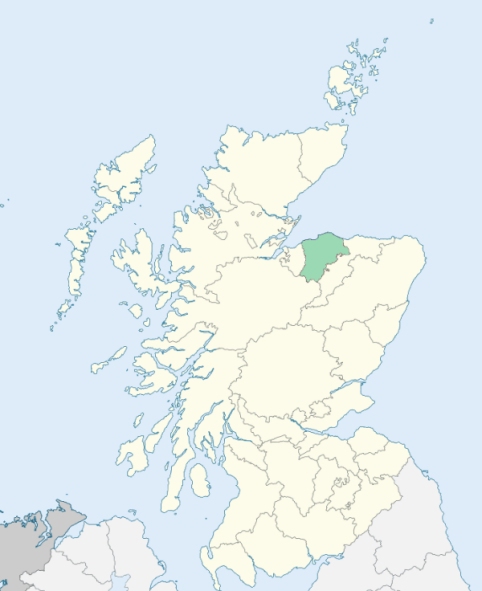
Elgin is a parish in Morayshire. It is bounded on the north by New Spynie, on the east by St Andrews Lhanbryde, on the south by Birnie, and on the west by Alves. (1867: The Imperial Gazetteer of Scotland, by John Marius Wilson).
Ashgrove, Bogside, Clackmarras, Elgin, Fogwatt, Inverlochtie, Langmorn or Longmorn, Moycroft, Muir of Miltonduff, New Elgin, Pittendreich, Plusgarden
PRE-REFORMATION GOVERNANCE:
POST-REFORMATION GOVERNANCE:
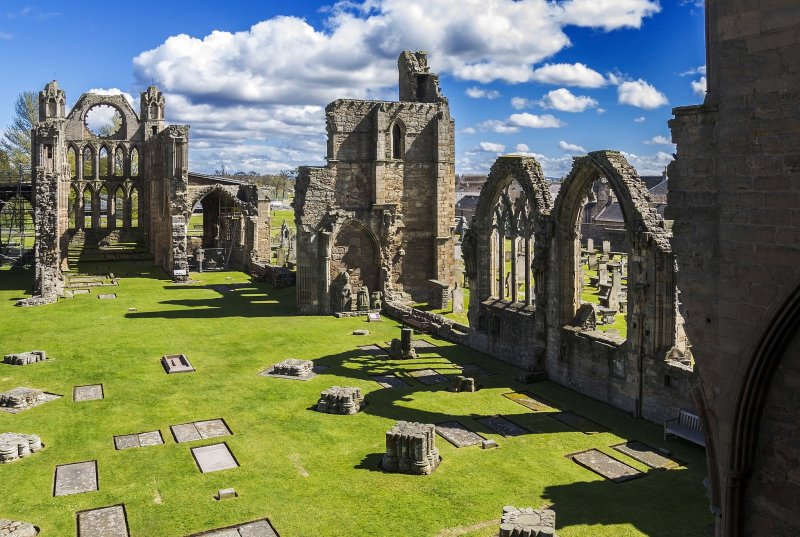
The parish church of Elgin was dedicated to St Giles. It was a mensal kirk of the Bishop of Moray. Nearby, in the Castle of Elgin, there was a chapel of St Mary. In the town were chapels of St John the Baptist and St Thomas, and also a Well of Our Lady. Elgin had, besides these, a chapel of St Peter, founded in 1480 by George, second Earl of Huntly. On the west side of the town stood a hospital, built in 1226. In 1233 King Alexander II established in Elgin a convent of the Black Friars. On the south side of the town the Grey Friars had a priory built in 1479. At Inverlochtie, in the landward part of the parish, there was a chapel of St John the Baptist. At Bogside stood another chapel, and there was a third at Lan Morgan, now called Langmorn. In the landward part of this parish Alexander II founded, in 1230, St Andrew's Priory of Pluscarden, belonging to the Order of the Val de Choux. Elgin used to hold a fair of St Giles. There is now in the city a mission chapel of St Columba. (1928: Fasti Ecclesiæ Scoticanæ, by Hew Scott, D. D.)
Includes ministers, licentiates, assistants, readers, and clerks.
Elgin (QO)
The Little Kirk (QO)
(1928: Fasti Ecclesiæ Scoticanæ, by Hew Scott, D. D.)
Parish registers turned over to the Registrar-General, as a result of the Registration of Births, Deaths, and Marriages (Scotland) Act of 1854. The letters B. D. and M. indicate Births (or Baptisms), Deaths (or Burials), and Marriages (or Proclamations of Banns) respectively. Numbers indicate separate volumes or books. Note: These records are by no means complete or without damage; consult the Detailed List of the Old Parochial Registers of Scotland (1872) to learn more about the condition of the records.
| OPR and RD Numbers | |||
|---|---|---|---|
| Date Range | Name | Number | Type |
| 1609-1854 | Elgin | 135 | OPR |
| 1855-1855 | Elgin Burgh | 135-1 | RD |
| 1855-1855 | Elgin Landward | 135-2 | RD |
| 1856-1971 | Elgin | 135 | RD |
| 1972-2006 | Elgin | 280 | RD |
| 2009 | Moray, Elgin | 280 | |
| 2026 | Moray Council; Elgin Community Council | ||
(2009: Parishes and Registration Districts of Scotland - Old and New, National Records of Scotland)
Local community councils (2026) are provided as a potential source of additional information for settlements within the original boundaries of the parish. (Source)
Statistics from informal and official censuses
Anderson, Cameron, Fraser, Gordon, Grant, Munro, Robertson, Ross, Simpson, Smith
Note: Names appearing in research materials, other than censuses. Simple names (First name, surname only) have been omitted unless they appear associated with large properties. All women's names, and men's names with occupations, military ranks, or peerage titles are included.
By the Reverend Mr John Grant, one of the Ministers of Elgin.
"The population of the parish of Elgin, in the country part of that district, is, from various causes, considerably on the decline. The town, indeed, has increased in the number of its inhabitants, but not of late in proportion to the decrease in the country. The number of souls, in the country parish is 1614, divided into 377 families, among which are 43 that have but one person in each. In the town are 2920 souls, divided into 658 families, of which 140 contain one person each. The total number is 1035 families, and 4534 souls.
That some estimate may be formed of the occupations in this parish, it may be proper to observe, that in the country part, there are 9 tailors, 19 weavers, 9 wrights, including mill-wrights, 5 shoemakers, and 7 blacksmiths. In the town are 16 blacksmiths, 70 weavers, 70 wrights, including makers of ploughs and wagons; 55 shoemakers, 32 tailors, 8 glovers, 3 tinmen, 6 barbers, 4 bakers, 2 surgeons, and 2 physicians. There are also 2 tanners, who carry on their business, though not on a large scale; and a soapery, in which the partners propose to manufacture a considerable quantity.
The inhabitants of the towns, in the northern parts of Scotland, are tolerably industrious; but, in general, they have not as yet established any manufacture, for employing young children, and giving them early habits of industry, which would operate greatly in their favour through life."
(This section contains excerpts, at times restructured or paraphrased, from an article appearing in Statistical Account of Scotland, Sir John Sinclair, 1791-1799)
Primary Sources:
Statistical Account of Scotland (1791-1799), Volume 5, p. 1
New Statistical Account of Scotland (1834-1845), Volume 13, Section II, p. 1
See Parish Page Sources for all source information and links.