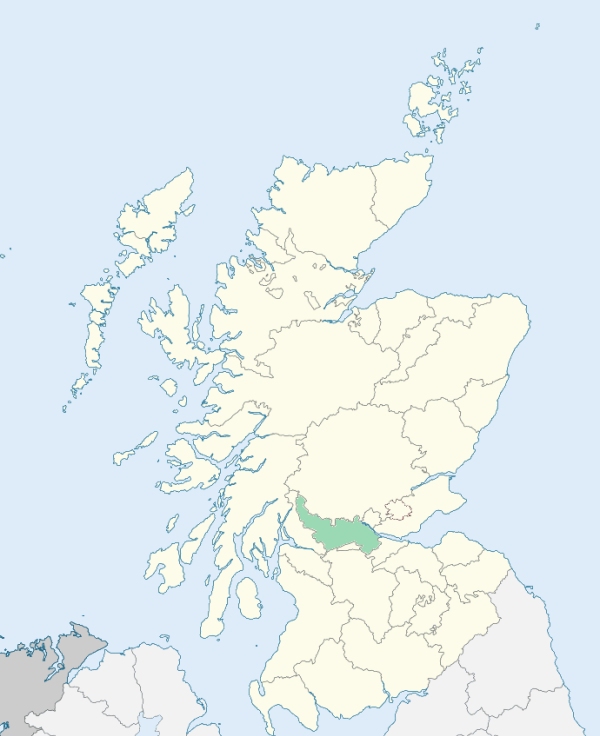
Kippen is a parish partly in Stirlingshire, and partly in Perthshire, yet quite compact, and all lying on the south side of the Firth of Forth. The parish is bounded by Port-of-Monteith, Kincardine, Kilmadock, Gargunnock, Balfron, and Drymen. (1867: The Imperial Gazetteer of Scotland, by John Marius Wilson).
Arnprior, Bucklyvie or Buchlyvie, Cauldhame, Kepp, Kippen, Shirgarton
Boquhan, Broich, Garden
The parish of Kippen was situated partly in the county of Stirling and partly in the county of Perth, part of the portion situated in the county of Perth being a detached part of Perthshire. The parish was placed wholly within the county of Stirling. See affected properties and landholders. (1892: Boundary of counties and parishes in Scotland as settled by the Boundary Commissioners under the Local Government Act, 1889, by Hay Shennan)
PRE-REFORMATION GOVERNANCE:
POST-REFORMATION GOVERNANCE:
The church of Kippen was dedicated to St Bean. It was a prebend of Dunblane, and belonged to the Abbey of Cambuskenneth. There was in the parish a spring called Our Lady's Well.
Disjoined Quoad Sacra Parishes:
Buchlyvie. A chapel was built here in 1835. The parish of Buchlyvie was disjoined from Kippen and Drymen, and erected 6 March 1876.
Includes ministers, licentiates, assistants, readers, and clerks.
Kippen (QO)
Buchlyvie (QS)
(1928: Fasti Ecclesiæ Scoticanæ, by Hew Scott, D. D.)
Parish registers turned over to the Registrar-General, as a result of the Registration of Births, Deaths, and Marriages (Scotland) Act of 1854. The letters B. D. and M. indicate Births (or Baptisms), Deaths (or Burials), and Marriages (or Proclamations of Banns) respectively. Numbers indicate separate volumes or books. Note: These records are by no means complete or without damage; consult the Detailed List of the Old Parochial Registers of Scotland (1872) to learn more about the condition of the records.
| OPR and RD Numbers | |||
|---|---|---|---|
| Date Range | Name | Number | Type |
| 1700-1854 | Kippen | 484 | OPR |
| 1855-1950 | Kippen | 484 | RD |
| 1951-1969 | Balfron and Kippen | 472 | RD |
| 2009 | Stirling, Balfron | 472 | RD |
| 2026 | Stirling Council; Kippen Community Council | ||
(2009: Parishes and Registration Districts of Scotland - Old and New, National Records of Scotland)
Local community councils (2026) are provided as a potential source of additional information for settlements within the original boundaries of the parish. (Source)
Statistics from informal and official censuses
Armstrong, Buchanan, Dougall, Graham, Leckie, Morrison, Paterson, Robertson, Stewart, Wilson
Note: Names appearing in research materials, other than censuses. Simple names (First name, surname only) have been omitted unless they appear associated with large properties. All women's names, and men's names with occupations, military ranks, or peerage titles are included.
By the Reverend Mr John Campbell.
"In 1793 the number of families was 399; there were 847 males, 930 females; in all 1777 souls. There were 1266 of the Established Church, 491 Antiburgher Seceders, 4 Burgher Seceders, 13 Cameronians, and 3 Episcopalians.
In 1792-3 there were in the parish of Kippen, 100 farmers, 83 farming men servants, 8 millers, 6 maltmen, 4 licensed distillers, 1 excise officer, 10 merchants, 37 weavers with 5 journeymen and 14 apprentices, 1 stocking weaver, 8 wrights with 3 journeymen and 6 apprentices, 2 wheel-wrights, 4 hecklers, 6 masons with 1 apprentice, 10 shoemakers with 2 journeymen and 2 apprentices, 1 saddler with 1 journeyman, 2 tanners with 1 journeyman, 4 coopers, 14 tailors with 2 journeymen and 2 apprentices, 8 smiths with 2 apprentices, 1 dyer, 1 baker, 2 butchers, 8 publicans, 7 carters, 4 sheriff-officers, and 47 day labourers.
In the village of Kippen 25 or 30 young girls, under the inspection of a mistress, are employed by a company in Glasgow tambouring muslins. In Buchlyvie, some of the newly invented jennies for spinning cotton have been set up by a company in Balfron. And in both villages, as well as through the parish, a considerable number of weavers has been been employed by several companies in weaving muslins. In Buchlyvie there is a tan-work.
The great body of the people in this parish is entitled to the praise of sobriety. There are few instances amongst us of notorious profligacy. By means of industry and economy, they in general obtain a comfortable subsistence, and some individuals have raised themselves to opulence. The same changes with respect to dress and manner of living, are observed here of late year as in other places."
(This section contains excerpts, at times restructured or paraphrased, from an article appearing in Statistical Account of Scotland, Sir John Sinclair, 1791-1799)
Primary Sources:
Statistical Account of Scotland (1791-1799), Volume 18, p. 317
New Statistical Account of Scotland (1834-1845), Volume 8, Section II, p. 264
See Parish Page Sources for all source information and links.