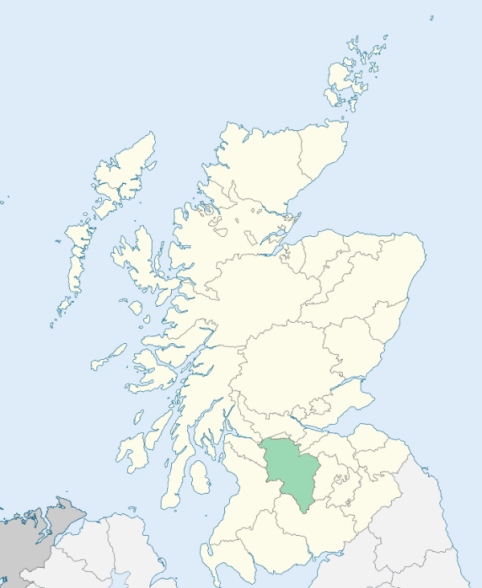
Lanark is a parish in the upper ward and nearly in the centre of Lanarkshire. It is bounded by Carluke, Carstairs, Pettinain, Carmichael, and Lesmahagow. (1867: The Imperial Gazetteer of Scotland, by John Marius Wilson).
Bridgend, Cartland, Hyndford, Jervis Wood, Lanark, Nemphlar, New Lanark
Bonnington, Castlebank, Cleghorn, Hyndford, Jerviswood, Wampherflat
PRE-REFORMATION GOVERNANCE:
POST-REFORMATION GOVERNANCE:
The church of Lanark was dedicated to St Kentigern. After 1150 it belonged to the Abbey of Dryburgh. Its ruins stand in the churchyard outside the town, hence called the Outkirk, sometimes the High Kirk. Within the burgh stood the Chapel of St Nicholas, with four altars, one of which was dedicated to St Catherine, commonly called the Laigh Kirk. The High Kirk was abandoned in 1668, the congregation meeting in St Nicholas Church, which was declared the legal parish kirk in 1708. In 1774 it was rebuilt. Half a mile east of the town stood the Hospital of St Leonard. The parish of Nemphlar and Cartland was united to Lanark in the reign of William the Lion. There was a chapel at Cleghorn. At the West Port was the monastery of Greyfriars, said to have been founded by Robert I. There is a mission chapel within the bounds at New Lanark.
Disjoined Quoad Sacra Parishes:
St Leonard's. On 17 May 1839 a constitution was granted to a chapel here, and a district assigned to it. A church was opened in March 1841. It was, however, closed from 1845 to 1851, when it was reopened as a chapel-of-ease. On 23 June 1873 St Leonard's Parish was disjoined from Lanark.
Includes ministers, licentiates, assistants, readers, and clerks.
Lanark (QO)
St Leonard's (QS)
(1928: Fasti Ecclesiæ Scoticanæ, by Hew Scott, D. D.)
Parish registers turned over to the Registrar-General, as a result of the Registration of Births, Deaths, and Marriages (Scotland) Act of 1854. The letters B. D. and M. indicate Births (or Baptisms), Deaths (or Burials), and Marriages (or Proclamations of Banns) respectively. Numbers indicate separate volumes or books. Note: These records are by no means complete or without damage; consult the Detailed List of the Old Parochial Registers of Scotland (1872) to learn more about the condition of the records.
| OPR and RD Numbers | |||
|---|---|---|---|
| Date Range | Name | Number | Type |
| 1646-1854 | Lanark | 648 | OPR |
| 1855-1856 | Lanark Burgh | 648-1 | RD |
| 1855-1856 | Lanark Landward | 648-2 | RD |
| 1857-1971 | Lanark | 648 | RD |
| 1972-2004 | Lanark | 583 | RD |
| 2005-2008 | Lanark, South Lanarkshire | 583 | RD |
| 2009 | South Lanarkshire, Lanark | 583 | RD |
| 2026 | South Lanarkshire Council; Royal Burgh of Lanark Community Council New Lanark Community Council | ||
(2009: Parishes and Registration Districts of Scotland - Old and New, National Records of Scotland)
Local community councils (2026) are provided as a potential source of additional information for settlements within the original boundaries of the parish. (Source)
Statistics from informal and official censuses
Anderson, Brown, Dickson, Dunlop, Hamilton, Scott, Smith, Stewart, Watson, Wilson
Note: Names appearing in research materials, other than censuses. Simple names (First name, surname only) have been omitted unless they appear associated with large properties. All women's names, and men's names with occupations, military ranks, or peerage titles are included.
By Mr William Lockhart, of Baronald.
"On May 15th 1792, there were 2260 in the town of Lanark and burgh lands, 1519 in the village of New Lanark, and 972 in the country, total number of souls 4751.
Of the 2260 inhabitants in the town and burgh lands of Lanark there were the following handicraftsmen, exclusive of journeymen and apprentices: 11 smiths, 80 shoemakers, 30 masons and wrights, 11 tailors, 60 weavers, 2 dykers, 1 skinner, 60 stocking-makers, 2 watchmakers, 5 bakers, 4 butchers, 5 gardeners, and 1 tanner. I do not know the exact number of merchants or shopkeepers, but there are four surgeons, seven attorneys or writers, and 50 innkeepers or publicans.
There is a considerable manufactory of stockings here, between 75 and 80 stocking frames, being constantly employed. Previous to the American War, a very great quantity of shoes was manufactured here for exportation, and sent to Glasgow weekly, but since that period the demand is considerably decreased.
In New Lanark there are 54 spinners, 45 labourers, 7 clockmakers, 5 weavers, 11 smiths, 10 wrights, 8 tailors, 7 masons, 3 shoemakers, 3 turners, and 2 merchants.
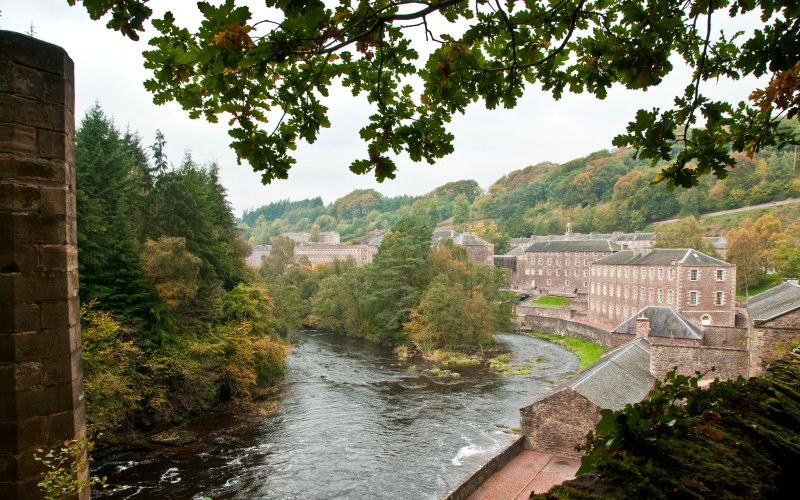
New Lanark, where the cotton mills are situated, is about a short mile from Lanark; and is the only village in the parish. At the mills are 90 masons, carpenters, and labourers employed in erecting buildings, 20 smiths, 12 clockmakers, 9 mill-wrights, 19 joiners, 10 turners, 2 founders, 15 hammermen and hagmen. Persons employed in carrying on the manufactory, viz. in cleaning cotton, carding, drawing, roving, winding, spinning, and reeling, viz: 145 men, 217 women, 376 boys, and 419 girls. Total number employed, 1334.
The people are, in general, industrious, though not remarkably so. They are naturally generous, hospitable, and fond of strangers, which induces them sometimes to make free with the bottle; but drunkenness, among the better class of inhabitants, is of late rather unusual. It is less so among the other inhabitants; but, upon the whole, they are a decent and orderly people; and crimes are seldomer committed here, than in any other parish of equal population."
(This section contains excerpts, at times restructured or paraphrased, from an article appearing in Statistical Account of Scotland, Sir John Sinclair, 1791-1799)
Primary Sources:
Statistical Account of Scotland (1791-1799), Volume 15, p. 1
New Statistical Account of Scotland (1834-1845), Volume 6, p. 1
See Parish Page Sources for all source information and links.