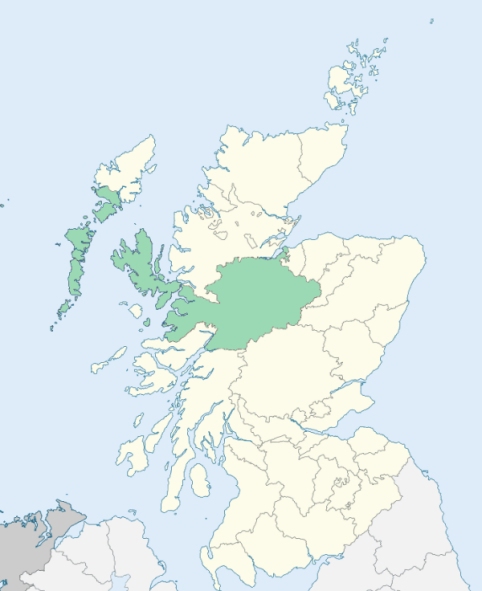
Boleskine and Abertarff is a united parish in Inverness-shire. It lies on both sides of Loch Ness, and is bounded by Urquhart, Dores, Daviot, Laggan, and Kilmanivaig. (1867: The Imperial Gazetteer of Scotland, by John Marius Wilson).
Aonachan, Balfrishel, Fort Augustus, Foyers, Glenquoich, Tomdoun
The parish of Boleskine & Abertarff had a detached part extending to 1,367 acres, and lying to the east of Loch Farraline and of the parish of Dores. The parish of Dores, on the other hand, had two detached parts, the one nearly and the other wholly surrounded by the parish of Boleskine & Abertarff. Dores detached No. 1 was situated south of Foyers and abutted on Loch Ness. Dores detached No. 2 lay south of Loch Killin and east of the River Killin. These parishes were made to exchange their detached parts. The detached part of Boleskine & Abertarff was transferred to Dores and the two detached parts of Dores were transferred to Boleskine & Abertarff. See affected properties and landholders. (1892: Boundary of counties and parishes in Scotland as settled by the Boundary Commissioners under the Local Government Act, 1889, by Hay Shennan)
PRE-REFORMATION GOVERNANCE:
POST-REFORMATION GOVERNANCE:
The three parishes of Boleskine, Kilchuimin and Dores were united in 1614. Dores was severed from the other two in 1617. Kilchuimin, called also Abertarff, was disjoined from Boleskine in 1676, and was then united to Glen Moriston. In 1688 it was taken from Glen Moriston and joined a second time to Boleskine. In 1883 it was severed a second time from Boleskine, and erected of new as the separate parish of Fort Augustus.
Boleskine. There is now a mission chapel at Foyers within the bounds of Boleskine. The parish was transferred to the Presbytery of Inverness 26 May 1920.
Abertarff, or Kilchuimin. The church of Kilchuimin was dedicated to St Cuimin, Abbot of Iona. It belonged to the Priory of Beauly. The parish of Kilchuimin, or Abertarff, was united to Boleskine and Dores in 1614. A fair of St Cuimin was long held in the parish. Here there were Wells of St John and St Katherine.
Disjoined Quoad Sacra Parishes:
Glengarry. The parish of Glengarry was disjoined from Kilmonivaig, Boleskine, and Glenelg, and erected 13 March 1867. There are mission chapels within the bounds at Glenquoich and Tomdoun.
Includes ministers, licentiates, assistants, readers, and clerks.
Boleskine (QO)
Abertarff, or Fort Augustus (QO)
Glengarry (QS)
(1928: Fasti Ecclesiæ Scoticanæ, by Hew Scott, D. D.)
Parish registers turned over to the Registrar-General, as a result of the Registration of Births, Deaths, and Marriages (Scotland) Act of 1854. The letters B. D. and M. indicate Births (or Baptisms), Deaths (or Burials), and Marriages (or Proclamations of Banns) respectively. Numbers indicate separate volumes or books. Note: These records are by no means complete or without damage; consult the Detailed List of the Old Parochial Registers of Scotland (1872) to learn more about the condition of the records.
| OPR and RD Numbers | |||
|---|---|---|---|
| Date Range | Name | Number | Type |
| 1739-1854 | Boleskine and Abertarff | 92 | OPR |
| 1855-1891 | Boleskine | 92-1 | RD |
| 1855-1891 | Abertarff, or Fort Augustus | 92-2 | RD |
| 1892-1970 | Boleskine | 92a1 | RD |
| 1892-1970 | Fort Augustus | 92a2 | RD |
| 1892-1970 | Cannich | 92b | RD |
| 1971-1971 | Fort Augustus | 92 | RD |
| 1972-2006 | Fort Augustus | 235 | RD |
| 2009 | Highland, Fort Augustus | 235 | |
| 2026 | (Boleskine) Highland Council; Stratherrick & Foyers Community Council | ||
| 2026 | (Abertarff) Highland Council; Fort Augustus & Glenmoriston Community Council | ||
| 2026 | (Fort Augustus) Highland Council; Fort Augustus & Glenmoriston Community Council | ||
| 2026 | (Cannich) Highland Council; Strathglass Community Council | ||
(2009: Parishes and Registration Districts of Scotland - Old and New, National Records of Scotland)
Local community councils (2026) are provided as a potential source of additional information for settlements within the original boundaries of the parish. (Source)
Statistics from informal and official censuses
Cameron, Campbell, Chisholm, Fraser, Grant, Kennedy, MacDonald, Matheson, Munro, Stoddart
Note: Names appearing in research materials, other than censuses. Simple names (First name, surname only) have been omitted unless they appear associated with large properties. All women's names, and men's names with occupations, military ranks, or peerage titles are included.
By a Heritor, a friend to Statistical Inquiries.
"The parish at present contains 378 families, but of these at least 18 are connected with the garrison of Fort Augustus, and 70 invalids, who all live in the fort; and the number of inhabitants (including invalids), in the whole parish, amounts only to 1741. From the number of men who have enlisted in his Majesty's service, in the course of the present war, it may be affirmed, that the proportion which the female sex bears to that of the male, is from 3 to 2.
The inhabitants of all ranks, are very regular in their attendance on divine worship; but we regret to mention our information, that the lower set, are apt to assemble in the evening at whisky-houses; the late parliamentary prohibition to distillation has brought about a great reformation in this respect, having almost annihilated these nuisances of retail, and we hope never again to observe, such frequent violation of morality and decency in this parish. We cannot conclude this narrative, without observing, that though few of the heritors reside in this parish, the principal inhabitants pay great attention to the police, such as establishing constables, holding regular meetings of Justices of the Peace, for conducting and repairing the highways, & c.; and though it must be acknowledged, that several mistakes are committed in forming their plans, yet if the skill and experience of the gentlemen of this parish was equal to their patriotic zeal, no district would be better supplied with these means of public accommodation."
(This section contains excerpts, at times restructured or paraphrased, from an article appearing in Statistical Account of Scotland, Sir John Sinclair, 1791-1799)
Primary Sources:
Statistical Account of Scotland (1791-1799), Volume 20, p. 19
New Statistical Account of Scotland (1834-1845), Volume 14, Section I, p. 51
See Parish Page Sources for all source information and links.