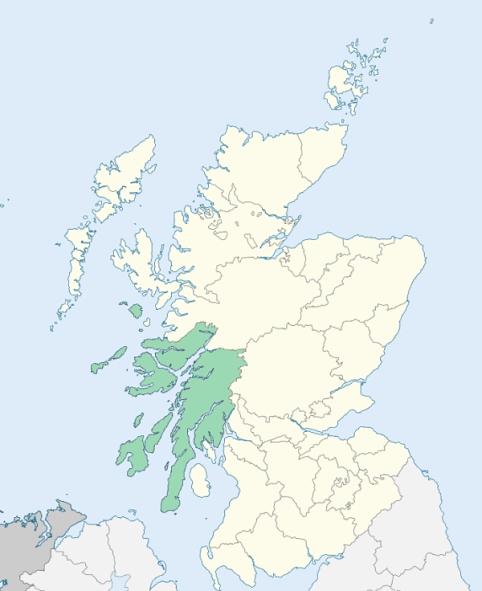
Glenorchy and Inishail is a united parish in the district of Lorn, Argyleshire. Glenorchy proper is on the east, and Innishail on the west. The united parish extends from the boundary with Perthshire near Tyndrum to the shores of Loch Etive at Bunawe, comprising eight miles of both sides of Loch Awe, and also extends from the boundary with Dumbartonshire across the head of Loch Long to the lofty line of watershed which divides Mid-Lorn from Appin. The parishes with which it marches are Fortingal, Killin, Arrochar, Inverary, Kilmorack, Kilchrenan, Muckairn, Ardchattan, and Lismore. (1867: The Imperial Gazetteer of Scotland, by John Marius Wilson).
Bunawe or Bonawe, Cladich, Dalmally
Inchdrynich, New Inverawe or Tirvane
The island of Inishail in Loch Awe was a detached part of the parish of Kilchrenan and Dalavich. It was transferred to the parish of Glenorchy and Inishail. See affected properties and landholders. (1892: Boundary of counties and parishes in Scotland as settled by the Boundary Commissioners under the Local Government Act, 1889, by Hay Shennan)
PRE-REFORMATION GOVERNANCE:
POST-REFORMATION GOVERNANCE:
The parishes of Glenorchy and Inishail were united in 1618, but were severed again in 1650. The new erection of Inishail was revoked by Parliament in 1661, thus the two parishes were joined again. Until 1668 they formed part of the Presbytery of Inveraray, but in that year the united parishes were transferred to the Presbytery of Cowal, now called Dunoon. On 12 May 1729 the united parishes of Glenorchy and Inishail were annexed to the Presbytery of Lorn. Each of the parishes continues to have its own church.
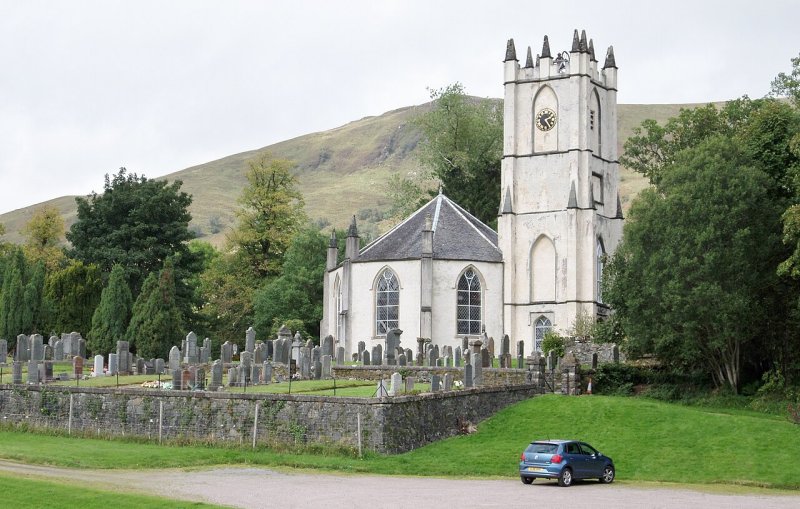
Glenorchy or Clachan an Diseairt. St Conan's Mission to the Picts had its seat at Dalmally in Glenorchy. When the saint died, they buried him on the island of Inis Chonain in the River Orchy. The remains of the ancient church of St Conan are still to be seen. The Diseairt, or Hermitage, to which St Conan retired, gave the place the name of Clachan an Diseairt (the Village of the Hermitage). The parish church has been rebuilt at Dalmally on the mainland. Glenorchy had two fairs, St Conan's and St Andrew's. There is now a mission chapel of St Conan on Loch Awe.
Inishail. The church of Inishail was dedicated to St Findoch. This seems to be St Findeach of Ath Duiru in Ossory, but there was also a female saint called Findocha. The church belonged to the Abbey of Inchaffrey. The ancient building, now ruined, stands on an island in Loch Awe. The island contained also a Cistercian Nunnery of St Findoch. The church of Inishail has been rebuilt upon the mainland.
Includes ministers, licentiates, assistants, readers, and clerks.
Glenorchy (QO)
Inishail (QO)
(1928: Fasti Ecclesiæ Scoticanæ, by Hew Scott, D. D.)
Parish registers turned over to the Registrar-General, as a result of the Registration of Births, Deaths, and Marriages (Scotland) Act of 1854. The letters B. D. and M. indicate Births (or Baptisms), Deaths (or Burials), and Marriages (or Proclamations of Banns) respectively. Numbers indicate separate volumes or books. Note: These records are by no means complete or without damage; consult the Detailed List of the Old Parochial Registers of Scotland (1872) to learn more about the condition of the records.
| OPR and RD Numbers | |||
|---|---|---|---|
| Date Range | Name | Number | Type |
| 1753-1854 | Glenorchy and Inishail | 512 | OPR |
| 1855-1969 | Glenorchy and Inishail | 512 | RD |
| 2009 | Argyll and Bute, Oban | 526 | RD |
| 2026 | Argyll and Bute Council; Glenorchy and Inishail Community Council | ||
(2009: Parishes and Registration Districts of Scotland - Old and New, National Records of Scotland)
Local community councils (2026) are provided as a potential source of additional information for settlements within the original boundaries of the parish. (Source)
Statistics from informal and official censuses
Glenorchy: Cameron, Campbell, Carmichael, Dewar, MacFarlane, MacIntyre, Munro, Rankin, Robertson, Sinclair
Inishail: Black, Campbell, Carmichael, Farquharson, Leitch, Marquis, Munro, Ross, Sinclair, Stewart
Note: Names appearing in research materials, other than censuses. Simple names (First name, surname only) have been omitted unless they appear associated with large properties. All women's names, and men's names with occupations, military ranks, or peerage titles are included.
By the Reverend Joseph MacIntyre, D. D..
"At present, (1792), the total number of people is 1639. Of these there are of males 783, of females 886.
The inhabitants of this parish have, from time immemorial, been marked, for peculiar regularity of conduct, and decency of manners. They are, in general, sober, industrious, and humane; courteous, peaceable and contented. They are all of the established church, and attend the public institutions of religion, with becoming attention and decorum. Enormous crimes are unknown in this place. Lawsuits occur but seldom.
The superior class of tacksmen live in commodious and decent houses, in the enjoyment of the comforts of life, with order, neatness, and hospitality: and even the middling and lower ranks of the peasantry live in a style of plenty and cleanliness, very different from that of their predecessors."
(This section contains excerpts, at times restructured or paraphrased, from an article appearing in Statistical Account of Scotland, Sir John Sinclair, 1791-1799)
Primary Sources:
Statistical Account of Scotland (1791-1799), Volume 8, p. 335
New Statistical Account of Scotland (1834-1845), Volume 7, Section II, p. 82
See Parish Page Sources for all source information and links.