Kildachanan (Kilchrenan)
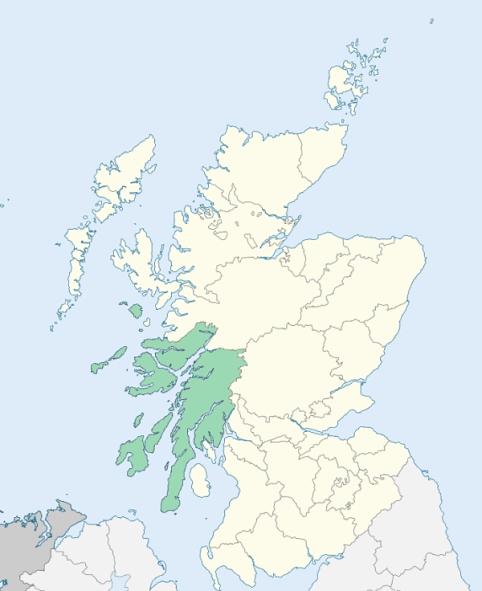
Kilchrennan and Dalavich is a united parish in the district of Lorn, Argyleshire. It is entirely inland, and lies along both sides of the south-west arm of Loch Awe. (1867: The Imperial Gazetteer of Scotland, by John Marius Wilson).
Annat, Ardchonnel, Barchanvore, Barnalian, Coillaig, Cruachan, Fernoch, Inverinan, Kilchrenan, Lephein, Port Innisherrich, Port Sonachan
Eredine
The island of Inishail in Loch Awe was a detached part of the parish of Kilchrenan and Dalavich. It was transferred to the parish of Glenorchy and Inishail. See affected properties and landholders. (1892: Boundary of counties and parishes in Scotland as settled by the Boundary Commissioners under the Local Government Act, 1889, by Hay Shennan)
PRE-REFORMATION GOVERNANCE:
POST-REFORMATION GOVERNANCE:
The parishes of Kilchrenan and Dalavich were united in 1661. Each of them still retains its own church. Until 1729 the united parishes were in the Presbytery of Inveraray, but, on the 12 of May in that year, they were transferred to the Presbytery of Lorn.
Kilchrenan or Kildachanan. The church of Kilchrenan belonged to the Abbey of Paisley. Of old it was dedicated to the Irish Saint Chreathanan. This, however, was superseded by a late dedication to St Peter the Deacon, a martyr of Antioch. When Kilchrenan had come under the rule of the Abbot of Paisley, it acquired the additional name of Kildachanan (The Church of the Canons). This was not an accurate name, for the monks of Paisley were not Canons Regular but Cluniacs. In the chapter of the Diocese of ARgyll, Kilchrenan formed the prebend of the Dean. There was a chapel within the bounds at Annat.
Dalavich. The parish of Dalavich gets its name (Dail an Amhaich = the Field of the Neck) from the site of its old church upon the narrow neck of land between Loch Awe and Loch Avich. So far as can be made out, it was in 1649 or 1650 that Dalavich was disjoined from Kilchrenan. Its erection was annulled in 1661, and these two parishes were united again.
Includes ministers, licentiates, assistants, readers, and clerks.
Kilchrenan and Dalavich (QO)
Dalavich (QO)
(1928: Fasti Ecclesiæ Scoticanæ, by Hew Scott, D. D.)
Parish registers turned over to the Registrar-General, as a result of the Registration of Births, Deaths, and Marriages (Scotland) Act of 1854. The letters B. D. and M. indicate Births (or Baptisms), Deaths (or Burials), and Marriages (or Proclamations of Banns) respectively. Numbers indicate separate volumes or books. Note: These records are by no means complete or without damage; consult the Detailed List of the Old Parochial Registers of Scotland (1872) to learn more about the condition of the records.
| OPR and RD Numbers | |||
|---|---|---|---|
| Date Range | Name | Number | Type |
| 1751-1854 | Kilchrenan and Dalavich | 517 | OPR |
| 1855-1930 | Kilchrenan | 517-1 | RD |
| 1855-1930 | Dalavich | 517-2 | RD |
| 1931-1969 | Kilchrenan and Dalavich | 517 | RD |
| 2009 | Argyll and Bute, Oban | 526 | RD |
| 2026 | Argyll and Bute Council; Avich and Kilchrenan Community Council | ||
(2009: Parishes and Registration Districts of Scotland - Old and New, National Records of Scotland)
Local community councils (2026) are provided as a potential source of additional information for settlements within the original boundaries of the parish. (Source)
Statistics from informal and official censuses
Kilchrenan: Cameron, Campbell, Clark, Fisher, Gilmour, Lamond, Livingston, Morrison, Munroe, Turner
Dalavich: Campbell, Currie, Fisher, MacColl, MacCulloch, MacDougall, MacIntyre, Sinclair, Thomson, Turner
Note: Names appearing in research materials, other than censuses. Simple names (First name, surname only) have been omitted unless they appear associated with large properties. All women's names, and men's names with occupations, military ranks, or peerage titles are included.
By the Reverend Mr William Campbell.
"The number of souls in 1792 was 1124, of whom 530 were males, and 594 females. There were 280 families. There were 6 residing proprietors possessing 1 farm each, 2 tacksmen possessing 4 farms each, 2 tacksmen possessing 2 farms each, and 1 tacksman possessing 1 farm. There were 90 small tenants, 1 shopkeeper, 2 innkeepers, 5 dram-sellers, 2 smiths, 2 house carpenters, 22 weavers, 6 shoemakers, 6 tailors, 4 millers, 3 packmen, 1 carrier, 2 waulk millers and dyers, 40 wood-cutters and dyke builders, 1 ferryman, 2 coopers, 18 married herds, 16 married workmen.
The inhabitants are all of the Established church; and, to very few, have all been born in the parish, and baptised by the present incumbent, who is near 80 years of age. They are a sober, regular, industrious set of people; generous, humane, high spirited, and loyal, when called to the exertion of those qualities."
(This section contains excerpts, at times restructured or paraphrased, from an article appearing in Statistical Account of Scotland, Sir John Sinclair, 1791-1799)
Primary Sources:
Statistical Account of Scotland (1791-1799), Volume 6, p. 266
New Statistical Account of Scotland (1834-1845), Volume 7, Section II, p. 372
See Parish Page Sources for all source information and links.