Deer, Fetterangus
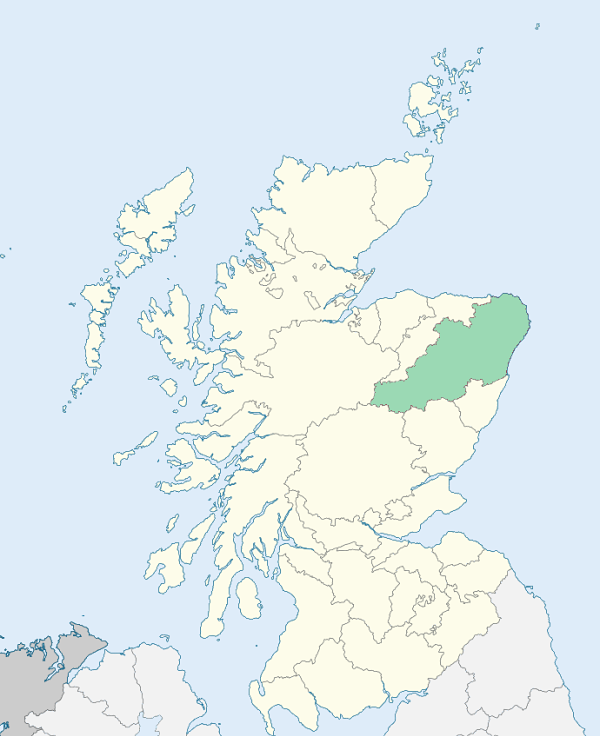
Old Deer is a parish partly in Banffshire, but chiefly in Aberdeenshire. It lies almost in the centre of the district of Buchan, and is strictly compact, its Banffshire section being a detached pendicle of a great barony whose main body constitutes the parish of St Fergus. Deer Parish is bounded by the parishes of Strichen, Longside, Cruden, Ellon, and New Deer. (1867: The Imperial Gazetteer of Scotland, by John Marius Wilson).
Aughnagatt, Biffy, Bullers-Buchan, Clochan, Clola, Deer, Fetterangus, Maud or New Maud, Stewartfield or Stuartfield
Pitfour
Part of the parish of New Machar, part of the parish of Old Deer, and the whole of the parish of St Fergus formed detached parts of the county of Banff surrounded by the county of Aberdeen. These detached parts have all been transferred to the county of Aberdeen. See affected properties and landholders. (1892: Boundary of counties and parishes in Scotland as settled by the Boundary Commissioners under the Local Government Act, 1889, by Hay Shennan)
PRE-REFORMATION GOVERNANCE:
POST-REFORMATION GOVERNANCE:
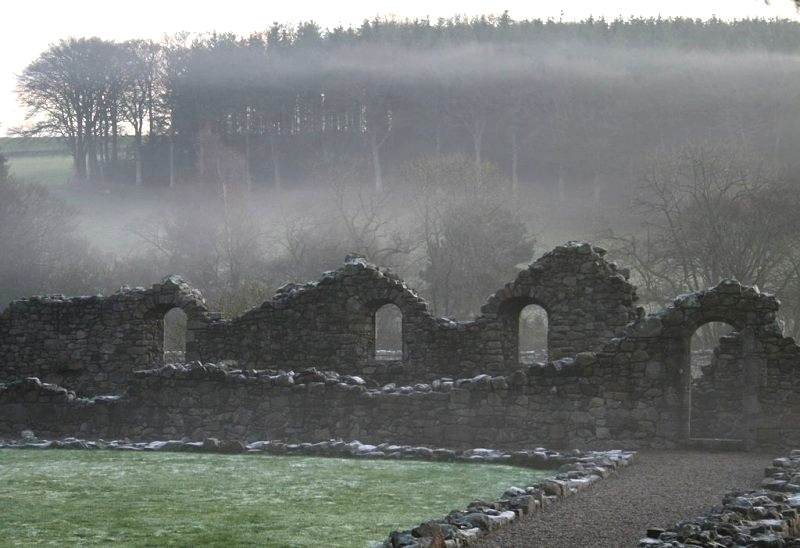
Deer. The ancient church of Deer was dedicated to St Drostan. It belonged to the Abbey of Deer. Near the church was St Drostan's Well. The Celtic monastery of Deer was founded by St Drostan, one of St Columba's monks, who came from Iona to Buchan. It was converted into St Mary's Cistercian Abbey of Deer, founded here in 1218 by William Comyn, first Earl of Buchan.
Fetterangus. The church built about 1120, prior to the Reformation, belonged to the Abbey of Arbroath. The parish was united to Deer before 12 October 1618. There is a mission chapel at Fetterangus.
Disjoined Quoad Sacra Parishes:
Ardallie. The parish of Ardallie was disjoined from Deer, Longside, Ellon, and Cruden on 11 July 1862. The erection of Ardallie was largely the work of William Yeats of Auquharney, and John Morrison, minister of Old Deer.
Kininmonth. The parish of Kininmonth was disjoined from Lonmay, Longside, Deer, Strichen, and Crimond, on 9 March 1874. There was a Well of St John at Kininmonth.
Maud. The parish of Maud was disjoined from Deer and New Deer on 15 July 1889.
Includes ministers, licentiates, assistants, readers, and clerks.
Deer (QO)
Fetterangus (QO)
Ardallie (QS)
Kininmonth (QS)
Maud (QS)
(1928: Fasti Ecclesiæ Scoticanæ, by Hew Scott, D. D.)
Parish registers turned over to the Registrar-General, as a result of the Registration of Births, Deaths, and Marriages (Scotland) Act of 1854. The letters B. D. and M. indicate Births (or Baptisms), Deaths (or Burials), and Marriages (or Proclamations of Banns) respectively. Numbers indicate separate volumes or books. Note: These records are by no means complete or without damage; consult the Detailed List of the Old Parochial Registers of Scotland (1872) to learn more about the condition of the records.
| OPR and RD Numbers | |||
|---|---|---|---|
| Date Range | Name | Number | Type |
| 1735-1854 | Old Deer | 228 | OPR |
| 1855-1897 | Old Deer | 228 | RD |
| 1898-1967 | Old Deer | 228a | RD |
| 1898-1967 | Old Machar | 228b | RD |
| 2009 | (Old Deer) Aberdeenshire, Maud | 312 | RD |
| 2009 | (Old Machar) Aberdeen City | 300 | RD |
| 2026 | (Old Deer) Aberdeenshire Council; Deer Community Council | ||
| 2026 | (Old Machar) Aberdeen City Council; Old Aberdeen Community Council | ||
(2009: Parishes and Registration Districts of Scotland - Old and New, National Records of Scotland)
Local community councils (2026) are provided as a potential source of additional information for settlements within the original boundaries of the parish. (Source)
Statistics from informal and official censuses
Anderson, Cruickshank, Davidson, Keith, Milne, Robertson, Simpson, Smith, Watt, Wilson
Note: Names appearing in research materials, other than censuses. Simple names (First name, surname only) have been omitted unless they appear associated with large properties. All women's names, and men's names with occupations, military ranks, or peerage titles are included.
By Mr George Cruden, Schoolmaster of Deer.
"By a correct list, taken in the year 1788, previous to building the new church there were found in the parish: 3267 persons, 1554 males, 1713 females. The parishioners are in general, a decent, sober, charitable people. Agriculture, the employment of the generality, is favourable to virtue; public worship, and the ordinances of religion, are attended with a laudable punctuality.
There are at present 26 retail shops in the parish, 2 saddler's shops, 1 baker, besides all the common tradesmen and mechanics. The peopling of the villages and small farms, a great increase of handicraftsmen, and a demand for hands to the neighbouring manufactures, have occasioned a temporary scarcity of servants in this place, and afforded them an opportunity, not only of raising their wages, but of demanding some other concessions which former times denied them.
A great deal of flax is given out to spin in this parish for the Aberdeen and Peterhead manufactures. A considerably quantity of linen-yard, spun from home-grown flax, is annually exported to the southern boroughs. In and near the villages of Stewartfield and Deer, 3000 yards of linens, checks, and linsey-woolseys, are every year made for sale. The Aberdeen merchants have been long in the practice of giving out wool to be knitted into stockings. Spinning and knitting form the chief employment of the women; and a very considerable sum of money is brought into the parish yearly from these sources."
(This section contains excerpts, at times restructured or paraphrased, from an article appearing in Statistical Account of Scotland, Sir John Sinclair, 1791-1799)
Primary Sources:
Statistical Account of Scotland (1791-1799), Volume 16, p. 469
New Statistical Account of Scotland (1834-1845), Volume 12, p. 138
See Parish Page Sources for all source information and links.