Aberden, Aberdon
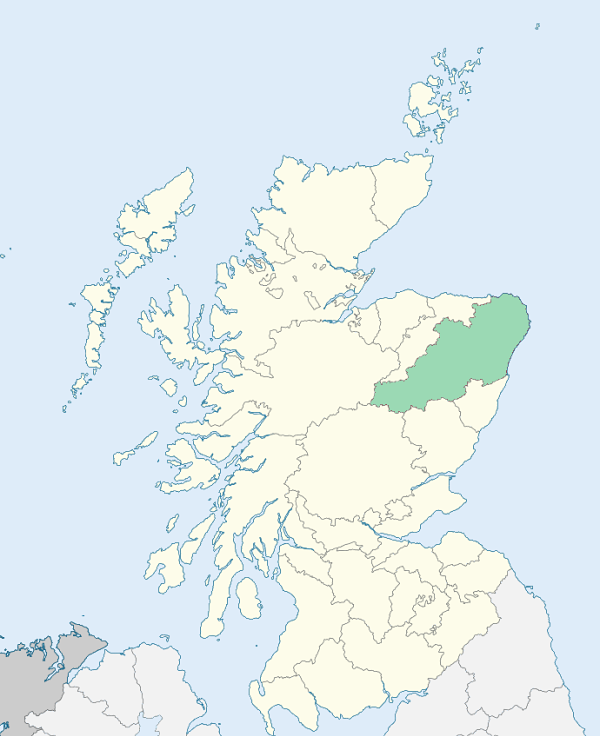
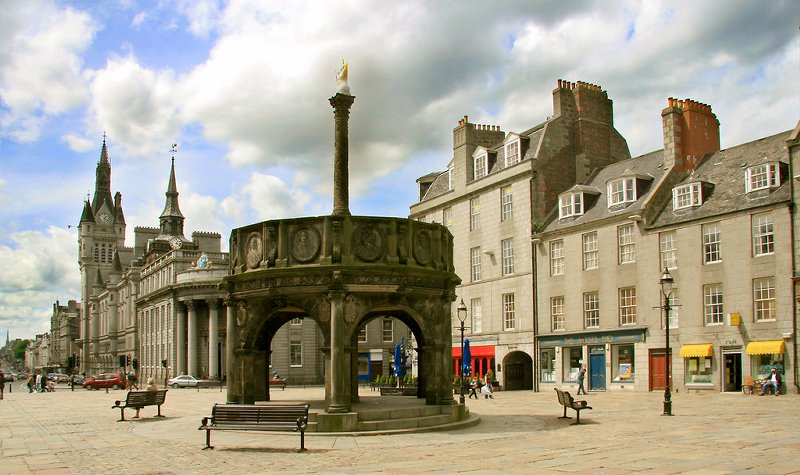
Aberdeen, the 'Granite City', capital of Aberdeenshire, seat of a university, and chief town and seaport in the North of Scotland, lies on the left bank of the Dee, at its entrance into the German Ocean. Aberdeen is 98 miles NNE of Edinburgh as the crow flies. (1867: The Imperial Gazetteer of Scotland, by John Marius Wilson).
Aberdeen, Auchmill, Gilcomston, Grandholm, Hoburn, Woodside
PRE-REFORMATION GOVERNANCE:
POST-REFORMATION GOVERNANCE:
St Machar's, commonly called Old Machar. Near the end of the sixth century St Columba, Abbot of Iona, sent forth St Machar, one of his monks, to found an evangelistic mission among the Eastern Picts. The spot chosen was called Aberdoin, that is, the place at the mouth of the Don. It is now known as Old Aberdeen. In after times, there arose along the coast to the south a notable harbour to which was given the name of New Aberdeen. The two are now united in the city of Aberdeen. In 1125, when King David I founded the See of Aberdeen, he fixed the bishop's seat at Old Aberdeen and made St Machar's Church there its cathedral. In 1560 the See of Aberdeen was suppressed, but St Machar's was made the parish church of Old Aberdeen. The parish of Old Aberdeen had been a prebend belonging to the Dean of the Diocese. It was of vast extent, including the lands that form such modern parishes as Gilcomston, Holburn, Ferryhill, Powis, Ruthrieston, Rosemount, and Woodside, together with the large area now forming the parishes of St Machar, New Machar, and Newhills. At Monkebuck, in the landward part of the parish, there had long been a chapel of St Columba. In 1609 this became the church of an extensive new parish taken off Old Aberdeen. For a time it kept its old name of Monkeybuck, but by the end of the seventeenth century it had got to be called Upper Machar. In the eighteenth century this name gradually gave place to the modern designation of New Machar. As a result of this latter change of title, the parish of Old Aberdeen came to be called Old Machar. Old Aberdeen held two fairs, those of St Machar and St Luke. There were two holy Wells in the town, St Machar's Well and that dedicated to the Nine Maidens of St Donald.
Greyfriars. The Priory of the Grey Friars in Aberdeen was founded in 1469, or near that date. It was dedicated to St Francis. About 1525, Gavin Dunbar, Bishop of Aberdeen, rebuilt its church. In 1560 the Priory was suppressed. Its lands and buildings were then granted to the City of Aberdeen. Some years later the Town Council conveyed them to be used in founding Marischal College. Thus the church of the Grey Friars became the college chapel. In 1749 this building was constituted a chapel-of-ease. The parish of the Greyfriars was disjoined from that of St Nicholas on 5 March 1828. In 1902 the Town Council took the church for an extension of Marischal College. The ancient building was taken down and a new church for the parish built at the expense of the city.
North Parish. In 1826 the North Church was built as a place of worship, owing to a great growth of population. On 4 March 1828, the Court of Teinds disjoined the North Parish from that of St Nicholas.
Rubislaw. On 19 March 1877 the parish of Rubislaw was disjoined from St Nicholas.
St Clement's, or Footdee. In the parish of St Nicholas, near the mouth of the River Dee, stood of old the fishing village of Futtie. In it, from an early time, there was a chapel of St Futach. It is more than likely that the dedication of this chapel gave the place its name of Futtie. There was at Futtie, in later times, a chapel dedicated to St Photinus. By the end of the fifteenth century the shrine of St Photinus at Futtie had given place to a later chapel dedicated to St Clement. In 1631 St Clement's Chapel was restored and became a place of regular worship. During the nineteenth century Futtie was taken into the city of Aberdeen. The old chapel of St Clement's was, about that time, rebuilt. On 28 March 1828 the parish of St Clement's was disjoined, quoad omnia, from that of St Nicholas.
St Nicholas' or West Parish. The High Kirk of Aberdeen is the Church of St Nicholas. The Parish of St Nicholas was of old a prebend of the diocese of Aberdeen. In 1441 a collegiate foundation was granted to St Nicholas' Church. Some years after the Red Friars came in 1211, King Alexander II settled a colony of the Black Friars here. They dedicated their house to St John the Baptist. At an early date, the Knights of the Temple also set up a Preceptory in Aberdeen. In 1350 a convent of the White Friars was erected in the city. The Grey Friars came in 1450, and settled near St Nicholas' Church. There was here too a convent of the Nuns of St Clara. Within the bounds there were four hospitals. Of these St Anne's and St Peter's were of early date. The Hospital of St Thomas the Martyr was founded in the fifteenth century. In 1538 Bishop Gavin Dunbar erected a fourth hospital. A fair was held in this parish on Trinity Sunday.
South Parish. In the eighteenth century the Synod of Relief formed a congregation which met for worship in Belmont Street, Aberdeen. On 11 August 1791 the minister and congregation of this chapel were admitted to the Church of Scotland, and their church constituted a chapel-of-ease. On 5 March 1828 the Court of Teinds disjoined the South Parish, with its church in Belmont Street, from that of St Nicholas.
Note: Also see Aberdeen Disjoined Quoad Sacra Parishes
Includes ministers, licentiates, assistants, readers, and clerks.
Note: Also see Aberdeen Quoad Sacra Parishes clergy
St Machar's, or Old Machar
Greyfriars
North Parish
Rubislaw
St Clement's, or Footdee
St Nicholas', or West Parish
South Parish
(1928: Fasti Ecclesiæ Scoticanæ, by Hew Scott, D. D.)
Parish registers turned over to the Registrar-General, as a result of the Registration of Births, Deaths, and Marriages (Scotland) Act of 1854. The letters B. D. and M. indicate Births (or Baptisms), Deaths (or Burials), and Marriages (or Proclamations of Banns) respectively. Numbers indicate separate volumes or books. Note: These records are by no means complete or without damage; consult the Detailed List of the Old Parochial Registers of Scotland (1872) to learn more about the condition of the records.
Aberdeen Registers:
Old Machar Registers:
| OPR and RD Numbers | |||
|---|---|---|---|
| Date Range | Name | Number | Type |
| 1560-1854 | Aberdeen | 168a | OPR |
| 1621-1854 | Old Machar | 168b | OPR |
| 1855-1930 | St Nicholas | 168-1 | RD |
| 1855-1863 | Old Machar, Landward | 168-2 | RD |
| 1855-1875 | Old Machar, Aberdeen Burgh | 168-3 | RD |
| 1855-1875 | Old Machar, Aberdeen Burgh | 168-2 | RD |
| 1864-1876 | Old Machar, Landward | 168-3 | RD |
| 1876-1885 | Old Machar | 168-2 | RD |
| 1886-1897 | Old Machar | 168-2 | RD |
| 1886-1913 | Woodside | 168-3 | RD |
| 1886-1913 | Old Aberdeen | 168-4 | RD |
| 1898-1930 | St Machar | 168-2 | RD |
| 1914-1930 | Rubislaw | 168-3 | RD |
| 1914-1930 | Woodside | 168-4 | RD |
| 1914-1930 | Old Aberdeen | 168-5 | RD |
| 1931-1967 | Aberdeen, Northern District | 168-1 | RD |
| 1931-1967 | Aberdeen, Southern District | 168-2 | RD |
| 1831-1967 | Aberdeen, Eastern District | 168-3 | RD |
| 1968-1971 | Aberdeen | 168 | RD |
| 1972-2006 | Aberdeen City | 300 | RD |
| 2009 | Aberdeen City Council | 300 | RD |
| 2026 | Aberdeen City Community Councils (See list below) | ||
(2009: Parishes and Registration Districts of Scotland - Old and New, National Records of Scotland)
Local community councils (2026) are provided as a potential source of additional information for settlements within the original boundaries of the parish. (Source)
Aberdeen City Community Councils:
Statistics from informal and official censuses
Anderson, Davidson, Duncan, Milne, Mitchell, Reid, Robertson, Smith, Taylor, Thomson
Note: Names appearing in research materials, other than censuses. Simple names (First name, surname only) have been omitted unless they appear associated with large properties. All women's names, and men's names with occupations, military ranks, or peerage titles are included.
From the Communication of several Gentlemen of that City.
"The whole population of the city and parishes of Aberdeen in 1790-95, it appears, amounted to 24,493. According to a list of the inhabitants within the strict limits of the city, taken in the month of July 1795, the population was 16,120, of whom were 4830 males, 7601 females, and 3689 under 10 years. That this remarkable disparity in the number of the different sexes really exists in this parish is evident from the minister's rolls, which are as accurate as the very fluctuating state of the people in so populous a place will admit of. It may, however, be satisfactorily explained by the following observations:
Most of our manufactures, especially the bleaching and thread-making businesses, employ a much greater number of women than of men; and the great manufacture of the place, the knitting of stockings, is carried on almost entirely by females. Accordingly, while most of our women remain at home, many of our young men emigrate to other places, in quest of more lucrative employment than they can find in this part of the country.
About 400 persons are employed in wool-combing, and 30,000 occasionally employed in spinning and knitting. It is said occasionally employed, because a great proportion of these are frequently otherwise occupied, particularly at harvest, at moss, and in the summer season, providing some pieces of clothing for themselves or families. The advantages peculiar to this branch of manufacture are, that children at the age of ten, and people very far advanced in life, may, and often do, though in a scanty measure, maintain themselves by their labour at this work, and the knitting can be carried on while traveling or watching cattle or the like.
The salmon-fishings at Aberdeen employ a considerable number of men, and are attended with no small profit to the persons concerned in them. The chief branch of the iron manufacture here is the making of nails. This work was established about the year 1780, and employs from 20 to 30 hands, who earn very high wages. The small stills in Aberdeen and its neighbourhood were lately either given up, or removed to the Highland districts. All the whisky made in such stills is liable to be seized as smuggled goods when brought to Aberdeen; so that the city depends entirely on the large distilleries in the south of Scotland for supplies of whisky."
(This section contains excerpts, at times restructured or paraphrased, from an article appearing in Statistical Account of Scotland, Sir John Sinclair, 1791-1799)
Primary Sources:
Statistical Account of Scotland (1791-1799), Volume 19, p. 140
New Statistical Account of Scotland (1834-1845), Volume 12, p. 1
See Parish Page Sources for all source information and links.