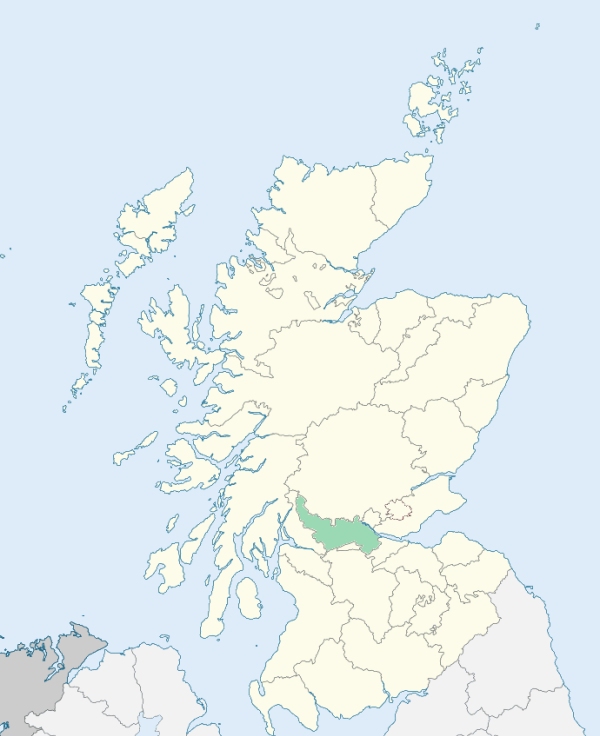
Killearn is a parish, containing a post-office vilalge of its own name, in the west of Stirlingshire. It is bounded by Dumbartonshire, and by the parishes of Drymen, Balfron, Fintry, and Strathblane. (1867: The Imperial Gazetteer of Scotland, by John Marius Wilson).
Blairessan, Gartness, Killearn
Balglass, Ballikinrain, Carbeth, Gartness, Moss
PRE-REFORMATION GOVERNANCE:
POST-REFORMATION GOVERNANCE:
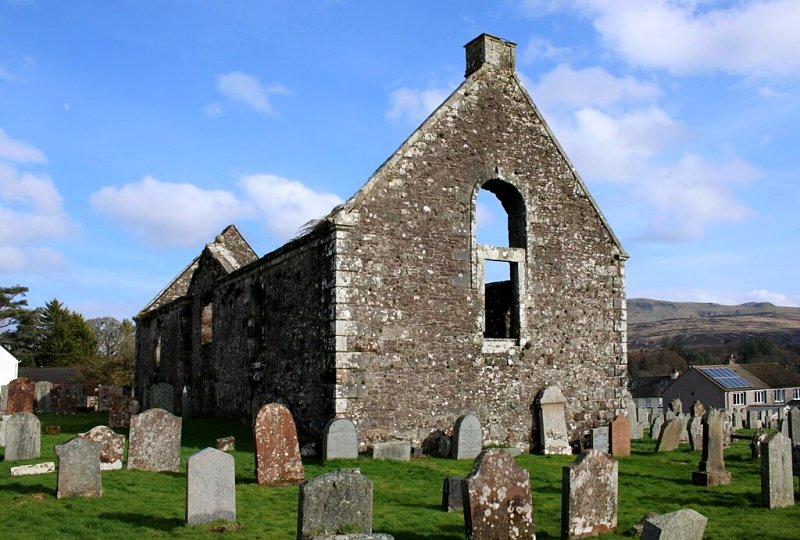
The church of Killearn was a prebend of Glasgow. Its name (Cill a Thigheairn = the Church of the Lord) marks its dedication to our Lord, like that of Kiltearn in Ross. Sir Archibald Orr Ewing of Ballikinrain, Bart., an elder of the parish, and one of its heritors, rebuilt Killearn Church in 1880 as a memorial to his daughter, Elizabeth Constance Lindsay Orr Ewing.
Includes ministers, licentiates, assistants, readers, and clerks.
(1928: Fasti Ecclesiæ Scoticanæ, by Hew Scott, D. D.)
Parish registers turned over to the Registrar-General, as a result of the Registration of Births, Deaths, and Marriages (Scotland) Act of 1854. The letters B. D. and M. indicate Births (or Baptisms), Deaths (or Burials), and Marriages (or Proclamations of Banns) respectively. Numbers indicate separate volumes or books. Note: These records are by no means complete or without damage; consult the Detailed List of the Old Parochial Registers of Scotland (1872) to learn more about the condition of the records.
| OPR and RD Numbers | |||
|---|---|---|---|
| Date Range | Name | Number | Type |
| 1694-1854 | Killearn | 482 | OPR |
| 1855-1969 | Killearn | 482 | RD |
| 2009 | Stirling | 472 | RD |
| 2026 | Stirling Council; Killearn Community Council | ||
(2009: Parishes and Registration Districts of Scotland - Old and New, National Records of Scotland)
Local community councils (2026) are provided as a potential source of additional information for settlements within the original boundaries of the parish. (Source)
Statistics from informal and official censuses
Blair, Brown, Buchanan, Mitchell, Neilson, Paul, Simpson, Sinclair, Thomson, Wilson
Note: Names appearing in research materials, other than censuses. Simple names (First name, surname only) have been omitted unless they appear associated with large properties. All women's names, and men's names with occupations, military ranks, or peerage titles are included.
By the Reverend Mr David Ure, M. A., Minister, Glasgow .
"The parish is inhabited by 206 families, 56 of whom live in the village of Killearn, which contains 223 persons. The 150 families residing in the country, will include 750 inhabitants, making in the whole 973 souls. Lately, from the rapid advance of trade, the population has been greatly on the increase. There are only about 12 adherents to the different parties of Seceders.
The village of Balfrone, which is in the immediate neighbourhood of Killearn, and which formerly contained no more than six or seven families, now contains no fewer than 220 families, arising wholly from a variety of manufactures recently introduced into the neighbourhood; a muslin manufactory was established in 1788. (See: Balfron)
The manufactures in the parish, besides what are carried on in the places already mentioned, are not very considerable. Their state may, in general, be known from the following list of tradesmen and artificers: 4 blacksmiths, 4 coopers, 4 dyers, 3 flax-dresser, 2 gardeners, 11 hosiers, 7 masons, 12 shoemakers, 5 tailors, 28 weavers, and 14 wrights.
By a community so actively employed, little time is wasted in idleness, intemperance, or political cabals. There are, however, five public houses in the parish, but they are chiefly frequented by travelers. Superstition yet continues to operate so strongly on some people, that they put a small quantity of salt into the first milk of a cow after calving, that is given any person to drink. But these, and such like superstitious customs, are every day more and more losing their influence."
(This section contains excerpts, at times restructured or paraphrased, from an article appearing in Statistical Account of Scotland, Sir John Sinclair, 1791-1799)
Primary Sources:
Statistical Account of Scotland (1791-1799), Volume 16, p. 100
New Statistical Account of Scotland (1834-1845), Volume 8, Section II, p. 60
See Parish Page Sources for all source information and links.