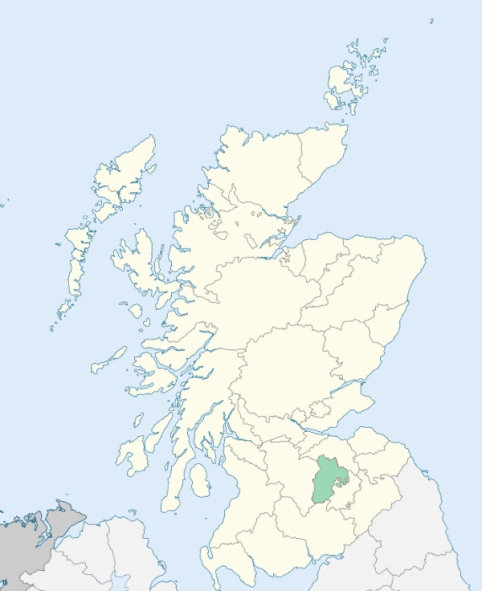
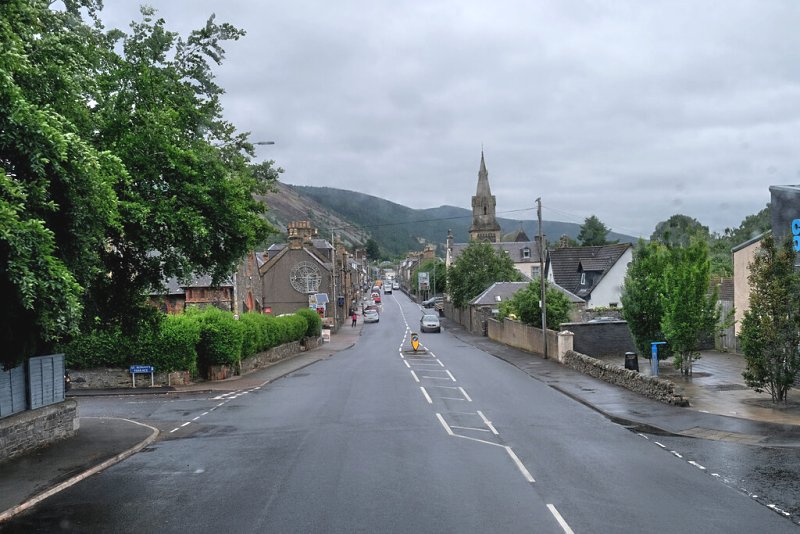
Innerleithen is a parish partly in Selkirkshire, but chiefly in Peeblesshire. It is bounded on the north-east by Edinburghshire and the Selkirkshire part of Stow, on the south, by the River Tweed, which divides it from Yarrow and Traquair, and on the west by the parishes of Peebles and Eddleston. (1867: The Imperial Gazetteer of Scotland, by John Marius Wilson).
Glenmoriston, Horsburgh, Innerleithen, Walkerburn
Glenmoriston House, Holylee, Innerleithen, Walkerburn
The parish of Innerleithen was situated partly in the county of Peebles and partly in the county of Selkirk. The Selkirkshire part of the parish consisted of (a) a detached part of Selkirkshire, and (b) part of the main portion of the county of Selkirk, these two parts being separated from each other by the Peeblesshire part of the parish. The parish has been placed wholly in the county of Peebles. See affected properties and landholders. (1892: Boundary of counties and parishes in Scotland as settled by the Boundary Commissioners under the Local Government Act, 1889, by Hay Shennan)
PRE-REFORMATION GOVERNANCE:
POST-REFORMATION GOVERNANCE:
Innerleithen. The church, dedicated to St Callistus, formerly belonged to the Abbey of Kelso.
Kailzie, or Hope Kailzie. Previous to the Reformation the church, dedicated to the Virgin Mary, belonged to the Abbey of Kelso. The parish was suppressed by the Commissioners for Plantation of Kirks between 22 May and 5 August 1674, and united to Traquair, Peebles, and Innerleithen.
Disjoined Quoad Sacra Parishes:
Caddonfoot. A chapel was opened here in 1863. The parish was disjoined quoad sacra from Galashiels, Innerleithen, Selkirk, Stow, and Yarrow in 1867.
Walkerburn. In 1876 Walkerburn became a chapel-of-ease, and on 2 July 1883 it was erected into a parish quoad sacra by the Court of Teinds. Disjoined from the parishes of Innerleithen and Traquair.
Includes ministers, licentiates, assistants, readers, and clerks.
Innerleithen (QO)
Caddonfoot (QS)
Walkerburn (QS)
(1928: Fasti Ecclesiæ Scoticanæ, by Hew Scott, D. D.)
Parish registers turned over to the Registrar-General, as a result of the Registration of Births, Deaths, and Marriages (Scotland) Act of 1854. The letters B. D. and M. indicate Births (or Baptisms), Deaths (or Burials), and Marriages (or Proclamations of Banns) respectively. Numbers indicate separate volumes or books. Note: These records are by no means complete or without damage; consult the Detailed List of the Old Parochial Registers of Scotland (1872) to learn more about the condition of the records.
| OPR and RD Numbers | |||
|---|---|---|---|
| Date Range | Name | Number | Type |
| 1642-1854 | Innerleithen | 762 | OPR |
| 1855-1889 | Innerleithen | 762 | RD |
| 1890-1967 | Innerleithen | 762-1 | RD |
| 1890-1967 | Walkerburn | 762-2 | RD |
| 1968-1971 | Innerleithen | 762 | RD |
| 1972-1976 | Innerleithen | 802 | RD |
| 2009 | (Innerleithen) Scottish Borders, Peebles | 801 | RD |
| 2009 | (Walkerburn) Scottish Borders, Peebles | 801 | RD |
| 2026 | (Innerleithen) Scottish Borders Council; Innerleithen and District Community Council | ||
| 2026 | (Walkerburn) Scottish Borders Council; Walkerburn and District Community Council | ||
(2009: Parishes and Registration Districts of Scotland - Old and New, National Records of Scotland)
Local community councils (2026) are provided as a potential source of additional information for settlements within the original boundaries of the parish. (Source)
Statistics from informal and official censuses
Anderson, Brown, Hislop, Hope, Scott, Stewart, Tait, Thomson, Turner, Wilson
Note: Names appearing in research materials, other than censuses. Simple names (First name, surname only) have been omitted unless they appear associated with large properties. All women's names, and men's names with occupations, military ranks, or peerage titles are included.
By the Reverend Mr John Walker, Minister of Traquair.
"The number of souls in the parish amounts to 560. The males, 289; the females, 271; under 10 years of age, 138. Of the whole, 388 inhabit the village of Innerleithen, and 222 the rest of the parish.
The greatest number of the inhabitants are employed in agriculture, and the care of their numerous flocks; a few mechanics and tradesmen are all that can be excepted; and these no more than what the supply of articles of the first necessity require."
(This section contains excerpts, at times restructured or paraphrased, from an article appearing in Statistical Account of Scotland, Sir John Sinclair, 1791-1799)
Primary Sources:
Statistical Account of Scotland (1791-1799), Volume 19, p. 592
New Statistical Account of Scotland (1834-1845), Volume 3, Section II, p. 24
See Parish Page Sources for all source information and links.