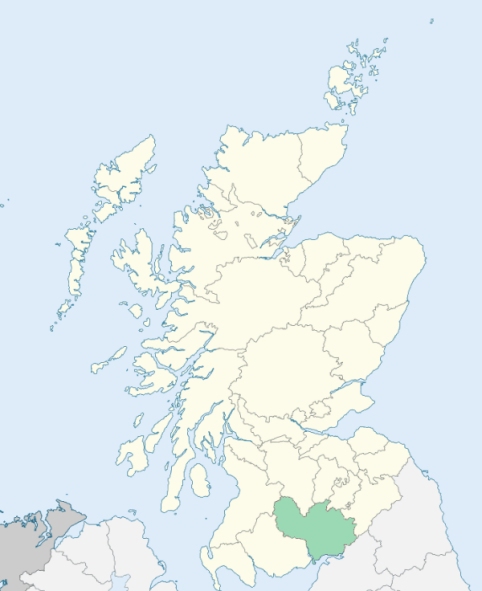
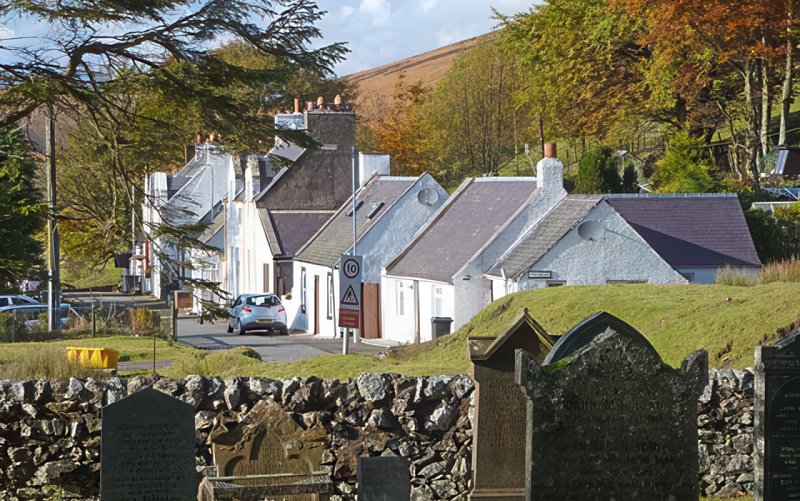
Wamphray - Wamphray is a parish in the upper part of Annandale. It is bounded on the north by Moffat, on the east by Hutton and Corrie, on the south by Applegarth, and on the west by the river Annan, which divides it from Johnstone and Kirkpatrick-Juxta. (1867: The Imperial Gazetteer of Scotland, by John Marius Wilson).
Wanlockhead - Wanlockhead is a large mining village previously in the parish of Sanquhar. It stands at the head of the Wanlock, on the road from Leadhills to Dumfries, 1¼ miles south of Leadhills, and 8½ miles east-north-east of Sanquhar. Its site adjoins the wild boundary with Lanarkshire. (1867: The Imperial Gazetteer of Scotland, by John Marius Wilson).
Gateside, Newton, Plantationfoot, Wamphray
Girthead
PRE-REFORMATION GOVERNANCE:
POST-REFORMATION GOVERNANCE:
The church was dedicated to St Cuthbert. There was in the parish a chapel of St Bernard.
Disjoined Quoad Sacra Parishes:
Wanlockhead. A chapel was built here in 1755. A new church was built in 1848. The parish was erected 27 January 1861, at the sole expense of its proprietor, Walter Francis, Duke of Buccleuch and Queensberry, who gave two of his farms, Carcoside and Orchard, in perpetuity for its endowment.
Includes ministers, licentiates, assistants, readers, and clerks.
Wamphray (QO)
Wanlockhead (QS)
(1928: Fasti Ecclesiæ Scoticanæ, by Hew Scott, D. D.)
Parish registers turned over to the Registrar-General, as a result of the Registration of Births, Deaths, and Marriages (Scotland) Act of 1854. The letters B. D. and M. indicate Births (or Baptisms), Deaths (or Burials), and Marriages (or Proclamations of Banns) respectively. Numbers indicate separate volumes or books. Note: These records are by no means complete or without damage; consult the Detailed List of the Old Parochial Registers of Scotland (1872) to learn more about the condition of the records.
| OPR and RD Numbers | |||
|---|---|---|---|
| Date Range | Name | Number | Type |
| 1709-1854 | Wamphray | 853 | OPR |
| 1866-1856 | Wamphray | 853 | RD |
| 1857-1968 | Wamphray | 853a | RD |
| 1857-1968 | Wanlockhead | 853b | RD |
| 1969-1971 | Wanlockhead | 853 | RD |
| 1972-1997 | Wanlockhead | 832 | RD |
| 2009 | (Wamphray) Dumfries and Galloway, Moffat | 836 | RD |
| 2009 | (Wanlockhead) Dumfries and Galloway, Sanquhar | 831 | RD |
| 2026 | (Wamphray) Dumfries and Galloway Council; Wamphray Community Council | ||
| 2026 | (Wanlockhead) Dumfries and Galloway Council; Wanlockhead Community Council | ||
(2009: Parishes and Registration Districts of Scotland - Old and New, National Records of Scotland)
Local community councils (2026) are provided as a potential source of additional information for settlements within the original boundaries of the parish. (Source)
Statistics from informal and official censuses
Beck, Bell, Carruthers, Kerr, Little, Paterson, Rogerson, Scott, Taylor, Wilson
Note: Names appearing in research materials, other than censuses. Simple names (First name, surname only) have been omitted unless they appear associated with large properties. All women's names, and men's names with occupations, military ranks, or peerage titles are included.
By a Friend to Statistial Inquiries.
"The number of the people in 1755, according to Dr Webster's report, was 458. The population of the parish seems to have been anciently greater than at present. One farmer now possesses what was occupied 60 years ago by 10 or 12 tenants. The population, however, has increased of late, and now amounts to 487: 235 males, 262 females, 90 inhabited houses. Of Seceders of different denominations, exclusive of those who used to attend the Relief meetings, there are about 36. There are 3 masons, 2 joiners, 4 tailors, 9 weavers, 2 smiths, 2 shoemakers, and 1 surgeon. There is one corn-mill in the parish."
(This section contains excerpts, at times restructured or paraphrased, from an article appearing in Statistical Account of Scotland, Sir John Sinclair, 1791-1799)
Primary Sources:
Statistical Account of Scotland (1791-1799), Volume 12, p. 602
New Statistical Account of Scotland (1834-1845), Volume 4, Section I, p. 137
See Parish Page Sources for all source information and links.