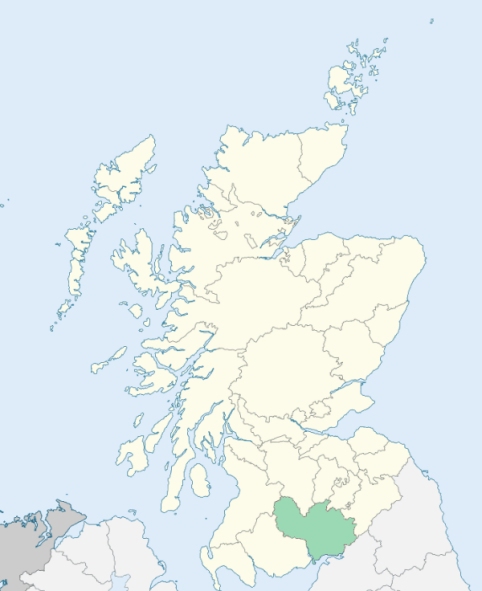
Sanquhar is a parish in the upper part of Nithsdale, Dumfriesshire. It extends from side to side of the district which Dumfriesshire projects between Ayrshire and Lanarkshire. It is bounded by Ayrshire, Kirkconnel, Lanarkshire, Durisdeer, and Penpont. (1867: The Imperial Gazetteer of Scotland, by John Marius Wilson).
Crawick Mill or Crawickmill, Minnick Bridge, Sanquhar, Wanlockhead
Elliock
PRE-REFORMATION GOVERNANCE:
POST-REFORMATION GOVERNANCE:
The parishes of Sanquhar and Kilbride were united in 1727.
Sanquhar. The rectory of Sanquhar was a prebend of Glasgow Cathedral. The church was dedicated to St Bride, and near its site is St Bride's Well, where offerings long continued to be made on the 1st of May. Kirkconnel was united to Sanquhar after 1680, but severed again in 1727.
Kilbride, or Kirkbride. St Bride's Church here belonged to the Abbey of Holyrood. Its ruins stand in the Glen of Enterkin. The parish was united to Sanquhar by the Commissioners of Teinds, 19 July 1727.
Includes ministers, licentiates, assistants, readers, and clerks.
Sanquhar (QO)
Kilbride, or Kirkbride (QO)
(1928: Fasti Ecclesiæ Scoticanæ, by Hew Scott, D. D.)
Parish registers turned over to the Registrar-General, as a result of the Registration of Births, Deaths, and Marriages (Scotland) Act of 1854. The letters B. D. and M. indicate Births (or Baptisms), Deaths (or Burials), and Marriages (or Proclamations of Banns) respectively. Numbers indicate separate volumes or books. Note: These records are by no means complete or without damage; consult the Detailed List of the Old Parochial Registers of Scotland (1872) to learn more about the condition of the records.
| OPR and RD Numbers | |||
|---|---|---|---|
| Date Range | Name | Number | Type |
| 1693-1854 | Sanquhar | 848 | OPR |
| 1855-1857 | Sanquhar Burgh | 848-1 | RD |
| 1855-1857 | Sanquhar Landward | 848-2 | RD |
| 1858-1971 | Sanquhar | 848 | RD |
| 1972-2004 | Sanquhar | 831 | RD |
| 2005-2009 | Dumfries and Galloway, Sanquhar | 831 | RD |
| 2026 | Dumfries & Galloway Council; Royal Burgh of Sanquhar and District Community Council | ||
(2009: Parishes and Registration Districts of Scotland - Old and New, National Records of Scotland)
Local community councils (2026) are provided as a potential source of additional information for settlements within the original boundaries of the parish. (Source)
Statistics from informal and official censuses
Broadfoot, Brown, Ferguson, Hunter, Kerr, Lorimer, Scott, Stitt, Watson, Wilson
Note: Names appearing in research materials, other than censuses. Simple names (First name, surname only) have been omitted unless they appear associated with large properties. All women's names, and men's names with occupations, military ranks, or peerage titles are included.
By the Reverend Mr William Ranken.
"The population in 1755, as returned to Dr Webster, was 1998 souls. From an enumeration made by the present incumbent in 1786, there were found to be 2600, young and old. The increase must be attributed principally to the success of the lead and coal mines, to pendicles of farms being subset by the tenants to such as are employed in leading coals to Wanlockhead, and Leadhills, and to the infant establishment of a carpet manufactory. The populous village of Wanlockhead contains about the third of the inhabitants of the parish.
There are two different branches of carpet manufacture begun within these few years, established on the banks of Crawick; in one of these branches 5 weavers are employed, 2 draw boys, and a pirn winder, 2 women twisting yarn, and one in what is called bobbining it, after it is dyed. Besides, this branch employs 8 weavers in town and country, for manufacturing of stuffs, serges, plaidens, flannels, &c. The other branch employs nearly the same number of weavers, boys and women.
Knitting of stockings was formerly a considerable branch of manufacture in the burgh, by which a number of the lower class were decently supported. But upon the breaking out of the American war, which for a time, shut up the commercial intercourse with this country, this branch received a fatal blow, because the stockings manufactured here, were chiefly exported to Virginia. This manufacture is still carried on, but feebly, and on a much narrower scale than formerly.
The condition of the people, like that of others in parallel circumstances, may be called a middle state betwixt barbarism and refinement. They have arrived at a considerable degree of civilization, and possess the abilities of making still farther improvement. They are, with a few exceptions, which are to be found in every age and in every society, an industrious, rational and religious set of people, regular in attendance upon divine ordinances, and pay a proper regard to the duties of social life. They are neither very rich, nor very poor, and possess a competent share of the comforts, but none of the luxuries of life."
(This section contains excerpts, at times restructured or paraphrased, from an article appearing in Statistical Account of Scotland, Sir John Sinclair, 1791-1799)
Primary Sources:
Statistical Account of Scotland (1791-1799), Volume 6, p. 443
New Statistical Account of Scotland (1834-1845), Volume 4, Section I, p. 297
See Parish Page Sources for all source information and links.