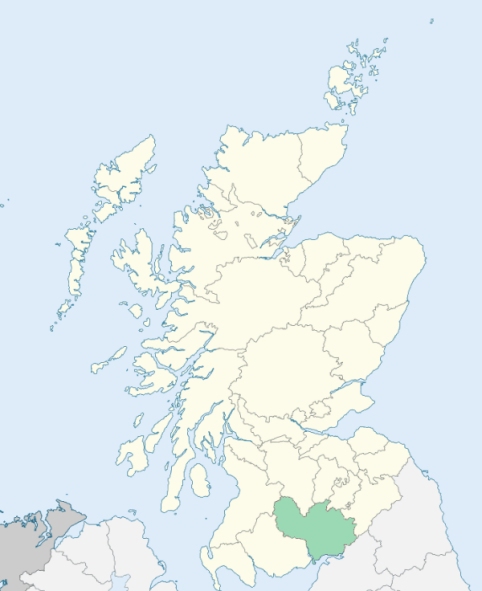
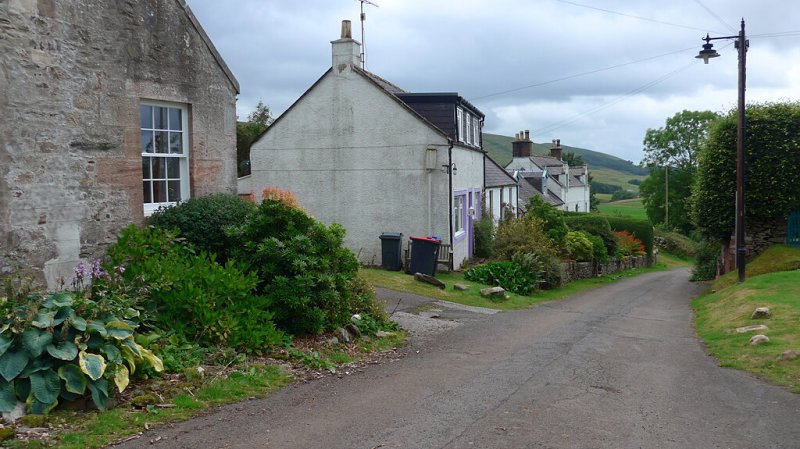
Durisdeer is a parish in the north of Nithsdale, Dumfriesshire. It is bounded by Lanarkshire, and by the parishes of Morton, Penpont, and Sanquhar. (1867: The Imperial Gazetteer of Scotland, by John Marius Wilson).
Carron Bridge or Carronbridge, Durisdeer, Enterkinfoot, Farthingbank
PRE-REFORMATION GOVERNANCE:
POST-REFORMATION GOVERNANCE:
The rectory of Durideer formed a prebend held by the subchanter of Glasgow Cathedral. The church was probably dedicated to St Cuthbert, and there is a well which still bears his name. There was a chapel in this parish on the Water of Carron. The spot is still called Chapel. Part of the ancient parish of Kilbride was annexed to Durisdeer in 1727.
Includes ministers, licentiates, assistants, readers, and clerks.
(1928: Fasti Ecclesiæ Scoticanæ, by Hew Scott, D. D.)
Parish registers turned over to the Registrar-General, as a result of the Registration of Births, Deaths, and Marriages (Scotland) Act of 1854. The letters B. D. and M. indicate Births (or Baptisms), Deaths (or Burials), and Marriages (or Proclamations of Banns) respectively. Numbers indicate separate volumes or books. Note: These records are by no means complete or without damage; consult the Detailed List of the Old Parochial Registers of Scotland (1872) to learn more about the condition of the records.
| OPR and RD Numbers | |||
|---|---|---|---|
| Date Range | Name | Number | Type |
| 1758-1854 | Durisdeer | 823 | OPR |
| 1855-1968 | Durisdeer | 823 | RD |
| 2009 | Dumfries and Galloway, Thornhill | 833 | RD |
| 2026 | Dumfries & Galloway Council; Durisdeer Community Council | ||
(2009: Parishes and Registration Districts of Scotland - Old and New, National Records of Scotland)
Local community councils (2026) are provided as a potential source of additional information for settlements within the original boundaries of the parish. (Source)
Statistics from informal and official censuses
Brown, Dalziel, Hyslop, Johnstone, Kerr, Laidlaw, Lockhart, Muir, Wilson, Wylie
Note: Names appearing in research materials, other than censuses. Simple names (First name, surname only) have been omitted unless they appear associated with large properties. All women's names, and men's names with occupations, military ranks, or peerage titles are included.
By the Reverend Mr John M'Kill.
"The parish contains 1031 souls. There are only 2 villages; 1 containing about 100 persons, and another about 50. The number of farmers, excluding those who have small subsets, is 43. All the inhabitants are natives of Scotland, except 2 families from Ireland. There are 27 Seceders, and 7 of those who call themselves of the Reformed Presbytery.
The inhabitants, in general, are hospitable, honest, sober, and industrious. They are of the middle size. A great number of the lower classes are employed in spinning yarn of coarse wool for carpets, which is mostly sold for ready money, and carried to Kilmarnock, and of late to Kendal. Some of the inhabitants have enlisted in the army. Several of the natives have gone abroad likewise in the mercantile line, and some of them have been very successful in the West Indies. The people, in general, live comfortably."
(This section contains excerpts, at times restructured or paraphrased, from an article appearing in Statistical Account of Scotland, Sir John Sinclair, 1791-1799)
Primary Sources:
Statistical Account of Scotland (1791-1799), Volume 4, p. 457
New Statistical Account of Scotland (1834-1845), Volume 4, Section I, p. 323
See Parish Page Sources for all source information and links.