Loch Carron
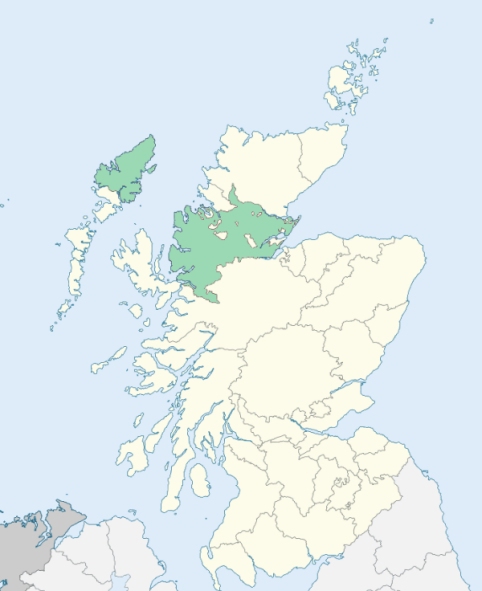
Lochcarron is a parish in the south-west of Ross-shire. It extends from the mountain watershed near the sources of the rivulet Carron south-westward to the peninsula at the forking of Loch Carron into Loch Kishorn, and is bounded elsewhere by the parishes of Applecross, Gairloch, and Lochalsh. (1867: The Imperial Gazetteer of Scotland, by John Marius Wilson).
Janetown, Jeantown, or Lochcarron
The parish of Lochcarron had four detached parts, all surrounded by the parish of Applecross. Lochcarron detached No. 1, containing 141 acres, was situated above a mile to the south of the southern end of Loch Damh. The other three detached parts, containing 89, 46, and 491 acres respectively, were situated at the head of Loch Kishorn and on the left bank of the River Kishorn.
(a) That part of Applecross which lies east of the River Kishorn and south of the north march of Kishorn estate was transferred to Lochcarron. In this way detached parts Nos. 2, 3, and 4 of Lochcarron are united to the main portion of the parish.
(b) Lochcarron detached No. 1 and a portion of the main portion of Lochcarron lying to the east of this detached part were transferred to Applecross. See affected properties and landholders. (1892: Boundary of counties and parishes in Scotland as settled by the Boundary Commissioners under the Local Government Act, 1889, by Hay Shennan)
PRE-REFORMATION GOVERNANCE:
POST-REFORMATION GOVERNANCE:
The church, dedicated to St Malrubh, was a common kirk of the Canons of Ross and the parish was erected by the Court of Teinds, 30 December 1726. The lands of Torridon and Kishorn were then joined to the parish of Applecross. At Seipal Dhonain, within the bounds, there was of old a chapel of St Donan.
Disjoined Quoad Sacra Parishes:
Shieldaig: The first of the parliamentary churches, was declared a quoad sacra parish by the General Assembly, 25 May 1833, and was disjoined from Applecross and Lochcarron by the Court of Teinds 19 February 1897.
Includes ministers, licentiates, assistants, readers, and clerks.
Lochcarron (QO)
Shieldaig (QS)
(1928: Fasti Ecclesiæ Scoticanæ, by Hew Scott, D. D.)
Parish registers turned over to the Registrar-General, as a result of the Registration of Births, Deaths, and Marriages (Scotland) Act of 1854. The letters B. D. and M. indicate Births (or Baptisms), Deaths (or Burials), and Marriages (or Proclamations of Banns) respectively. Numbers indicate separate volumes or books. Note: These records are by no means complete or without damage; consult the Detailed List of the Old Parochial Registers of Scotland (1872) to learn more about the condition of the records.
| OPR and RD Numbers | |||
|---|---|---|---|
| Date Range | Name | Number | Type |
| 1819-1854 | Lochcarron | 76 | OPR |
| 1855-1971 | Lochcarron | 76 | RD |
| 1972-2001 | Lochcarron | 206 | RD |
| 2002-2006 | Lochcarron and Shieldaig | 206 | RD |
| 2009 | Highland, Shieldaig | 206 | RD |
| 2026 | (Lochcarron) Highland Council; Lochcarron Community Council | ||
| 2026 | (Shieldaig) Highland Council; Shieldaig Community Council | ||
(2009: Parishes and Registration Districts of Scotland - Old and New, National Records of Scotland)
Local community councils (2026) are provided as a potential source of additional information for settlements within the original boundaries of the parish. (Source)
Statistics from informal and official censuses
Finlayson, MacDonald, MacKay, Mackenzie, MacLean, MacLennan, MacRae, Matheson, Murchison, Stewart
Note: Names appearing in research materials, other than censuses. Simple names (First name, surname only) have been omitted unless they appear associated with large properties. All women's names, and men's names with occupations, military ranks, or peerage titles are included.
By the Reverend Mr Lachlan Mackenzie.
"About 40 years ago, there was a lint manufacture in Lochcarron. If there were a woollen manufacture established here, it would employ a great number of idle hands, and might prevent emigration. All the common tenants upon the shore towns are fishers. Many of the poor people live for several months upon herring and potatoes. With this humble fare, they are cheerful and thankful, and when they take it with sobriety, and qualify it by drinking water gruel after it, it proves wholesome food."
(This section contains excerpts, at times restructured or paraphrased, from an article appearing in Statistical Account of Scotland, Sir John Sinclair, 1791-1799)
Primary Sources:
Statistical Account of Scotland (1791-1799), Volume 13, p. 551
New Statistical Account of Scotland (1834-1845), Volume 14, Section II, p. 107
See Parish Page Sources for all source information and links.