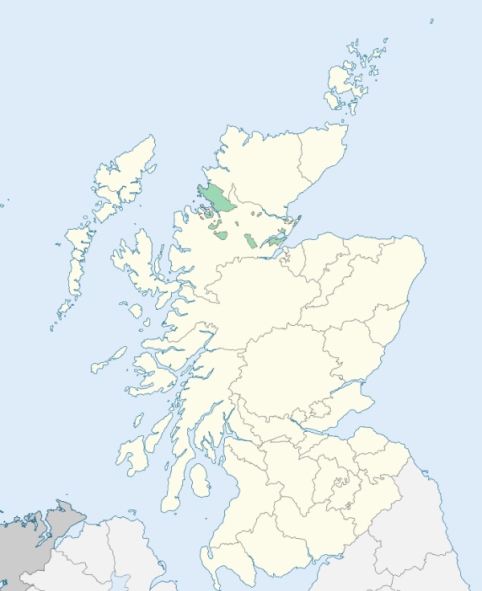
Kincardine is a parish lying on the northern border of Ross-shire, and comprising two detached portions of Cromartyshire. It is bounded by the county of Sutherland, and by the parishes of Edderton, Rosskeen, Fodderty, and Lochbroom. (1867: The Imperial Gazetteer of Scotland, by John Marius Wilson).
Achnahannet or Auchnahannet, Ardgay, Ballyphuill, Croick
PRE-REFORMATION GOVERNANCE:
POST-REFORMATION GOVERNANCE:
The church of Kincardine was dedicated to St Columba. In the Chapter of Fortrose Cathedral there was a prebend of Kincardine. Within the bounds was a Well of St Mary.
Disjoined Quoad Sacra Parishes:
Croick: A parliamentary church was built here in 1827. The parish of Croick was disjoined from Kincardine on 4 Mar 1846.
Includes ministers, licentiates, assistants, readers, and clerks.
Kincardine (QO)
Croick (QS)
(1928: Fasti Ecclesiæ Scoticanæ, by Hew Scott, D. D.)
Parish registers turned over to the Registrar-General, as a result of the Registration of Births, Deaths, and Marriages (Scotland) Act of 1854. The letters B. D. and M. indicate Births (or Baptisms), Deaths (or Burials), and Marriages (or Proclamations of Banns) respectively. Numbers indicate separate volumes or books. Note: These records are by no means complete or without damage; consult the Detailed List of the Old Parochial Registers of Scotland (1872) to learn more about the condition of the records.
| OPR and RD Numbers | |||
|---|---|---|---|
| Date Range | Name | Number | Type |
| 1804-1854 | Kincardine | 71 | OPR |
| 1855-1867 | Kincardine | 71 | RD |
| 1868-1872 | Kincardine | 71-1 | RD |
| 1868-1872 | Strathoykel | 71-2 | RD |
| 1873-1892 | Kincardine | 71a1 | RD |
| 1873-1892 | Strathoykel | 71a2 | RD |
| 1873-1892 | Kinlochluichart | 71b | RD |
| 1893-1967 | Kincardine | 71-1 | RD |
| 1893-1967 | Strathoykel | 71-2 | RD |
| 1968-1971 | Kincardine | 71 | RD |
| 1972-1975 | Kincardine | 192 | RD |
| 1976-2006 | Bonar and Kincardine | 181 | RD |
| 2009 | Highland, Bonar and Kincardine | 181 | RD |
| 2026 | (Kincardine) Highland Council; Ardgay and District Community Council | ||
| 2026 | (Strathoykel) Highland Council; Creich Community Council | ||
| 2026 | (Kinlochluichart) Highland Council; Garve and District Community Council | ||
| 2026 | (Bonar) Highland Council; Creich Community Council | ||
(2009: Parishes and Registration Districts of Scotland - Old and New, National Records of Scotland)
Local community councils (2026) are provided as a potential source of additional information for settlements within the original boundaries of the parish. (Source)
Statistics from informal and official censuses
Campbell, MacDonald, MacGregor, MacKay, Mackenzie, MacLeod, Munro, Ross, Urquhart
Note: Names appearing in research materials, other than censuses. Simple names (First name, surname only) have been omitted unless they appear associated with large properties. All women's names, and men's names with occupations, military ranks, or peerage titles are included.
By the Reverend Mr Andrew Gallie.
"The number of the inhabitants is at present far short of what it was 16 years ago, when the present incumbent was settled. It was then upwards of 2000, above 7 years of age, whereas there are not now about 1600 examinable persons. The chief cause of the late decrease is, that in 1782, many were reduced to poverty by the loss of their cattle, and the almost total failure of the crop of that year, which occasioned such accumulated distress, that they were obliged to remove with their families and settle in the low country, as day labourers, or domestic servants.
There are no manufactures of any consequence carried on in this parish. The act of 1746, discharging the Highland dress, had the worst of consequences. Prior to that period, the Highland women were remarked for their skill and success in spinning and dying wool, and clothing themselves and their households, each according to her fancy, in tartans, fine, beautiful, and durable. Deprived of the pleasure of seeing their husbands, sons, and favourites, in that elegant drapery, emulation died, and they became contented with manufacturing their wool in the coarsest and clumsiest manner; perhaps thinking, that since they must appear like the neighbouring Lowlanders, the less they shone, in the ornaments of the Lowland dress, they would be the more in character.
The character of the people here, as in most places, is of a mixed nature. Most of them are moral in their lives, and when occasion requires, capable of unremitting industry. In common with most other Highlanders, they are hospitable, of quick parts, of great agility, inquisitive and fond of information, and extremely patient under hunger, cold, and other distresses, from which their southern neighbours would shrink with horror. They still retain a sacred regard for the clan and family they are sprung from; but it must be allowed, that this feeling is on the decline."
(This section contains excerpts, at times restructured or paraphrased, from an article appearing in Statistical Account of Scotland, Sir John Sinclair, 1791-1799)
Primary Sources:
Statistical Account of Scotland (1791-1799), Volume 3, p. 505
New Statistical Account of Scotland (1834-1845), Volume 14, Section II, p. 403
See Parish Page Sources for all source information and links.