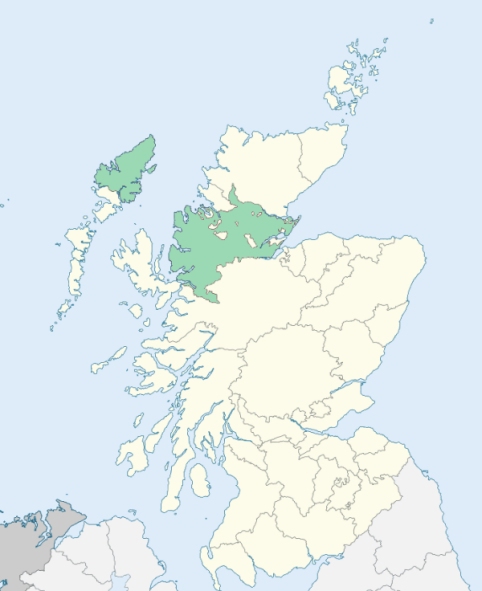
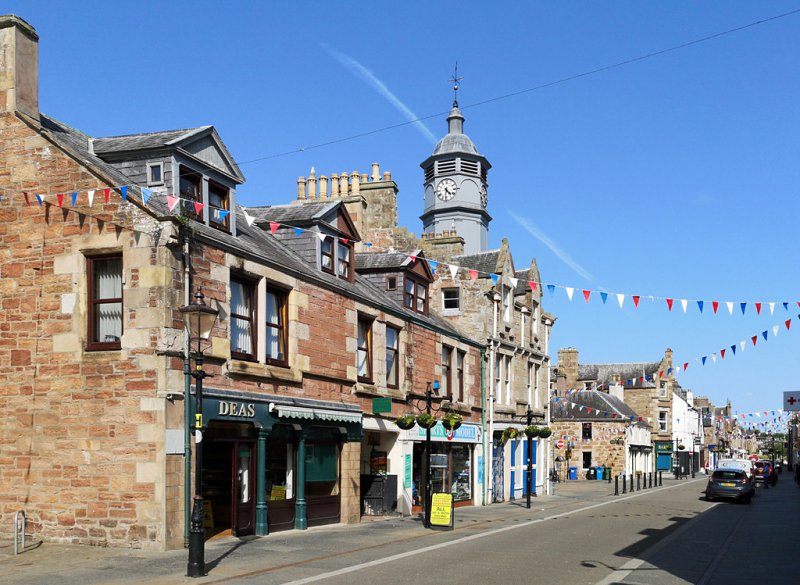
Dingwall is a parish at the head of the Cromarty Firth in Ross-shire. It is bounded on the east by the parish of Kiltearn, on the north by the vast mass of Ben Wyvis, and on the west and south, by the parish of Fodderty. That part of the parish of Urquhart called Ferintosh lies on the skirt to the south-east, but Dingall parish is divided from it by the River Conan. (1867: The Imperial Gazetteer of Scotland, by John Marius Wilson).
Dingwall, Maryburgh, Newton of Ferintosh, Strathpeffer
The parish of Fodderty had two detached parts:
(a) Fodderty detached No. 1 extended to 18,474 acres, and was almost surrounded by the parish of Contin.
(b) Fodderty detached No. 2, extending to 2,720 acres, lay to the south of the main portion of the parish, and was separated from it by a narrow strip to the parish of Dingwall.
Not only had the parish of Urray two detached parts in the county of Ross and Cromarty, but in addition part of the main portion of the parish was situated in the county of Inverness.
(a) Urray detached No. 1, containing 2,463 acres, was almost surrounded by the parish of Contin.
(b) Urray detached No. 2, with 38,561 acres, lay in Glen Orrin west of the main portion of the parish, being separated from it by a strip of Contin and a strip of Fodderty detached No. 1.
In dealing with these two parishes it was found necessary to effect alterations on the boundaries of the parishes of Contin and Dingwall. With the view of uniting Fodderty detached No. 2 to the main portion of that parish, part of the parish of Dingwall has been transferred to the parish of Fodderty. See affected properties and landholders. (1892: Boundary of counties and parishes in Scotland as settled by the Boundary Commissioners under the Local Government Act, 1889, by Hay Shennan)
PRE-REFORMATION GOVERNANCE:
POST-REFORMATION GOVERNANCE:
The church of Dingwall was dedicated to St Colin. It belonged to the Priory of Pluscarden. There were within the bounds chapels of St Laurence and St Clement. A fair of St Malrubh was transferred from Contin to Dingwall.
Includes ministers, licentiates, assistants, readers, and clerks.
(1928: Fasti Ecclesiæ Scoticanæ, by Hew Scott, D. D.)
Parish registers turned over to the Registrar-General, as a result of the Registration of Births, Deaths, and Marriages (Scotland) Act of 1854. The letters B. D. and M. indicate Births (or Baptisms), Deaths (or Burials), and Marriages (or Proclamations of Banns) respectively. Numbers indicate separate volumes or books. Note: These records are by no means complete or without damage; consult the Detailed List of the Old Parochial Registers of Scotland (1872) to learn more about the condition of the records.
| OPR and RD Numbers | |||
|---|---|---|---|
| Date Range | Name | Number | Type |
| 1662-1854 | Dingwall | 62 | OPR |
| 1855-1855 | Dingwall Burgh | 62-1 | RD |
| 1855-1855 | Dingwall Landward | 62-2 | RD |
| 1856-1971 | Dingwall | 62 | RD |
| 1972-2001 | Dingwall | 196 | RD |
| 2002-2006 | Dingwall and Carnoch | 196 | RD |
| 2009 | Highland, Dingwall and Carnoch | 196 | RD |
| 2026 | (Dingwall) Highland Council; Dingwall Community Council | ||
| 2026 | (Carnoch) Highland Council; Dornoch Area Community Council | ||
(2009: Parishes and Registration Districts of Scotland - Old and New, National Records of Scotland)
Local community councils (2026) are provided as a potential source of additional information for settlements within the original boundaries of the parish. (Source)
Statistics from informal and official censuses
Bain, Cameron, Fraser, MacDonald, MacLean, MacLennan, MacRae, Munro, Ross, Stewart
Note: Names appearing in research materials, other than censuses. Simple names (First name, surname only) have been omitted unless they appear associated with large properties. All women's names, and men's names with occupations, military ranks, or peerage titles are included.
By the Reverend Mr Daniel Rose.
"There is abundance of people in the parish and neighbourhood, who would be glad of employment; living is comparatively moderate; the home market for several sorts of manufactures would by no means be inconsiderable; and a communication with the foreign market would always be easy and open. Gaelic is still the language of the common people, in which, therefore, the greater part of public worship is performed. But most of the parishioners now understand and speak English. There are comparatively few of the younger people who were not early sent to school, and taught both to read and write.
The lower order of people is not remarkable for any extraordinary degree of hospitality. Living in a country well inhabited, and much resorted to by strangers, and not enjoying those means of wealth which arise from extensive commerce, or regular manufactures, this virtue cannot have much room to exert itself among this class. According to their situation, however, they are by no means unwilling to share what they possess, either in the way of hospitality or charity. In general, the people are sober and industrious, decent in their behaviour, and submissive to the laws."
(This section contains excerpts, at times restructured or paraphrased, from an article appearing in Statistical Account of Scotland, Sir John Sinclair, 1791-1799)
Primary Sources:
Statistical Account of Scotland (1791-1799), Volume 3, p. 1
New Statistical Account of Scotland (1834-1845), Volume 14, Section II, p. 210
See Parish Page Sources for all source information and links.