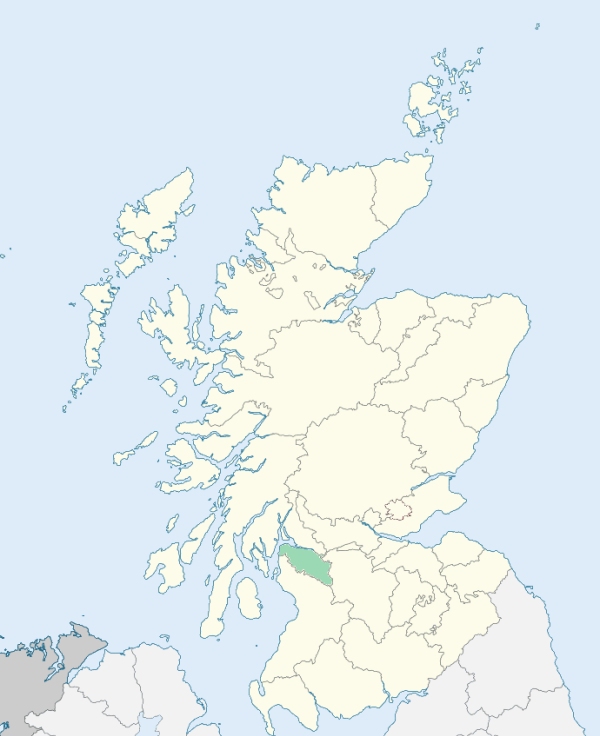
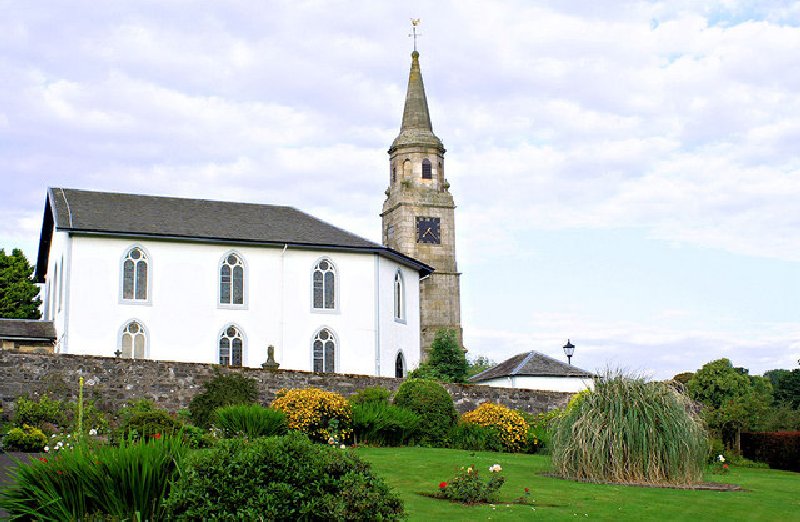
Eaglesham is a parish forming the south-eastern portion of the county of Renfrew. It is bounded on the north-west by Mearns, on the south-west by Fenwick, and on the south by Loudoun, and on the east by Carmunnock and East Kilbride. (1867: The Imperial Gazetteer of Scotland, by John Marius Wilson).
Eaglesham
The parish of East Kilbride was situated partly in the county of Renfrew and partly in the county of Lanark, the part in the county of Renfrew being a small detached part of the parish. No change was made on the county boundary, but this detached part (being the Renfrewshire part of the parish) was transferred to the parish of Eaglesham. See affected properties and landholders. (1892: Boundary of counties and parishes in Scotland as settled by the Boundary Commissioners under the Local Government Act, 1889, by Hay Shennan)
PRE-REFORMATION GOVERNANCE:
POST-REFORMATION GOVERNANCE:
The rectory of Eaglesham was a prebend of Glasgow. In March 1596 this parish was severed from the Presbytery of Hamilton and added to that of Glasgow.
Includes ministers, licentiates, assistants, readers, and clerks.
(1928: Fasti Ecclesiæ Scoticanæ, by Hew Scott, D. D.)
Parish registers turned over to the Registrar-General, as a result of the Registration of Births, Deaths, and Marriages (Scotland) Act of 1854. The letters B. D. and M. indicate Births (or Baptisms), Deaths (or Burials), and Marriages (or Proclamations of Banns) respectively. Numbers indicate separate volumes or books. Note: These records are by no means complete or without damage; consult the Detailed List of the Old Parochial Registers of Scotland (1872) to learn more about the condition of the records.
| OPR and RD Numbers | |||
|---|---|---|---|
| Date Range | Name | Number | Type |
| 1659-1854 | Eaglesham | 561 | OPR |
| 1855-1964 | Eaglesham | 561 | RD |
| 2009 | East Renfrewshire, Eastwood | 650 | RD |
| 2026 | East Renfrewshire Council; Eaglesham and Waterfoot Community Council | ||
(2009: Parishes and Registration Districts of Scotland - Old and New, National Records of Scotland)
Local community councils (2026) are provided as a potential source of additional information for settlements within the original boundaries of the parish. (Source)
Statistics from informal and official censuses
Brown, Browning, Fleming, Hamilton, Melville, Robertson, Smith, Steven, Watson, Young
Note: Names appearing in research materials, other than censuses. Simple names (First name, surname only) have been omitted unless they appear associated with large properties. All women's names, and men's names with occupations, military ranks, or peerage titles are included.
By the Reverend Mr Alexander Dobie.
"The number of people from six years old or upwards, is 700, and there are about 300 under that age. There are a few Cameronians, 40 Antiburghers.
In the country part of the parish, the farmers themselves, with their wives and children, do the farmer and dairy work, with very little additional assistance. In the 63 farms in the parish, there are not above 40 male, and 63 female servants, except in hay time and harvest, when a few labourers and cottagers are hired occasionally. The trades people live all in the village.
A few years ago, there were 63 silk looms at work there, but at present there are only 33, and these are mostly employed in weaving cotton, the materials of which are furnished by the Glasgow and Paisley manufacturers. There are 4 joiners, 2 smiths, 4 shoemakers, 5 tailors, 3 coopers, 8 day-labourers, 2 horse-dealers, 1 baker, 8 public house-keepers. Surgeons, at different times, have attempted to settle at Eaglesham; but made no stay on account of wanting employment.
The people in general are very industrious: There are few in the parish in affluent circumstances, but they support themselves and families in a comfortable manner. At church, and other public occasions, they are clean and decent. The morals of the people are, according to the best information, stricter now than they were in former times. Public ordinances are regularly attended: and there has not been, in the memory of man, a single instance of any person belonging to this parish, being either banished or capitally condemned."
(This section contains excerpts, at times restructured or paraphrased, from an article appearing in Statistical Account of Scotland, Sir John Sinclair, 1791-1799)
Primary Sources:
Statistical Account of Scotland (1791-1799), Volume 2, p. 119
New Statistical Account of Scotland (1834-1845), Volume 7, Section I, p. 383
See Parish Page Sources for all source information and links.