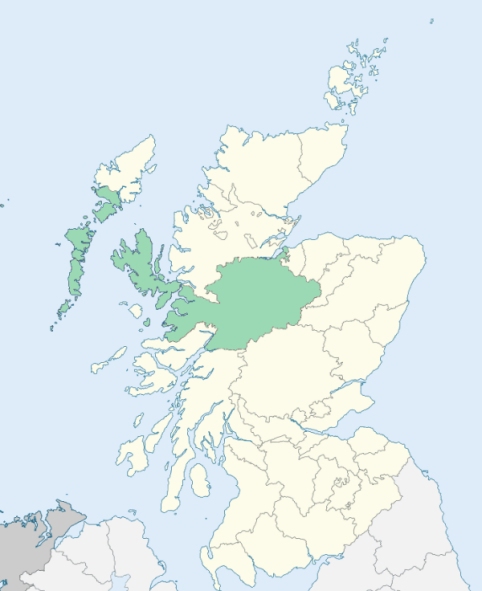
Kirkhill is a parish on the north border of Inverness-shire. It is bounded on the east and south by Inverness parish, on the west by Kiltarlity, and on the north by the Beauly River, and the Beauly Firth, which separate it from Kilmorack and from Ross-shire. (1867: The Imperial Gazetteer of Scotland, by John Marius Wilson).
Bunchrew, Dunballoch, Kirkhill, Kirkton
PRE-REFORMATION GOVERNANCE:
POST-REFORMATION GOVERNANCE:
At the union of Wardlaw and Farnua on 14 July 1618, the name Kirkhill was given to the parish.
Wardlaw. The original church of Wardlaw stood at Dunballoch. At the beginning of the thirteenth century it was transferred to a hillock then called Balabrach. The church is said to have been dedicated to St Muireach.
Fernua or Farnua. Fernua stood at Baile-na-h-Eaglais, or Kirkton. It was dedicated to Curadan or Queritinus who, in the early days of the Celtic Church, was Bishop and abbot of Rosemarkie. In Fernua stood also the cell of Bunchrew, whose hermits kept a register of local events, known as Scriptum Bunchriviae.
Includes ministers, licentiates, assistants, readers, and clerks.
Kirkhill (QO)
Fernua, or Farnua (QO)
(1928: Fasti Ecclesiæ Scoticanæ, by Hew Scott, D. D.)
Parish registers turned over to the Registrar-General, as a result of the Registration of Births, Deaths, and Marriages (Scotland) Act of 1854. The letters B. D. and M. indicate Births (or Baptisms), Deaths (or Burials), and Marriages (or Proclamations of Banns) respectively. Numbers indicate separate volumes or books. Note: These records are by no means complete or without damage; consult the Detailed List of the Old Parochial Registers of Scotland (1872) to learn more about the condition of the records.
| OPR and RD Numbers | |||
|---|---|---|---|
| Date Range | Name | Number | Type |
| 1663-1854 | Kirkhill | 103 | OPR |
| 1855-1970 | Kirkhill | 103 | RD |
| 1971-1971 | Knoydart | 103 | RD |
| 2009 | (Kirkhill) Highland, Inverness | 240 | RD |
| 2009 | (Knoydart) Highland, Mallaig and Knoydart | 238 | RD |
| 2026 | (Kirkhill) Highland Council, Kirkhill and Bunchrew Community Council | ||
| 2026 | (Knoydart) Highland Council, Mallaig Community Council | ||
(2009: Parishes and Registration Districts of Scotland - Old and New, National Records of Scotland)
Local community councils (2026) are provided as a potential source of additional information for settlements within the original boundaries of the parish. (Source)
Statistics from informal and official censuses
Cameron, Chisholm, Fraser, Grant, MacDonald, Mackenzie, MacLean, MacLennan, Munro, Ross
Note: Names appearing in research materials, other than censuses. Simple names (First name, surname only) have been omitted unless they appear associated with large properties. All women's names, and men's names with occupations, military ranks, or peerage titles are included.
By the Reverend Mr Alexander Fraser.
"By an exact survey made in the close of the year 1789, the examinable persons were 1190, of whom there were 489 males, 701 females. Under 9 years of age, not entered on the list, were 380, making for the number of souls 1571. The decrease of adult males is owing to their leaving the parish. Numbers of young men go to the south of Scotland, as handicraftsmen, or labourers: Several enlist in the army, and some go to the West Indies, while the women remain.
Frequently one man has three occupations; he manages his croft, works as a labourer in summer, or while the weather is good, and as a weaver, tailor, shoemaker, or carpenter in winter, or when the weather is bad. There may be of this description, labourers without a handicraft, 34; handicraftsmen, 77; male servants, 134; female servants 104; household servants are included. About 10 years ago cottagers were employed in agriculture, but now hired servants.
The people of this parish, in general, are sober and industrious, free from gross crimes, tractable and submissive. They, as well as the people of the neighbouring parishes, have made a greater progress in civilization within the last 50 years, than for several centuries before. This is owing, first, to the decline of the feudal system. Before the year 1745, that system had considerable influence."
(This section contains excerpts, at times restructured or paraphrased, from an article appearing in Statistical Account of Scotland, Sir John Sinclair, 1791-1799)
Primary Sources:
Statistical Account of Scotland (1791-1799), Volume 4, p. 111
New Statistical Account of Scotland (1834-1845), Volume 14, Section I, p. 459
See Parish Page Sources for all source information and links.