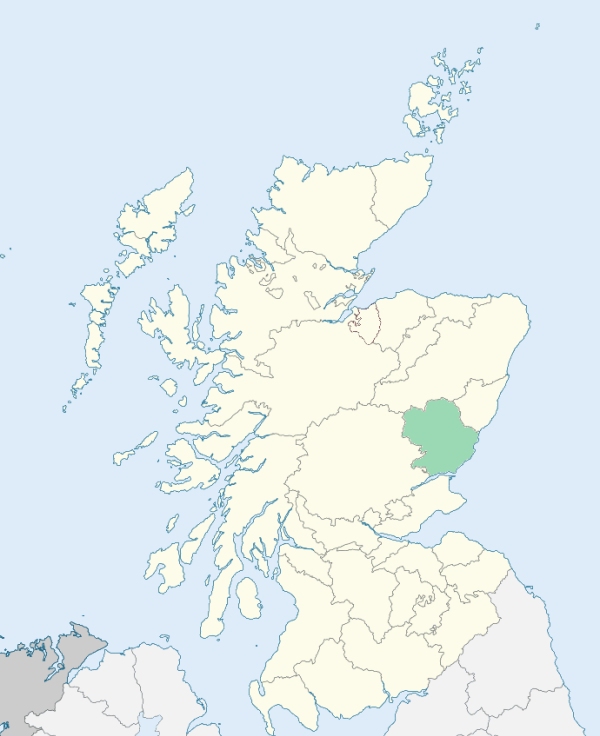
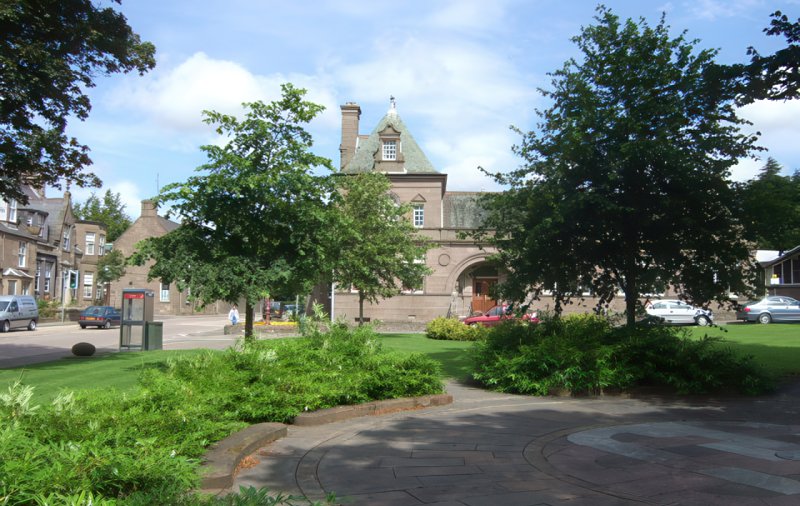
Brechin is a parish in the north-east of Forfarshire. It is bounded by the parishes of Menmuir, Stracathro, Dun, Farnell, Aberlemno, and Caraldston. (1867: The Imperial Gazetteer of Scotland, by John Marius Wilson).
Brechin, Craigend, Leightonhill, Little Brechin, Trinity, West Muir
PRE-REFORMATION GOVERNANCE:
POST-REFORMATION GOVERNANCE:
The parishes of Brechin and Kelimore were united in the sixteenth century.
Brechin. In eary times Brechin was the seat of a great Celtic Abbey. About 1150 David I appropriated its endowments, and founded with them the See of Brechin. The old dedication to the Holy Trinity was retained for both the parish church and the cathedral. Soon after the Reformation the cathedral was made the church of the parish. After the Reformation the church fell into ruin, and in 1807 the aisles were rebuilt. In 1900 a complete restoration was begun, and the church was opened for public worship on 23 April 1902. In 1267 there was built in Brechin the hospital or Maison Dieu of St Mary. There were in the parish chapels of St Michael and St Magdalene, and another chapel at Arrat. A fair was held at Brechin on Trinity Sunday.
Kelimore. The church of Kelimore, or Kilmoir, was dedicated to St Mary. This parish was a prebend of Brechin.
Disjoined Quoad Sacra Parishes:
East Parish. A chapel was built here in 1836. The East Parish was disjoined from Brechin on 6 July 1874.
Gardner Memorial. This church, erected in memory of Alexander Gardner, minister of the Second Charge, 1843-93, by his trustees and Mrs and Miss Agnes Milne of Mooranbank, Brechin, was dedicated 18 November 1898. The parish was endowed out of Mr Gardner's estate of Esbie, Dumfriesshire, by his trustees in memory of his son, and was disjoined by the Court of Teinds on 14 July 1899.
(1928: Fasti Ecclesiæ Scoticanæ, by Hew Scott, D. D.)
Includes ministers, licentiates, assistants, readers, and clerks.
Brechin and Kelimore (QO)
East Parish (QS)
Gardner Memorial (QS)
(1928: Fasti Ecclesiæ Scoticanæ, by Hew Scott, D. D.)
Parish registers turned over to the Registrar-General, as a result of the Registration of Births, Deaths, and Marriages (Scotland) Act of 1854. The letters B. D. and M. indicate Births (or Baptisms), Deaths (or Burials), and Marriages (or Proclamations of Banns) respectively. Numbers indicate separate volumes or books. Note: These records are by no means complete or without damage; consult the Detailed List of the Old Parochial Registers of Scotland (1872) to learn more about the condition of the records.
| OPR and RD Numbers | |||
|---|---|---|---|
| Date Range | Name | Number | Type |
| 1612-1854 | Brechin | 275 | OPR |
| 1855-1855 | Brechin Burgh | 275-1 | RD |
| 1855-1855 | Brechin Landward | 275-2 | RD |
| 1856-1965 | Brechin | 275 | RD |
| 1966-1968 | Brechin and Stracathro | 275 | RD |
| 1969-1971 | Brechin | 275 | RD |
| 1972-2004 | Brechin | 366 | RD |
| 2009 | Angus, Brechin | 366 | RD |
| 2026 | Angus Council; City of Brechin and District Community Council | ||
(2009: Parishes and Registration Districts of Scotland - Old and New, National Records of Scotland)
Local community councils (2026) are provided as a potential source of additional information for settlements within the original boundaries of the parish. (Source)
Statistics from informal and official censuses
Anderson, Bruce, Duncan, Milne, Mitchell, Scott, Smith, Stewart, Thomson, Young
Note: Names appearing in research materials, other than censuses. Simple names (First name, surname only) have been omitted unless they appear associated with large properties. All women's names, and men's names with occupations, military ranks, or peerage titles are included.
Drawn up from Materials communicated by the Reverend Mr Andrew Bruce, One of the Ministers of the Parish.
"The population of the town of Brechin at present (1790-1) cannot be estimated under 5000; in the country about 697; Episcopals in the town 188, Episcopals in the country 12; Seceders in the town 61, Seceders in the country 6.
The people, in general, are active and industrious, honest in their dealings, and by no means superstitious; but cannot be said to be altogether free from those vices, which generally accompany in influx of wealth from trade and manufactures. They are also occasionally infected with a spirit of litigation, and spend considerable sums at the law, often about mere trifles. In public spirit, they are inferior to none. They are, in general, of the ordinary stature, from 5 feet, to 5 feet 9 or 10 inches; some near 6 feet, and there is one man several inches above it.
No person has been known to die for want. Indeed, there is work enough for all who are able and willing to work, and those who are not able, are provided for. There have, therefore, been few or no instances of emigration; only a few left the parish, upon the failing of the cotton manufactory. None have been banished for a considerable time past. There are very few uninhabited houses. The language usually spoken is the common Scotch dialect, but most of the names of places are derived from the Gaelic."
(This section contains excerpts, at times restructured or paraphrased, from an article appearing in Statistical Account of Scotland, Sir John Sinclair, 1791-1799)
Primary Sources:
Statistical Account of Scotland (1791-1799), Volume 5, p. 457
New Statistical Account of Scotland (1834-1845), Volume 11, Section I, p. 129
See Parish Page Sources for all source information and links.