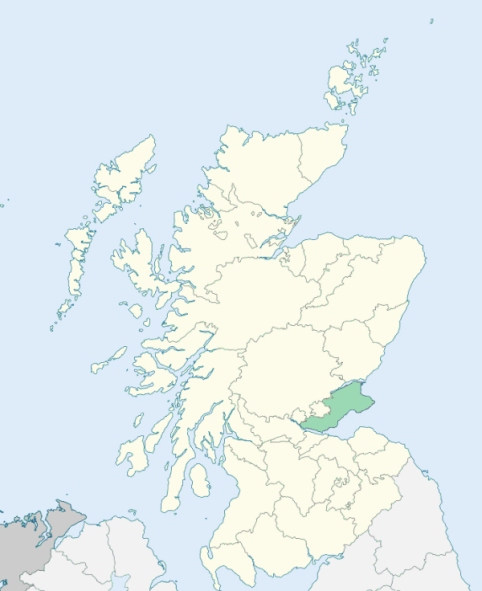
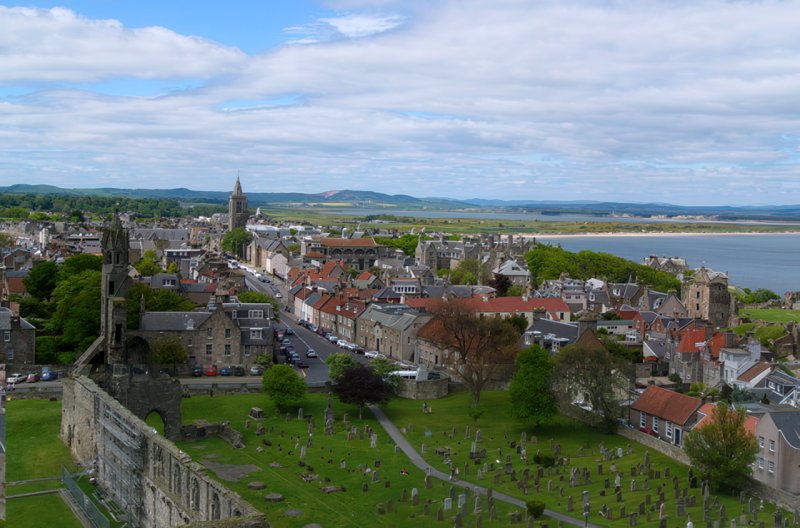
St Andrews is a parish on the east coast of Fife. It is bounded on the north by the Eden River and its estuary, which separate it from Leuchars parish, on the north-east by the German Ocean (North Sea), on the south-east by the Kenly Burn, which separates it from Kingsbarns and Dunino parishes, and on the south and west by the parishes of Dunino, Cameron, Ceres, and Kemback. (1867: The Imperial Gazetteer of Scotland, by John Marius Wilson).
Balone, Boarhills, Brownhills, Denhead, Grange, Kincaple, St Andrews, Strathkinness
Balmungo, Clatto, Denbrae, Kincaple, Kingask, Kinkell
The parish of St Leonards consisted of four separate parts. The largest in area was situated at the south end of St Andrews parish at Kenly, and was treated as the main part of the parish. The parts marked St Leonards detached No. 1 and St Leonards detached No. 2 were situated within the burgh of St Andrews, the latter being at the site of the old College of St Leonards. St Leonards detached No 3 was situated at Rathelpie, at the west of the burgh. A new parish of St Leonards was formed. The result is that the Kenly district, the Rathelpie district, and a small portion of St Leonards detached No 2 have been transferred to St Andrews in exchange for the part of St Andrews embraced within the new boundary of St Leonards parish. St Leonards parish is now situated wholly within the burgh of St Andrews, and the subjects composing the two parishes, in so far as within burgh, can be readily ascertained, the boundary between them being now clearly defined. See affected properties and landholders. (1892: Boundary of counties and parishes in Scotland as settled by the Boundary Commissioners under the Local Government Act, 1889, by Hay Shennan)
PRE-REFORMATION GOVERNANCE:
POST-REFORMATION GOVERNANCE:
St Andrews. The site of St Andrews was an early home of the Celtic Church. At Mucross, as it was then called, St Kenneth of Achabo carried on mission work in the sixth century. There either he, or someone before him, founded the Christian settlement to which the name of Kilrimont was given. The relics of St Andrew were brought to Kilrimont from Hexham in Northumberland, at the instance of King Angus MacFergus, in or about 736. Not long after, there arose the church called Kilrule, of which St Rule's Chapel is the standing successor. Of the later Celtic Church the chief memorial is St Mary's on the Kirk Heugh. St Mary's was endowed as Chapel Royal by Alexander II in 1250. In 1504 it received a collegiate endowment. At an early time a parish church was built in St Andrews, and dedicated to the Holy Trinity. That church belonged to the Priory of St Andrews. Eminent among the many religious foundations of St Andrews is the College of St Salvator. This addition to the resources of the ancient University was erected by Bishop James Kennedy in 1450. During the early years of the Reformed Church, the General Assembly held several sessions at St Andrews. Of these the first was in 1572. In 1274 St Mary's Convent of the Black Friars was founded at St Andrews. In 1450 the Grey Friars also established a priory in the city. The chief monastic feature was the Augustinian Priory of St Andrews, founded in 1114. The Cathedral was built close beside it in 1162. There were three great fairs in St Andrews, those of Our Lady Day in Lentron, and St Andrew's Day, and the Senzie Market, held during the summer session of the University.
St Leonards. In medieval times great numbers of pilgrims thronged to St Andrews to visit the shrines and relics of the saints. In or about 1140, a hospital for the benefit of such pilgrims was founded in that city, and was dedicated to St Leonard, a famous patron of hospitals. Out of the hospital endowment an additional parish was provided for the Cathedral city. The new church was built beside the hospital, and like it, was dedicated to St Leonard. Earliest records tell of it as in full working in 1413. As time went on, the hospital was found to be of little practical use. In 1512 St Leonard's Hospital was converted into a college of St Andrews University. From the Reformation up till 1824 the Principal of St Leonard's College was also minister of this parish. In 1759, the church being ruinous, the Presbytery ordered the minister and congregation to assemble for worship in St Salvator's Chapel. In 1844 St Salvator's Chapel was disjoined from the parish of St Andrews. A new parish church was dedicated on 28 July 1904.
Disjoined Quoad Sacra Parishes:
Boarhills. Boarhills chapel dates back to the ninth century or the tenth. When the church was built in 1865 it is said that remains of a Culdee chapel were found. From about 1840 onwards services were conducted in Boarhills school. The foundation stone of the present church was laid on 23 May 1866, and on 20 March 1903 the parish of Boarhills was disjoined from St Andrews and St Leonards.
Strathkinness. The parish of Strathkinness was disjoined from St Andrews on 18 July 1860.
(1928: Fasti Ecclesiæ Scoticanæ, by Hew Scott, D. D.)
Includes ministers, licentiates, assistants, readers, and clerks.
St Andrews (QO)
St Leonard's (QO)
Boarhills (QO)
Strathkinness (QO)
(1928: Fasti Ecclesiæ Scoticanæ, by Hew Scott, D. D.)
Parish registers turned over to the Registrar-General, as a result of the Registration of Births, Deaths, and Marriages (Scotland) Act of 1854. The letters B. D. and M. indicate Births (or Baptisms), Deaths (or Burials), and Marriages (or Proclamations of Banns) respectively. Numbers indicate separate volumes or books. Note: These records are by no means complete or without damage; consult the Detailed List of the Old Parochial Registers of Scotland (1872) to learn more about the condition of the records.
| OPR and RD Numbers | |||
|---|---|---|---|
| Date Range | Name | Number | Type |
| 1627-1854 | St Andrews and St Leonards | 453 | OPR |
| 1855-1855 | St Andrews Burgh | 453-1 | RD |
| 1855-1855 | St Andrews Landward | 453-2 | RD |
| 1855-1855 | St Leonards | 453-3 | RD |
| 1856-1967 | St Andrews and St Leonards | 453 | RD |
| 1968-1971 | St Andrews | 453 | RD |
| 1972-2007 | St Andrews | 413 | RD |
| 2009 | Fife, St Andrews | 413 | RD |
| 2026 | Fife Council; Royal Burgh of St Andrews Community Council Boarhills and Dunino Community Council | ||
(2009: Parishes and Registration Districts of Scotland - Old and New, National Records of Scotland)
Local community councils (2026) are provided as a potential source of additional information for settlements within the original boundaries of the parish. (Source)
Statistics from informal and official censuses
St Andrews: Anderson, Brown, Cunningham, Duncan, Mitchell, Robertson, Scott, Smith, Thomson, Wilson
St Leonards: Anderson, Brown, Duncan, Grieve, Melville, Mitchell, Ritchie, Robertson, Thomson, Wilson
Note: Names appearing in research materials, other than censuses. Simple names (First name, surname only) have been omitted unless they appear associated with large properties. All women's names, and men's names with occupations, military ranks, or peerage titles are included.
By the Reverend Mr John Adamson, D. D., first Minister of St Andrew's.
"The number of souls in the town and royalty is 2390; in the suburbs 129, in the country, 1431, total 3950. The number of artificers in the parish, masters and freeman, is nearly as follows: 21 smiths, including 1 watchmaker, 2 tinmen, 2 workers in brass, and 3 glovers, incorporated with the smith; 50 wrights, carpenters, and masons, 19 bakers, 19 fleshers, 23 tailors, 34 shoemakers, 52 weavers, and 1 saddler. Besides the professor of medicine in the university, there are in St Andrew's 2 regular physicians; all the three practice in midwifery and surgery, as occasion offers; one apothecary, who is also a practitioner in physic. Several shopkeepers vend a few of the more common medicines; 5 writers, or attorneys, 2 messengers at arms.
Several vessels have within these 2 years been built at this port, which are employed by the inhabitants in the wood and coasting trades. In the spring of 1792 a factory for sewing and tambouring muslin was established; in a few months, they collected between 3 and 4 score apprentices, girls from 5 to 14 years of age. But the chief support of this city is the University, and the conflux of strangers, who here find excellent teachers in all different branches.
There are no known instances of people dying here for want, nor of murder, nor of suicide, excepting the case of one man who hanged himself about fourscore years ago; his body was dissected, and his skeleton remains in the university library. No emigration from this parish; and though, as in every other town, a few houses may be occasionally unoccupied, yet in general there is a demand, and the building of new houses is found a profitable application of money. The greatest number of students at the university in any one year, 179. Several places, between 3 and 4 miles east from St Andrew's may be reckoned villages: in these besides farmers and cottagers, you find alehouses, blacksmiths, wrights, weavers, tailors, and shoemakers."
(This section contains excerpts, at times restructured or paraphrased, from an article appearing in Statistical Account of Scotland, Sir John Sinclair, 1791-1799)
Primary Sources:
Statistical Account of Scotland (1791-1799), Volume 13, p. 185
New Statistical Account of Scotland (1834-1845), Volume 9, Section I, p. 449
See Parish Page Sources for all source information and links.