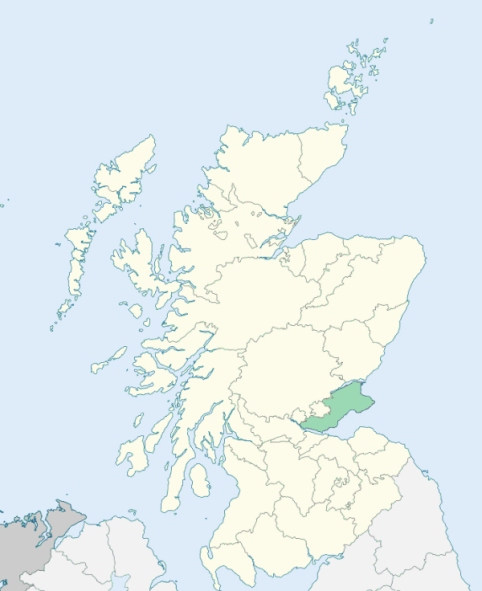
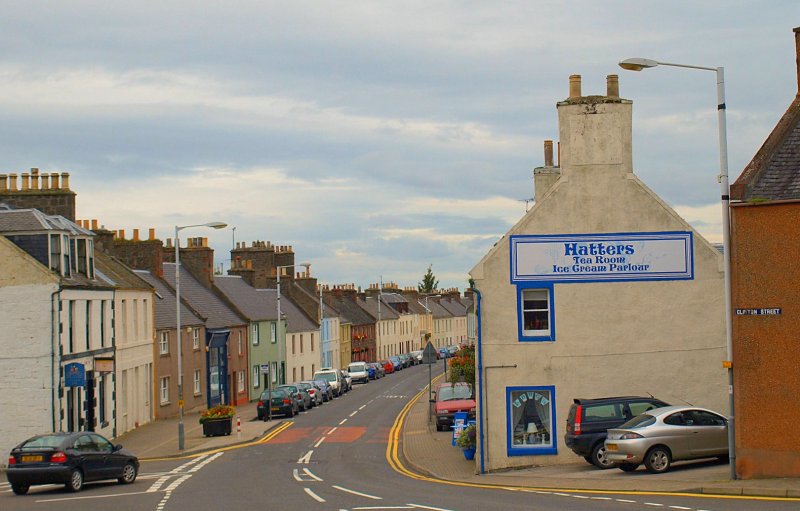
Newburgh is a parish in the extreme north-west of Fife. It is bounded by the River Tay, and by Abdie, Collessie, Auchtermuchty, and Abernethy. (1867: The Imperial Gazetteer of Scotland, by John Marius Wilson).
Burnside, Clevitch, Easter Colzie, Easer Lumbenny, Lochmill, Newburgh, Wester Lumbenny, Whinnybank, Woodriffe
Mugdrum, Pitcairlie
(1) The parish of Abdie had two detached parts. The first, containing 1889 acres, lay to the east of the main portion of the parish, being bounded on the south by the parish of Dunbog. The second, containing 448 acres, lay to the west on the borders of the county, and adjoined the parish of Newburgh. The first detached part (Abdie detached No. 1) was annexed to Dunbog, and the second (Abdie detached No. 2) to Newburgh. See affected properties and landholders. (1892: Boundary of counties and parishes in Scotland as settled by the Boundary Commissioners under the Local Government Act, 1889, by Hay Shennan)
(2) Whereas the parish of Abernethy is situated partly in the county of Fife and partly in the county of Perth, the parts in the county of Fife adjoining the parishes of Newburgh and Strathmiglo:
I. So much of the parish of Abernethy as lies to the east and south of the east march of the farms and lands of Pitmedden shall cease to be part of the parish of Abernethy, and shall form part of the parish of Newburgh and of the county of Fife.
II. So much of the parish of Abernethy as lies to the east of the west march of the lands of Nochnarrie, and so much of the said parish as lies to the east of the west march of the lands of Pitlour shall cease to be part of the parish of Abernethy, and shall form part of the parish of Strathmiglo and of the county of Fife.
III. The remainder of the parish of Abernethy shall be included in and shall form part of the county of Perth.
See affected properties and landholders. (1892: Boundary of counties and parishes in Scotland as settled by the Boundary Commissioners under the Local Government Act, 1889, by Hay Shennan)
PRE-REFORMATION GOVERNANCE:
POST-REFORMATION GOVERNANCE:
The district now forming this parish was previously part of Abdie, and was ministered to by a chapel of St Katherine. In 1632 the parish of Newburgh was disjoined and erected. A fair of St Katherine was held in Newburgh, and also a Lammas fair. St Andrew's Tironensian Abbey of Lindores was founded here in 1178 by David, Earl of Huntingdon, brother of Malcolm IV and of William the Lion. (1928: Fasti Ecclesiæ Scoticanæ, by Hew Scott, D. D.)
Includes ministers, licentiates, assistants, readers, and clerks.
(1928: Fasti Ecclesiæ Scoticanæ, by Hew Scott, D. D.)
Parish registers turned over to the Registrar-General, as a result of the Registration of Births, Deaths, and Marriages (Scotland) Act of 1854. The letters B. D. and M. indicate Births (or Baptisms), Deaths (or Burials), and Marriages (or Proclamations of Banns) respectively. Numbers indicate separate volumes or books. Note: These records are by no means complete or without damage; consult the Detailed List of the Old Parochial Registers of Scotland (1872) to learn more about the condition of the records.
| OPR and RD Numbers | |||
|---|---|---|---|
| Date Range | Name | Number | Type |
| 1654-1854 | Newburgh | 450 | OPR |
| 1855-1855 | Newburgh Burgh | 450-1 | RD |
| 1855-1855 | Newburgh Landward | 450-2 | RD |
| 1856-1931 | Newburgh | 450 | RD |
| 1932-1967 | Newburgh and Abdie | 450 | RD |
| 1968-1971 | Newburgh | 450 | RD |
| 1972-2008 | Newburgh | 416 | RD |
| 2009 | Fife, Newburgh | 416 | RD |
| 2026 | Fife Council; Newburgh Community Council | ||
(2009: Parishes and Registration Districts of Scotland - Old and New, National Records of Scotland)
Local community councils (2026) are provided as a potential source of additional information for settlements within the original boundaries of the parish. (Source)
Statistics from informal and official censuses
Blyth, Clark, Fotheringham, Lawson, Melville, Nairn, Robertson, Ross, Wilkie, Wilson
Note: Names appearing in research materials, other than censuses. Simple names (First name, surname only) have been omitted unless they appear associated with large properties. All women's names, and men's names with occupations, military ranks, or peerage titles are included.
By the Reverend Mr Thomas Stuart.
"From the report of one, who, during the indisposition of the writer, was employed to ascertain the number of parishioners, it appears, that the parish, at large, contains 1664 souls, of whom 1552 belong to the town, suburbs, and shore of Newburgh, and 112 to the country part of the parish. The inhabitants of the town, suburbs and shore, consist of 772 males, and 780 females. Of the inhabitants in the country, 64 are males, and 48 females.
The town of Newburgh, consists of one street of considerable length, with small suburbs at each end, and a lane leading towards the shore from its centre. The houses, on each side of the lane, and in the suburbs, have been built within these 30 years. The town itself, does not occupy more ground than it did in the end of last century; but, in consequence of alterations, that have since been made upon the buildings, it must be capable of containing double the number of inhabitants.
The trade which occupies the greatest number of hands, is that of weaving cloth. Now fewer than 270 of the inhabitants, are at present employed in it. The weavers of Newburgh, however, do not yet abide constantly by the loom. Accustomed from their early years, to handle the oar, as well as the shuttle, they betake themselves, in considerable numbers, to a sea-faring life, when the price of these kinds of cloth, which they are in the practice of weaving, falls low in the market.
In a provincial town, inhabited chiefly by sailors and weavers, possessed of small properties, and nearly on a level with respect to riches, one does not look for polished manners, and the courtly attentions practiced in great cities. The bulk of the inhabitants undoubtedly merit the praise of sobriety and industry; and instances of persons are not wanting, who, by signal propriety, in their own deportment, furnish a daily rebuke to the unprincipled and idle; and, by superior attention to the education of their children, take the surest method of producing a thorough reformation on the manners of the people. No person belonging to the parish of Newburgh, has suffered the punishment of death for any crime, within the period to which its records extend. In times of peace, Perth receives its most expert sailors from this district; whilst, in time of war, Newburgh supplies the Navy of Great Britain, with steady, well behaved, and gallant men."
(This section contains excerpts, at times restructured or paraphrased, from an article appearing in Statistical Account of Scotland, Sir John Sinclair, 1791-1799)
Primary Sources:
Statistical Account of Scotland (1791-1799), Volume 8, p. 170
New Statistical Account of Scotland (1834-1845), Volume 9, Section I, p. 56
See Parish Page Sources for all source information and links.