Kirkpatrick-Fleming, Kirkconnel, and Irving
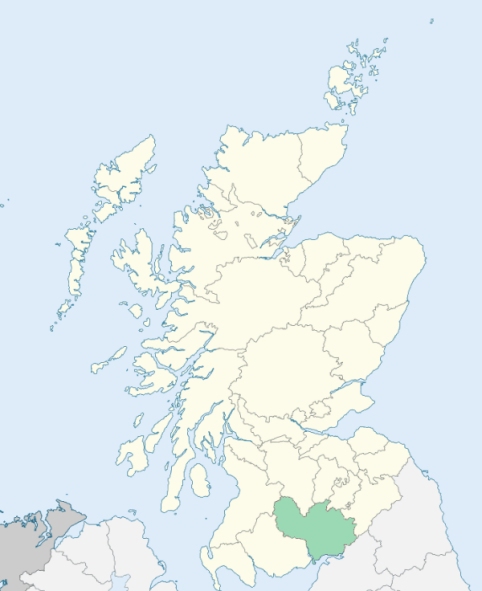
Kirkpatrick-Fleming is a parish in the southeast of Dumfriesshire. It is bounded by Middlebie, Half-Morton, Gretna, Dornoch, and Annan. (1867: The Imperial Gazetteer of Scotland, by John Marius Wilson).
Burnfoot, Hollee, Kirkpatrick-Fleming, Moorend, Newton, Springkell
Cove, Langshaw, Springkell, Wyseby
The parish of Dornock had a detached part situated to the north of the main portion of the parish, and separated from it by an intervening portion of the parish of Kirkpatrick-Fleming. This intervening portion has been transferred to the parish of Dornock, and the main portion of Dornock has thus been united with its detached part. See affected properties and landholders. (1892: Boundary of counties and parishes in Scotland as settled by the Boundary Commissioners under the Local Government Act, 1889, by Hay Shennan)
PRE-REFORMATION GOVERNANCE:
POST-REFORMATION GOVERNANCE:
The parishes of Kirkpatrick-Fleming, Kirkconnel, and Irving were united in 1609.
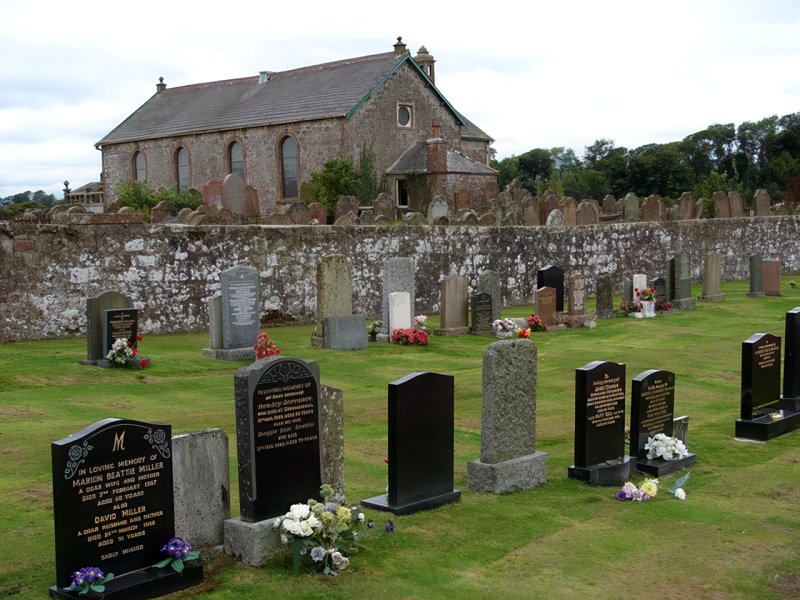
Kirkpatrick-Fleming. The church was dedicated to St Patrick. The name Fleming was given to the parish from the family of Fleming of Redhall, to which most part or the land here long pertained. There was a chapel at Logan, and there was also in the parish a Well of St Helen.
Kirkconnel. United to Kirkpatrick-Fleming, 24 June 1609. The church was dedicated to St Conal.
Irving. This parish was united to Kirkpatrick-Fleming and Kirkconnel in 1609.
Includes ministers, licentiates, assistants, readers, and clerks.
(1928: Fasti Ecclesiæ Scoticanæ, by Hew Scott, D. D.)
Parish registers turned over to the Registrar-General, as a result of the Registration of Births, Deaths, and Marriages (Scotland) Act of 1854. The letters B. D. and M. indicate Births (or Baptisms), Deaths (or Burials), and Marriages (or Proclamations of Banns) respectively. Numbers indicate separate volumes or books. Note: These records are by no means complete or without damage; consult the Detailed List of the Old Parochial Registers of Scotland (1872) to learn more about the condition of the records.
| OPR and RD Numbers | |||
|---|---|---|---|
| Date Range | Name | Number | Type |
| 1748-1854 | Kirkpatrick Fleming | 837 | OPR |
| 1855-1865 | Kirkpatrick Fleming | 837 | RD |
| 1866-1932 | Kirkpatrick Fleming, Northern District | 837-1 | RD |
| 1866-1932 | Kirkpatrick Fleming, Southern District | 837-2 | RD |
| 1833-1968 | Kirkpatrick Fleming | 837 | RD |
| 2009 | Dumfries and Galloway, Gretna | 840 | RD |
| 2026 | Dumfries & Galloway Council; Kirkpatrick Fleming and District Community Council | ||
(2009: Parishes and Registration Districts of Scotland - Old and New, National Records of Scotland)
Local community councils (2026) are provided as a potential source of additional information for settlements within the original boundaries of the parish. (Source)
Statistics from informal and official censuses
Beattie, Bell, Carruthers, Davidson, Gordon, Graham, Irving, Johnston, Smith, Thomson
Note: Names appearing in research materials, other than censuses. Simple names (First name, surname only) have been omitted unless they appear associated with large properties. All women's names, and men's names with occupations, military ranks, or peerage titles are included.
By the Reverend Mr Alexander Monilaws.
"According to Dr Webster's report (1755), the number of souls then was 1147. The following is the present state of population as taken in September last (1792), with every degree of accuracy. There were 1542 souls, of whom 720 were males and 822 were females. There were 369 under 10 years of age, and 319 families. There were 1480 members of the Established Church, 52 Seceders, and 10 Episcopalians.
There were 1 surgeon, 2 schoolmasters, 102 farmers, 9 shopkeepers, 6 smiths, 21 masons, 18 carpenters, 36 weavers, 7 shoemakers, 11 tailors, 2 millers, 2 bakers, 3 gardeners, 68 male farm-servants, 15 female farm-servants, 9 male domestic servants, 15 female domestic servants, and 2 cloggers.
The people in this district are, upon the whole, virtuous, intelligent, sober, active, industrious, regular in their attendance upon public worship, and deservedly marked for their moderation and liberality of sentiment in religious matters. Comparatively few instances of fraud and dishonesty occur to require the interposition of the civil judge. They are kind and hospitable to strangers; benevolent without ostentation; and, when occasion requires, ready to relieve the wretched. Enjoying all of them the necessaries, and many of them, in a considerable degree, the conveniences of life, though ambitious of improving, they seem in general contented and happy in their present situation."
(This section contains excerpts, at times restructured or paraphrased, from an article appearing in Statistical Account of Scotland, Sir John Sinclair, 1791-1799)
Primary Sources:
Statistical Account of Scotland (1791-1799), Volume 13, p. 248
New Statistical Account of Scotland (1834-1845), Volume 4, Section I, p. 274
See Parish Page Sources for all source information and links.