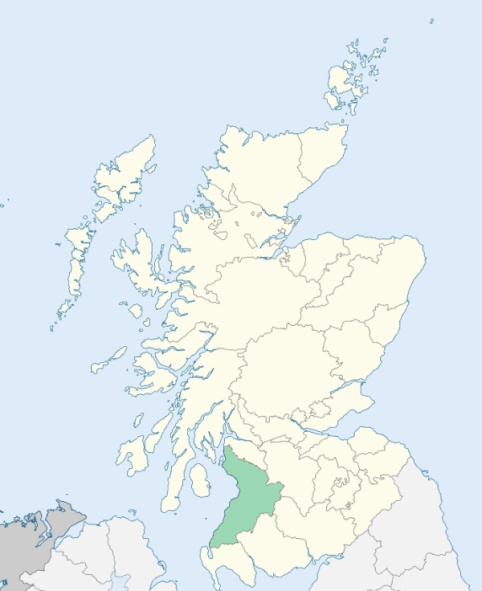
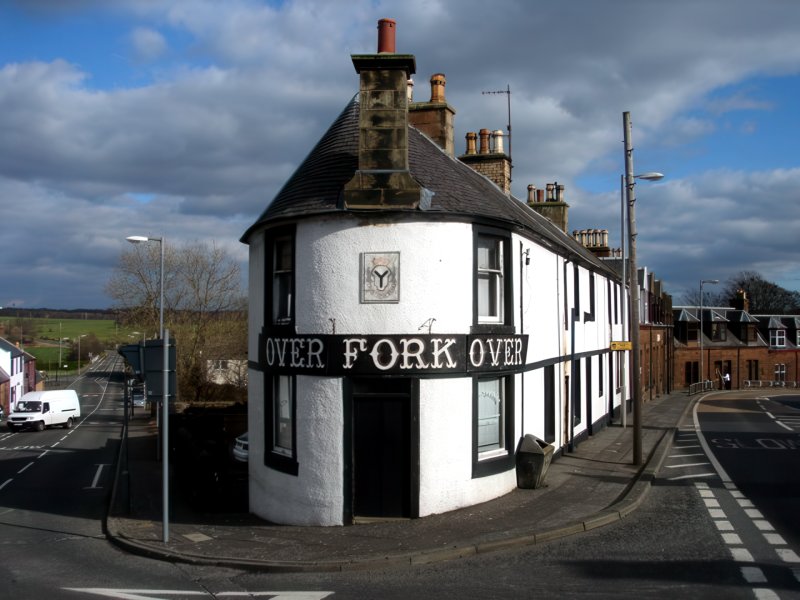
Ochiltree is a parish nearly in the centre of Kyle, and of Ayrshire. It is bounded by Stair, Auchinleck, Old Cumnock, New Cumnock, Dalmellington, and Coylton. 1867: The Imperial Gazetteer of Scotland, by John Marius Wilson).
Ochiltree, Sinclairston
The parish of Stair had two detached parts, one (Stair detached No. 1) wholly surrounded by the parish of Ochiltree, and the other (Stair detached No. 2) adjoining that parish and the parish of Coylton. An exchange of territory was effected between the parishes of Stair and Ochiltree, whereby the divided condition of Stair is done away with, both parishes being now self-contained: (a) Stair detached No. 2 was transferred to the parish of Ochiltree, and (b) the portion of Ochiltree parish described in the Clause I. of the Order was transferred to Stair, and thereby Stair detached No. 1 was united with the main portion of Stair parish. See affected properties and landholders. (1892: Boundary of counties and parishes in Scotland as settled by the Boundary Commissioners under the Local Government Act, 1889, by Hay Shennan)
PRE-REFORMATION GOVERNANCE:
POST-REFORMATION GOVERNANCE:
The vicarage of Ochiltree belonged to the Abbey of Melrose. Its church was dedicated to St Conal, and contained an altar of St Mary. In 1789 the Parish Church was rebuilt.
Includes ministers, licentiates, assistants, readers, and clerks.
(1928: Fasti Ecclesiæ Scoticanæ, by Hew Scott, D. D.)
Parish registers turned over to the Registrar-General, as a result of the Registration of Births, Deaths, and Marriages (Scotland) Act of 1854. The letters B. D. and M. indicate Births (or Baptisms), Deaths (or Burials), and Marriages (or Proclamations of Banns) respectively. Numbers indicate separate volumes or books. Note: These records are by no means complete or without damage; consult the Detailed List of the Old Parochial Registers of Scotland (1872) to learn more about the condition of the records.
| OPR and RD Numbers | |||
|---|---|---|---|
| Date Range | Name | Number | Type |
| 1641-1854 | Ochiltree | 609 | OPR |
| 1855-1957 | Ochiltree | 609 | RD |
| 1958-1968 | Ochiltree | 609-1 | RD |
| 1958-1968 | Drongan | 609-2 | RD |
| 1970-1971 | Newmilns | 609 | RD |
| 2009 | (Ochiltree) East Ayrshire, Old Cumnock | 682 | RD |
| 2009 | (Drongan) East Ayshire, Ayr | 680 | RD |
| 2009 | (Newmilns) East Ayrshire, Galston, Darvel and Newmilns | 670 | RD |
| 2026 | (Ochiltree) East Ayrshire Council; Ochiltree Community Council | ||
| 2026 | (Drongan) East Ayrshire Council; Drongan, Rankinston and Stair Community Council | ||
| 2026 | (Newmilns) East Ayrshire Council; Newmilns and Greenholm Community Council | ||
(2009: Parishes and Registration Districts of Scotland - Old and New, National Records of Scotland)
Local community councils (2026) are provided as a potential source of additional information for settlements within the original boundaries of the parish. (Source)
Statistics from informal and official censuses
Brown, Clement, Gilmour, Millar, Murdoch, Sloan, Smith, Wallace, Wilson, Wyllie
Note: Names appearing in research materials, other than censuses. Simple names (First name, surname only) have been omitted unless they appear associated with large properties. All women's names, and men's names with occupations, military ranks, or peerage titles are included.
By the Reverend Mr William Thomson.
"The number of inhabitants, according to a list taken this year (1792), amounts to 1150. There are about 220 families in the parish, and 67 of these in the village. There are about 9 families of Seceders, some of the Burgher, and some of the Antiburgher persuasion. All the rest attend the parish church, and are regular in their attendance on ordinances.
The inhabitants in general are remarkable for the simplicity, integrity, and purity of their manners. Except a few shopkeepers, masons, joiners, and weavers, chiefly in the village, they are all farmers, who are not much in the world, and for the most part dwell in solitary houses, at some distance from each other. The children of the farmers are pretty numerous, four neighbouring farmers have two of them 8, and two of them 9 children apiece."
(This section contains excerpts, at times restructured or paraphrased, from an article appearing in Statistical Account of Scotland, Sir John Sinclair, 1791-1799)
Primary Sources:
Statistical Account of Scotland (1791-1799), Volume 5, p. 446
New Statistical Account of Scotland (1834-1845), Volume 5, Section I, p. 105
See Parish Page Sources for all source information and links.