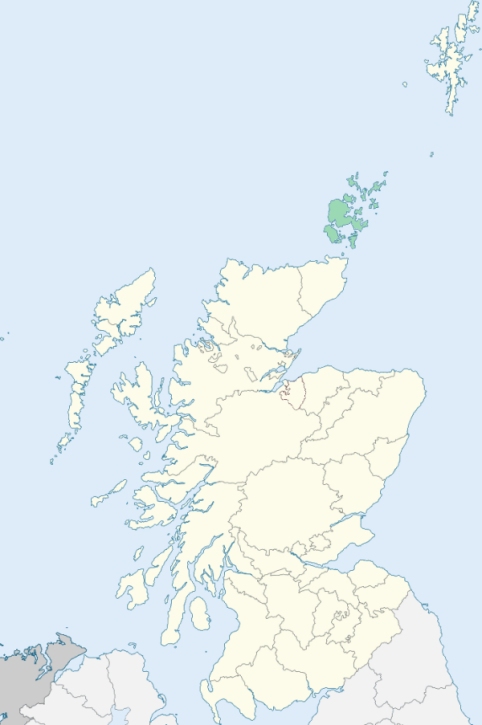
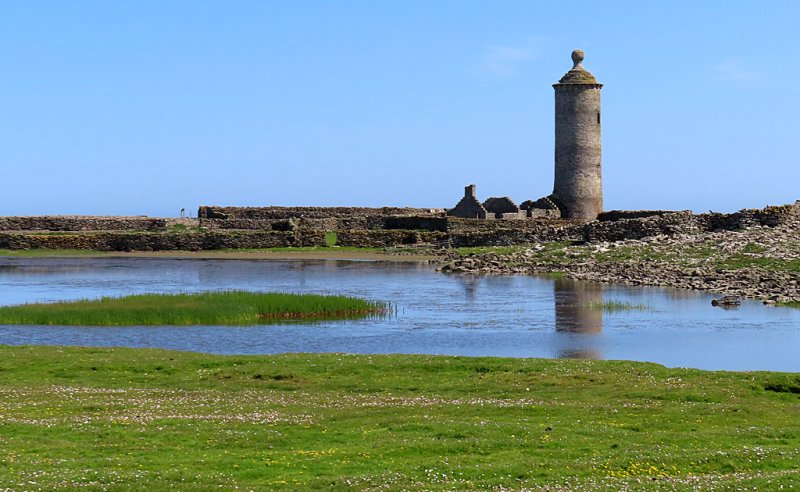
North Ronaldsay is an island and a parish in Orkney. It is the most northerly of the North Isles of Orkney, lying 2½ miles north of Sanday, and 15 miles east of Papa Westray. It is divided from Sanday by North Ronaldsay Firth. (1892-6: Ordnance Gazetteer of Scotland, by Francis H. Groome)
Ancumtoun, Bustatoun, Hollandstoun, Nesstoun
PRE-REFORMATION GOVERNANCE:
POST-REFORMATION GOVERNANCE:
The church of Ringansay was dedicated to St Ninian. In the sixteenth century the three parishes of Ringansay, Cross and Burness were united. In 1830 a parliamentary chapel was built on Ringansay. The parish was severed quoad sacra from Cross and Burness on 2 June 1847. Within the bounds there was a chapel of St Bride.
Includes ministers, licentiates, assistants, readers, and clerks.
(1928: Fasti Ecclesiæ Scoticanæ, by Hew Scott, D. D.)
Parish registers turned over to the Registrar-General, as a result of the Registration of Births, Deaths, and Marriages (Scotland) Act of 1854. The letters B. D. and M. indicate Births (or Baptisms), Deaths (or Burials), and Marriages (or Proclamations of Banns) respectively. Numbers indicate separate volumes or books. Note: These records are by no means complete or without damage; consult the Detailed List of the Old Parochial Registers of Scotland (1872) to learn more about the condition of the records.
| OPR and RD Numbers | |||
|---|---|---|---|
| Date Range | Name | Number | Type |
| 1800-1854 | North Ronaldsay | 22 | OPR |
| 1855-1971 | North Ronaldsay | 22 | RD |
| 1972-2003 | North Ronaldsay | 103 | RD |
| 2009 | Orkney Islands, North Ronaldsay | 130 | RD |
| 2026 | Orkney Islands Council; North Ronaldsay Community Council | ||
(2009: Parishes and Registration Districts of Scotland - Old and New, National Records of Scotland)
Local community councils (2026) are provided as a potential source of additional information for settlements within the original boundaries of the parish. (Source)
Statistics from informal and official censuses
Note: Names appearing in research materials, other than censuses. Simple names (First name, surname only) have been omitted unless they appear associated with large properties. All women's names, and men's names with occupations, military ranks, or peerage titles are included.
By the Reverend Mr William Clouston.
"The people of these islands can undergo great labour and fatigue, although they are not remarkable for strength or size. It is thought they have a more florid complexion than those of the other Orkney islands, by reason of their not having fire in such plenty, and that by this they can be easily distinguished. The people, in so far as can be judged, are not remarkable for any personal or mental qualifications, but are not deficient in natural parts and sagacity. There are some few that are indolently inclined, and plead inability for hard labour; but the generality of the people are industrious, or at least laborious, as may be presumed from this circumstance, that there is no place in the county where a greater quantity of grain is raised, or kelp made, by an equal number of people. There is no manufacture carried on in these islands, unless kelp may be reckoned one. They manufacture linen and coarse cloths for their own use only."
(This section contains excerpts, at times restructured or paraphrased, from an article appearing in Statistical Account of Scotland, Sir John Sinclair, 1791-1799)
Primary Sources:
Statistical Account of Scotland (1791-1799), Volume 7, p. 450
New Statistical Account of Scotland (1834-1845), Volume 15, Section III, p. 85
See Parish Page Sources for all source information and links.