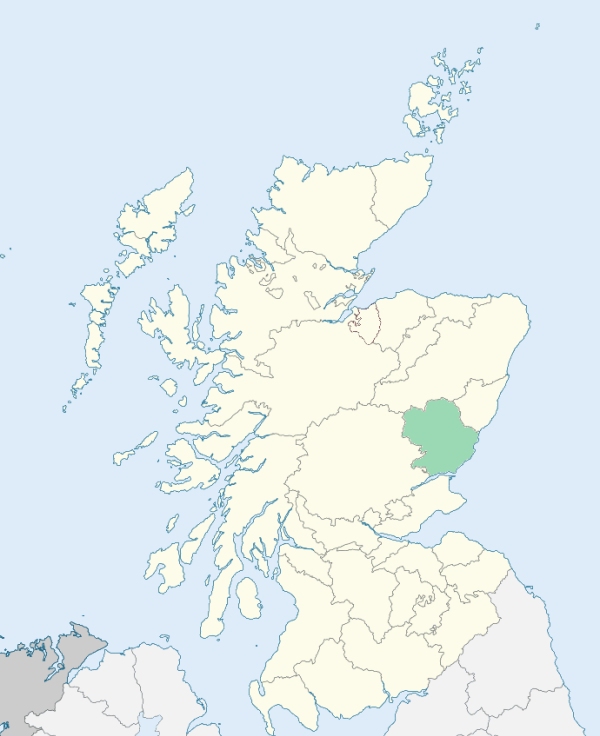
Logie-Pert is a parish on the north-east border of Forfarshire. It is bounded by Kincardineshire, and by the parishes of Montrose, Dun, and Strickathrow. (1867: The Imperial Gazetteer of Scotland, by John Marius Wilson).
Craigo, Logie or Logie-Pert, Muirside, Upper Gallery
Gallery
PRE-REFORMATION GOVERNANCE:
POST-REFORMATION GOVERNANCE:
The parishes of Logie and Pert were united in or about 1612.
Logie. The old church of Logie (restored in 1857) was dedicated to St Martin. Near it are St Martin's Well and St Martin's Den.
Pert, or Over Inchbrayock. An Act of Parliament for building a central church was passed 12 March 1647, and ratified 4 July 1661. The church was rebuilt in 1775 and 1841.
Includes ministers, licentiates, assistants, readers, and clerks.
Logie-Pert (QO)
Pert (QO)
(1928: Fasti Ecclesiæ Scoticanæ, by Hew Scott, D. D.)
Parish registers turned over to the Registrar-General, as a result of the Registration of Births, Deaths, and Marriages (Scotland) Act of 1854. The letters B. D. and M. indicate Births (or Baptisms), Deaths (or Burials), and Marriages (or Proclamations of Banns) respectively. Numbers indicate separate volumes or books. Note: These records are by no means complete or without damage; consult the Detailed List of the Old Parochial Registers of Scotland (1872) to learn more about the condition of the records.
| OPR and RD Numbers | |||
|---|---|---|---|
| Date Range | Name | Number | Type |
| 1717-1854 | Logie Pert | 304 | OPR |
| 1855-1963 | Logie Pert | 304 | RD |
| 2009 | Angus, Montrose | 367 | RD |
| 2026 | Angus Council; Hilside, Dun and Logie Pert Community Council | ||
(2009: Parishes and Registration Districts of Scotland - Old and New, National Records of Scotland)
Local community councils (2026) are provided as a potential source of additional information for settlements within the original boundaries of the parish. (Source)
Statistics from informal and official censuses
Alexander, Beattie, Brown, Clark, Donald, Duncan, Johnston, Ritchie, Smith, Stewart
Note: Names appearing in research materials, other than censuses. Simple names (First name, surname only) have been omitted unless they appear associated with large properties. All women's names, and men's names with occupations, military ranks, or peerage titles are included.
By the Reverend Mr Alexander Peter.
"The amount of the population in the month of February this year (1791) was about 999 individuals, of whom 469 were males, 530 females. None reside in towns, one family excepted, who generally reside for some months during the winter season in Montrose. There are only two places in the parish, which, with any sort of propriety, can be called villages, viz. North Water Bridge, and Mains of Craigo, the one containing only about 70 individuals, and the other about 60. All our people are of the Established Church, except 2 or 3 Seceders, 8 or 10 Episcopalians, and about half a dozen of persons, who call themselves Bereans; no Roman Catholics.
The number of farmers having families, and who earn a livelihood by farming, is about 36. Besides these, there are several who occupy small tacks, which they hold chiefly of landed proprietors; but which, being insufficient for their subsistence, they have recourse at times to hiring for manual labour, or exercise some trade, such as weaving, &c. There are 5 smiths, 2 coopers, 9 wrights, 4 masons, 10 weavers, 7 tailors, 4 shoemakers, 1 butcher, 1 dyer, 4 merchants or shopkeepers, 2 flax-dressers, and about 20 apprentices and journeymen under these. A few hands are occasionally employed in salmon-fishing, one ferryman at the boat of Craigo, several miners employed at the limeworks, a few household servants, about 80 labouring servants, male and female, and 2 students. There is one surgeon, who was in the navy.
The people in general are disposed to industry, and seem fond of agriculture. There are no manufactures carried on in the parish, excepting the limeworks, bleachings, and mills; only the women find excellent employment in spinning factory yarn, given out by the shopkeepers in the parish. The people do not seem to possess any fondness either for a sea-faring or military life."
(This section contains excerpts, at times restructured or paraphrased, from an article appearing in Statistical Account of Scotland, Sir John Sinclair, 1791-1799)
Primary Sources:
Statistical Account of Scotland (1791-1799), Volume 9, p. 33
New Statistical Account of Scotland (1834-1845), Volume 11, Section I, p. 263
See Parish Page Sources for all source information and links.