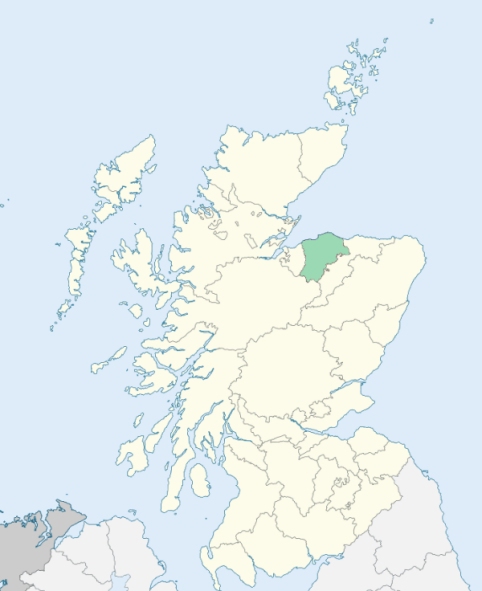

Duthil and Rothiemurchas is a parish at the south-west extremity of Morayshire. It is bounded on the north by Nairnshire, on the north-east by a detached district of Inverness-shire, on the northern part of the east by the parish of Abernethy, and on all other sides by the main body of Inverness-shire. (1867: The Imperial Gazetteer of Scotland, by John Marius Wilson).
Achnahannet, Aviemore, Boat of Garten, Bogroy, Carrbridge or Carr Bridge, Dalnahaitnach, Drumuillie, Duthil, Slochd
The parish of Cromdale was situated partly in the county of Elgin and partly in the county of Inverness. No change has been made on the county boundary, but the Inverness-shire part of the parish has been transferred to the parish of Duthil and Rothiemurchas. See affected properties and landholders. (1892: Boundary of counties and parishes in Scotland as settled by the Boundary Commissioners under the Local Government Act, 1889, by Hay Shennan)
PRE-REFORMATION GOVERNANCE:
POST-REFORMATION GOVERNANCE:
The parishes of Duthil and Rothiemurchus were united in 1625.
Duthil. The church of Duhil was dedicated to St Peter, but there is evidence of an earlier dedication to St Duchald. Duthil was a prebend of the Cathedral of Elgin. There is a mission chapel in this parish at Boat of Garten.
Rothiemurchus. A parliamentary church was erected on the site of the old church in 1830, and the district declared by Act of Assembly, 25 May 1833, to be a quoad sacra parish. Erected by the Court of Teinds, 16 Feb 1859. Aviemore was added to the parish in 1917.
Disjoined Quoad Sacra Parishes:
Tomintoul. Erected as a parliamentary charge in 1826, and as a parish quoad sacra, 25 June 1845.
(1928: Fasti Ecclesiæ Scoticanæ, by Hew Scott, D. D.)
Includes ministers, licentiates, assistants, readers, and clerks.
Duthil (QO)
Rothiemurchas and Aviemore (QO)
Tomintoul (QS)
(1928: Fasti Ecclesiæ Scoticanæ, by Hew Scott, D. D.)
Parish registers turned over to the Registrar-General, as a result of the Registration of Births, Deaths, and Marriages (Scotland) Act of 1854. The letters B. D. and M. indicate Births (or Baptisms), Deaths (or Burials), and Marriages (or Proclamations of Banns) respectively. Numbers indicate separate volumes or books. Note: These records are by no means complete or without damage; consult the Detailed List of the Old Parochial Registers of Scotland (1872) to learn more about the condition of the records.
| OPR and RD Numbers | |||
|---|---|---|---|
| Date Range | Name | Number | Type |
| 1766-1854 | Duthil and Rothiemurchus | 132 | OPR |
| 1855-1869 | Duthil | 132-1 | RD |
| 1855-1869 | Rothiemurchus | 132-2 | RD |
| 1870-1970 | Duthil | 96b-1 | RD |
| 1870-1970 | Rothiemurchus | 96b-2 | RD |
| 2009 | Highland, Aviemore | 233 | RD |
| 2026 | (Duthil) Moray Council; Speyside Community Council | ||
| 2026 | (Rothiemurchus) Moray Council; Aviemore & Vicinity Community Council | ||
(2009: Parishes and Registration Districts of Scotland - Old and New, National Records of Scotland)
Local community councils (2026) are provided as a potential source of additional information for settlements within the original boundaries of the parish. (Source)
Statistics from informal and official censuses
Note: Names appearing in research materials, other than censuses. Simple names (First name, surname only) have been omitted unless they appear associated with large properties. All women's names, and men's names with occupations, military ranks, or peerage titles are included.
By the Reverend Mr Patrick Grant.
"(Duthil) The amount of the present population of Duthil is 830, all of the established church; 132 males, 458 females, 54 farmers and families, 3 household servants, 230 male and female labouring servants, one student at college.
(Rothiemurchus) The amount of the numbers at present is 280, all of the established church. There are 130 males, 150 females, 9 farmers and families, 3 household servants, and 46 labouring servants. Each marriage, at an average, produces 5 children.
The general size of the people is 5 feet 6. They are extremely industrious, more properly laborious, in the cultivation of their possessions, superstitiously treading in the footsteps of their ancestors, disregarding every new mode of improvement, in which, unfortunately, this country is not singular. Until of late, the people were very fond of a military life; but the wages of servants increasing so exceedingly, that spirit is almost totally overcome. The people are sufficiently economical, yet extremely hospitable and well disposed."
(This section contains excerpts, at times restructured or paraphrased, from an article appearing in Statistical Account of Scotland, Sir John Sinclair, 1791-1799)
Primary Sources:
Statistical Account of Scotland (1791-1799), Volume 4, p. 308
New Statistical Account of Scotland (1834-1845), Volume 13, Section II, p. 123
See Parish Page Sources for all source information and links.