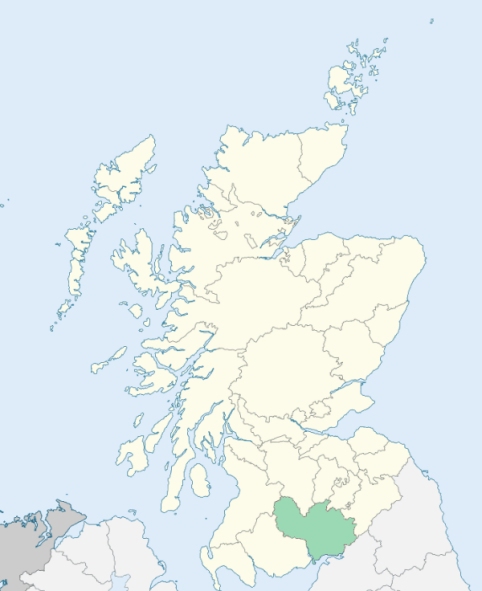
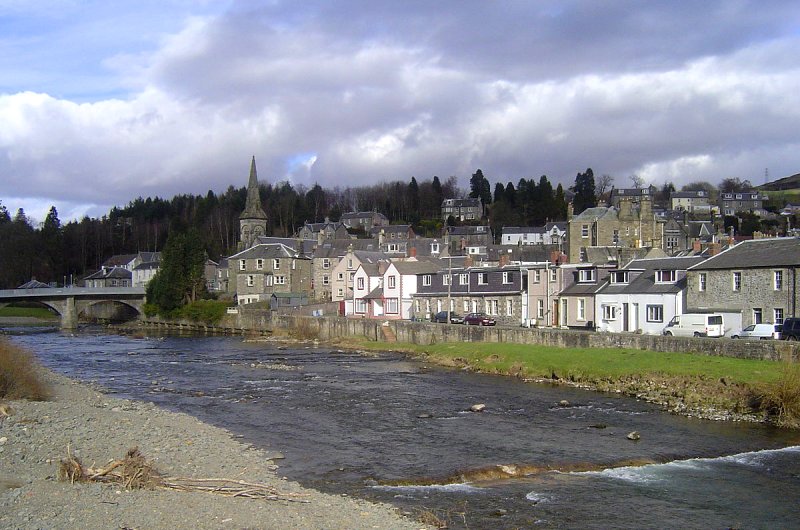
Langholm is a parish in the district of Eskdale, Dumfriesshire. It is bounded by Westerkirk, Ewes, Canonbie, Half-Morton, Middlebie, and Tundergarth. (1867: The Imperial Gazetteer of Scotland, by John Marius Wilson).
Langholm, New Langholm, Staplegordon
Broomholm
PRE-REFORMATION GOVERNANCE:
POST-REFORMATION GOVERNANCE:
The parishes of Stapelgorton and Wauchope were united in 1702.
Langholm. The church of Staplegorton belonged to the Abbey of Kelso. When Staplegorton and Wauchope were united in 1702 a portion of the adjoining parish of Morton (Half-Morton) was included in the union. At that time the parish church was removed from Staplegorton to Langholm. At Langholm is St David's Well.
Wauchope, or Wauchopedale. The church of Wauchope belonged to the Priory of Canonbie. Wauchope was joined to Canonbie before 1 Sept 1609. Having been disjoined again, it was united to Staplegorton in 1702.
Includes ministers, licentiates, assistants, readers, and clerks.
Langholm, or Staplegorton (QO)
Wauchope, or Wauchopedale (QO)
(1928: Fasti Ecclesiæ Scoticanæ, by Hew Scott, D. D.)
Parish registers turned over to the Registrar-General, as a result of the Registration of Births, Deaths, and Marriages (Scotland) Act of 1854. The letters B. D. and M. indicate Births (or Baptisms), Deaths (or Burials), and Marriages (or Proclamations of Banns) respectively. Numbers indicate separate volumes or books. Note: These records are by no means complete or without damage; consult the Detailed List of the Old Parochial Registers of Scotland (1872) to learn more about the condition of the records.
| OPR and RD Numbers | |||
|---|---|---|---|
| Date Range | Name | Number | Type |
| 1668-1854 | Langholm | 839 | OPR |
| 1855-1971 | Langholm | 839 | RD |
| 1972-2004 | Langholm | 838 | RD |
| 2005-2009 | Dumfries and Galloway, Langholm | 838 | RD |
| 2026 | Dumfries & Galloway Council; Langholm, Ewes and Westerkirk Community Council | ||
(2009: Parishes and Registration Districts of Scotland - Old and New, National Records of Scotland)
Local community councils (2026) are provided as a potential source of additional information for settlements within the original boundaries of the parish. (Source)
Statistics from informal and official censuses
Armstrong, Beattie, Bell, Elliot, Graham, Irving, Johnstone, Little, Murray, Scott
Note: Names appearing in research materials, other than censuses. Simple names (First name, surname only) have been omitted unless they appear associated with large properties. All women's names, and men's names with occupations, military ranks, or peerage titles are included.
By the Reverend Mr Thomas Martin.
"From the many vestiges of old houses, it is evident, that in the landward part of the parish, population has decreased considerably during the present century. This may be owing, in a great measure, to the union of farms, many of the present tenants holding, in one farm, what was formerly about the beginning of this century, divided among 7 or 8. It appears that the lands now occupied by 14 tenants, about the beginning of the current century, were divided among no fewer than 80 families, most of whom, people now alive, or lately deceased, remembered. The population of the town, which did not then perhaps contain about 150 or 200 souls, now exceeds 1500.
In the beginning of October 1793, the population of Langholm and Halfmorton consisted as follows: 725 children 10 years of age and under, 746 married persons, 68 widows, 93 widowers, 442 bachelors, and 508 maids; total 2582 souls.
In the town are 2 surgeons, 2 attorneys or writers, 14 shopkeepers, 15 innkeepers and publicans, exclusive of some who keep private tippling houses and dram-shops, 6 manufactures in checks, thread and stockings, 1 tanner, 1 skinner, 1 clock and watch maker, 1 saddler, 2 dyers, 5 bakers, 5 butchers, 3 bleachers, and 3 barbers.
In the town and country part of the parish, there are, including journeymen and apprentices, 30 masons, 20 house carpenters, 8 blacksmiths, 43 weavers, 11 shoemakers (who make shoes with wooden soles, which are commonly worn by trades people and labourers in this part of the country), 3 cloggers, 4 gardeners, and 15 tailors.
A branch of the cotton manufacture was established about 4 years ago in New Langholm, which employed from 80 to 100 people, but it has been at a stand since July last. Fortunately for the weavers, most, if not all of them, are now employed by two respectable manufactures in Carlisle, in weaving checks, &c. (so called, from being chequered or striped) by which means they are kept from emigrating into other parts of the country in quest of bread for themselves and their families. The manufacture of checks and thread has lately been begun in Langholm, and promises to succeed. Stockings have also begun to be manufactured. A woollen manufacture, upon an extensive scale has not long ago been established."
(This section contains excerpts, at times restructured or paraphrased, from an article appearing in Statistical Account of Scotland, Sir John Sinclair, 1791-1799)
Primary Sources:
Statistical Account of Scotland (1791-1799), Volume 13, p. 587
New Statistical Account of Scotland (1834-1845), Volume 4, Section I, p. 416
See Parish Page Sources for all source information and links.