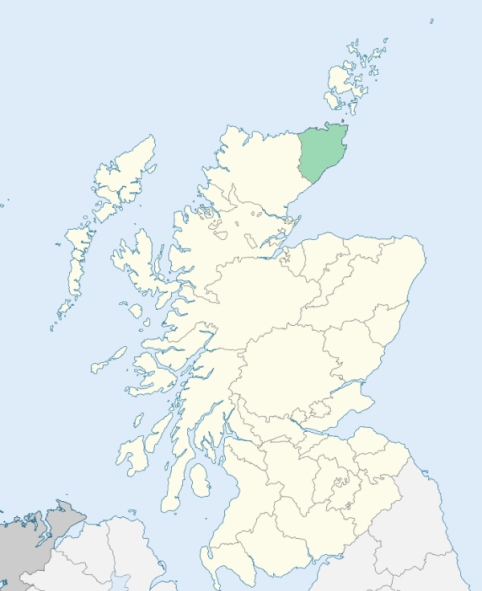
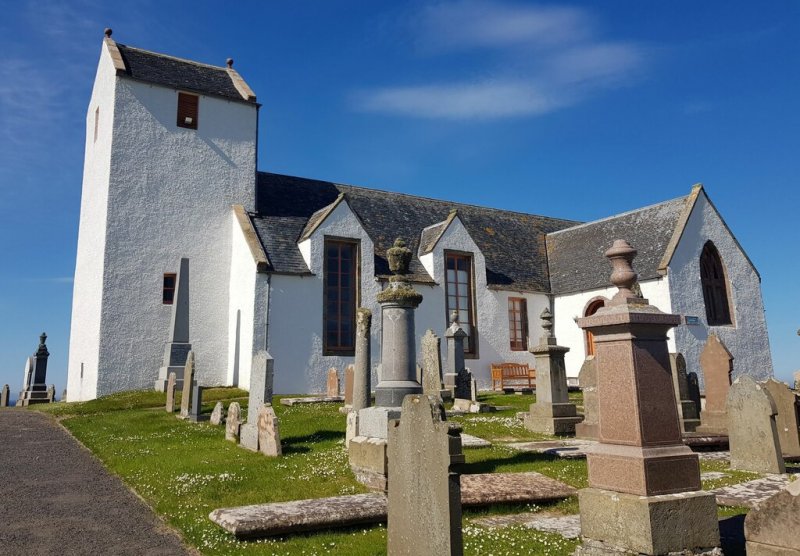
Canisbay is a parish in the north-east of Caithness-shire. It is bounded on the north by the Pentland Firth, on the east by the German Ocean (North Sea), and on the inland side by the parishes of Dunnet, Bower, and Wick. (1867: The Imperial Gazetteer of Scotland, by John Marius Wilson).
Auckingill, Brabster, Duncansbay or Duncansby, East Mey, Freswick, Gills, Houna or Huna, Mey, Stroma, West Mey
PRE-REFORMATION GOVERNANCE:
POST-REFORMATION GOVERNANCE:
The church of Canisbay was dedicated to St Anne. Canisbay was a prebend of the Cathedral of Dornoch. There were in this parish at least six chapels, that of St John the Evangelist at the Dun of Mey near St John's Head, St Modan's at Freswick, St Drostan's at Brabster, the Lady Kirk of St Mary at Duncansby, St Irchard's and two on the island of Stroma, where now there is a mission chapel.
Includes ministers, licentiates, assistants, readers, and clerks.
(1928: Fasti Ecclesiæ Scoticanæ, by Hew Scott, D. D.)
Parish registers turned over to the Registrar-General, as a result of the Registration of Births, Deaths, and Marriages (Scotland) Act of 1854. The letters B. D. and M. indicate Births (or Baptisms), Deaths (or Burials), and Marriages (or Proclamations of Banns) respectively. Numbers indicate separate volumes or books. Note: These records are by no means complete or without damage; consult the Detailed List of the Old Parochial Registers of Scotland (1872) to learn more about the condition of the records.
| OPR and RD Numbers | |||
|---|---|---|---|
| Date Range | Name | Number | Type |
| 1652-1854 | Canisbay | 35 | OPR |
| 1855-1967 | Canisbay | 35 | RD |
| 2009 | Highland | 160 | RD |
| 2026 | Highland Council; Dunnet and Canisbay Community Council | ||
(2009: Parishes and Registration Districts of Scotland - Old and New, National Records of Scotland)
Local community councils (2026) are provided as a potential source of additional information for settlements within the original boundaries of the parish. (Source)
Statistics from informal and official censuses
Banks, Bremner, Manson, Mowat, Rosie, Simpson, Sinclair, Smith, Steven, Sutherland
Note: Names appearing in research materials, other than censuses. Simple names (First name, surname only) have been omitted unless they appear associated with large properties. All women's names, and men's names with occupations, military ranks, or peerage titles are included.
By the Reverend Mr John Morison, D. D..
"In Canisbay there are no manufactures. Their common apparel is of home growth and texture, generally dyed black. Their dress clothes are all imported, and in general of better quality, than their circumstances can well afford. Both sexes are alike ambitious to appear fine. Few country congregations are more crowded, or brilliant in the summer season. Meetings for dancing are very common in winter. It is then, too, that they generally marry. Their weddings are often crowded; but the entertainment is always gratuitous. There are annual emigrations from the parish, both of males and females in the menial line, who leave the place of their nativity, in quest of superior wages in the south of Scotland. Many of the young men become soldiers, preferring the land to the sea service. Their character in that capacity has always been to their credit. There are few superstitious usages among them: ghosts and fairies are believed to manifest themselves occasionally."
(This section contains excerpts, at times restructured or paraphrased, from an article appearing in Statistical Account of Scotland, Sir John Sinclair, 1791-1799)
Primary Sources:
Statistical Account of Scotland (1791-1799), Volume 8, p. 142
New Statistical Account of Scotland (1834-1845), Volume 15, Section II, p. 21
See Parish Page Sources for all source information and links.