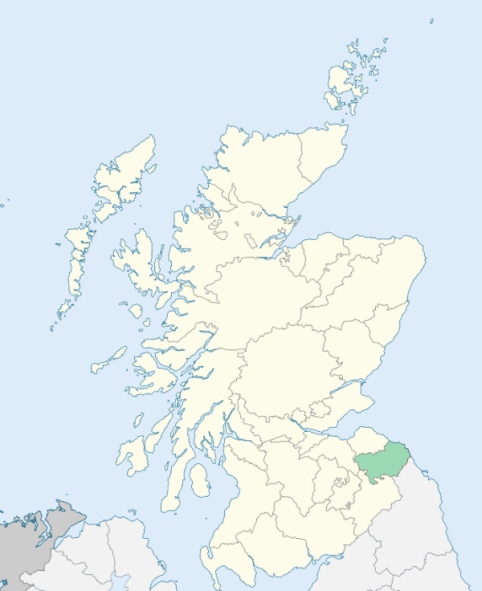
Polwarth is a parish nearly in the centre of Berwickshire. It is bounded by Langton, Fogo, Greenlaw, and Longformacus. (1867: The Imperial Gazetteer of Scotland, by John Marius Wilson).
Marchmont, Polwarth
PRE-REFORMATION GOVERNANCE:
POST-REFORMATION GOVERNANCE:
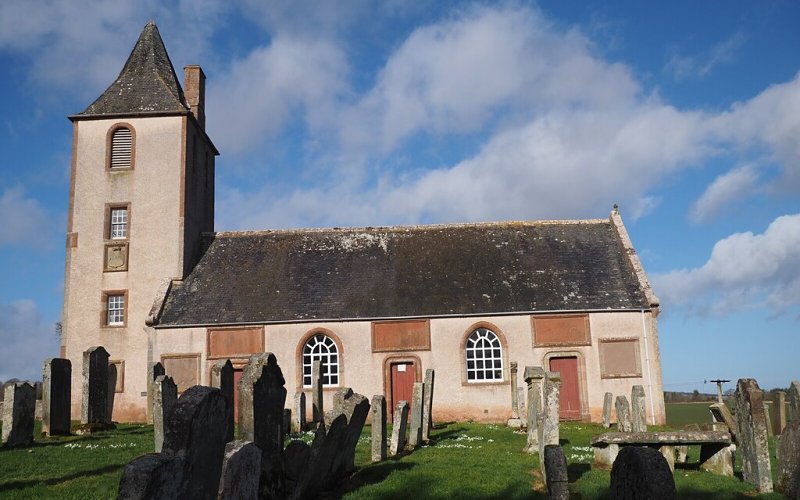
A church was built here about the year 900. On 7 April 1242 a new church, dedicated to St Mungo, was consecrated by Bishop David de Bernham. It was rebuilt in 1378, and again in 1703, by Sir Patrick Hume, first Earl of Marchmont.
Includes ministers, licentiates, assistants, readers, and clerks.
(1928: Fasti Ecclesiæ Scoticanæ, by Hew Scott, D. D.)
Parish registers turned over to the Registrar-General, as a result of the Registration of Births, Deaths, and Marriages (Scotland) Act of 1854. The letters B. D. and M. indicate Births (or Baptisms), Deaths (or Burials), and Marriages (or Proclamations of Banns) respectively. Numbers indicate separate volumes or books. Note: These records are by no means complete or without damage; consult the Detailed List of the Old Parochial Registers of Scotland (1872) to learn more about the condition of the records.
| OPR and RD Numbers | |||
|---|---|---|---|
| Date Range | Name | Number | Type |
| 1652-1854 | Polwarth | 754 | OPR |
| 1855-1947 | Polwarth | 754 | RD |
| 2009 | Scottish Borders, Duns | 785 | RD |
| 2026 | Scottish Borders Council; Gavinton, Fogo and Polwarth Community Council | ||
(2009: Parishes and Registration Districts of Scotland - Old and New, National Records of Scotland)
Local community councils (2026) are provided as a potential source of additional information for settlements within the original boundaries of the parish. (Source)
Statistics from informal and official censuses
Anderson, Bolton, Elliot, Foster, Gibb, Lothian, Nisbet, Redpath, Somerville, Watson
Note: Names appearing in research materials, other than censuses. Simple names (First name, surname only) have been omitted unless they appear associated with large properties. All women's names, and men's names with occupations, military ranks, or peerage titles are included.
By the Reverend Mr Robert Home, Minister.
"The village of Polwarth is the most populous part of the parish. The population has, on the whole, increased within these 40 years. In the village are 55 families and 184 souls; in the country are 17 families, and 104 souls; total in 1793, 72 families and 288 souls. The number of souls in the whole parish, as returned to Dr Webster in 1755 was 251. Of professions in the village, there are 3 wrights, 1 mason, 1 smith, 2 weavers, 2 tailors, 5 shoemakers, 1 tanner, and 3 carters.
Almost every householder, along with his house, rents a small portion of land, called an acre, but which is often nearer two. Most of the families have been in the village for several generations back; and, for every house that becomes empty, there are always several competitors. The 3 carters above mentioned have a larger portion of land, and keep 2 horses, with which they plough the people's acres; and bring home their turf, which is their principal fuel."
(This section contains excerpts, at times restructured or paraphrased, from an article appearing in Statistical Account of Scotland, Sir John Sinclair, 1791-1799)
Primary Sources:
Statistical Account of Scotland (1791-1799), Volume 17, p. 93
New Statistical Account of Scotland (1834-1845), Volume 2, Section III, p. 231
See Parish Page Sources for all source information and links.