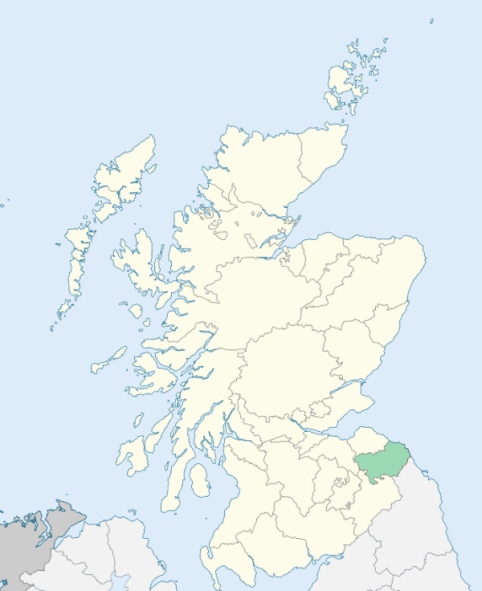
Coldingham is a parish on the coast of Berwickshire. Except a detached portion which is enbosomed to the east in the parish of Eyemouth, it is bounded on the north by the German Ocean (North Sea), on the east by the German Ocean (North Sea) and the parishes of Eyemouth and Ayton, on the south by the parishes of Chirnside and Bunkle, and on the west by the parishes of Abbey St Bathans, Oldhamstocks, and Cockburnspath. (1867: The Imperial Gazetteer of Scotland, by John Marius Wilson).
Auchincraw, Coldingham, Coldingham Shore, Grant's House, Heughhead, Houndwood, Northfield, Reston
Fairlaw, Renton House
The parish of Oldhamstocks was situated partly in the county of Berwick and partly in the county of Hadddington. The Berwickshire portion was in two parts, one being a detached part of Oldhamstocks parish, and the other being part of the main portion of the parish. The detached part of the parish was transferred to the parish of Coldingham, being retained in the county of Berwick. The parish of Oldhamstocks, as thus altered in area, was then placed wholly in the county of Haddington. See affected properties and landholders. (1892: Boundary of counties and parishes in Scotland as settled by the Boundary Commissioners under the Local Government Act, 1889, by Hay Shennan)
PRE-REFORMATION GOVERNANCE:
POST-REFORMATION GOVERNANCE:
The church, dedicated to St Mary, belonged to the Priory of Coldingham till the Reformation. At St Abb's Head in this parish, St Ebba, daughter of Ethelfrith, King of Northumberland, and sister of St Oswald, founded a double convent of monks and nuns. This she ruled as abbess till her death in 683. Some years later the building was destroyed by fire. In 1090 King Edgar founded a Benedictine priory, dedicated to the Virgin Mary, St Cuthbert, and St Ebba. It was built at Coldingham, two miles inland from the remains on St Abb's Head. In 1509 the monastery passed under the rule of the Abbey of Dunfermline. After the Reformation the priory church was used for parochial purposes, and much of the ancient structure survives in the existing parish church.
Disjoined Quoad Sacra Parishes:
Houndwood. In early times the Priory of Coldingham had a chapel at West Renton, dedicated to St Nicholas. But no services were afterwards available for the western portion of Coldingham Parish till 1790, when Sir John Stirling of Glorat and Renton proposed that his chaplain should preach at Renton. A chapel-of-ease was built at Houndwood, and this parish was erected by the Court of Teinds, 9 July 1851. The church was renovated and considerably enlarged in 1900.
Includes ministers, licentiates, assistants, readers, and clerks.
Coldingham (QO)
Houndwood (QS)
(1928: Fasti Ecclesiæ Scoticanæ, by Hew Scott, D. D.)
Parish registers turned over to the Registrar-General, as a result of the Registration of Births, Deaths, and Marriages (Scotland) Act of 1854. The letters B. D. and M. indicate Births (or Baptisms), Deaths (or Burials), and Marriages (or Proclamations of Banns) respectively. Numbers indicate separate volumes or books. Note: These records are by no means complete or without damage; consult the Detailed List of the Old Parochial Registers of Scotland (1872) to learn more about the condition of the records.
| OPR and RD Numbers | |||
|---|---|---|---|
| Date Range | Name | Number | Type |
| 1690-1854 | Coldingham | 732 | OPR |
| 1855-1879 | Coldingham | 732 | RD |
| 1880-1968 | Coldingham | 732-1 | RD |
| 1880-1968 | Grantshouse | 732-2 | RD |
| 1969-1971 | Coldingham | 732 | RD |
| 1972-1978 | Coldingham | 781 | RD |
| 2009 | (Coldingham) Scottish Borders, Eyemouth | 782 | RD |
| 2009 | (Grantshouse) Scottish Borders, Duns | 785 | RD |
| 2026 | (Coldingham) Scottish Borders Council; Coldingham Community Council | ||
| 2026 | (Grantshouse) Scottish Borders Council; Grantshouse Community Council | ||
(2009: Parishes and Registration Districts of Scotland - Old and New, National Records of Scotland)
Local community councils (2026) are provided as a potential source of additional information for settlements within the original boundaries of the parish. (Source)
Statistics from informal and official censuses
Anderson, Brown, Cockburn, Gibson, Nisbet, Purves, Rae, Thorburn, White, Wilson
Note: Names appearing in research materials, other than censuses. Simple names (First name, surname only) have been omitted unless they appear associated with large properties. All women's names, and men's names with occupations, military ranks, or peerage titles are included.
By John Renton, Esq., of Chesterbank.
"By an accurate list made out in the year 1791, the heads of families in this parish are 529; the number of souls 2391, of whom 1136 are males, and 1255 females. There were 643 under 10 years of age. No Papists, Episcopals, or Unitarians. The established Presbyterian religion is the only manner of worship attended to and professed here; there are, however, a few seceders.
Before the spirit of improving land began to appear here, there were 3 considerable villages besides the town of Coldingham, viz. Renton, Auchencraw, and the 2 Prestons; but since that, the heritors have built good farm-steadings upon the most centrical parts of their outfields. Hence, the villages of Renton and East Preston have disappeared, and Auchencraw and West Preston have dwindled to less than the half of what they were before that period. There are above 60 farms in this parish, besides the acres that lie around the town of Coldingham.
We have few manufactures in this parish owing to our distance from collieries. Our young men go partly to England, and partly to Edinburgh, and other populous towns in Scotland, in quest of employment. Very few of them relish either the sailor or soldier's way of life. Our young women are, for the most part, employed in spinning. Our handicraftsmen and labourers seem to depend upon the farmers for their subsistence, as they are principally employed by them. There are, however, about 36 master weavers in the parish, who besides what they weave for the inhabitants, manufacture a good deal of linen and woollen cloths for sale. They are generally in easy circumstances, and some of them are becoming rich in that line of life.
There are several shopkeepers in the town of Coldingham, but none of them deal extensively. No writers or attorneys of influence; nor is there one single justice of peace resident in this large parish. There is not a single surgeon in this parish.
The generality of the people in this parish are sober, frugal, and industrious, plain and decent in their dress and deportment, and very few of them discover any desire for fineries, or expensive amusements. The only extravagance they are guilty of is their breakfasting upon tea, in place of pottage, and the immoderate use of whisky, which too many of the lower class are guilty of, which destroys them."
(This section contains excerpts, at times restructured or paraphrased, from an article appearing in Statistical Account of Scotland, Sir John Sinclair, 1791-1799)
Primary Sources:
Statistical Account of Scotland (1791-1799), Volume 12, p. 43
New Statistical Account of Scotland (1834-1845), Volume 2, Section III, p. 279
See Parish Page Sources for all source information and links.