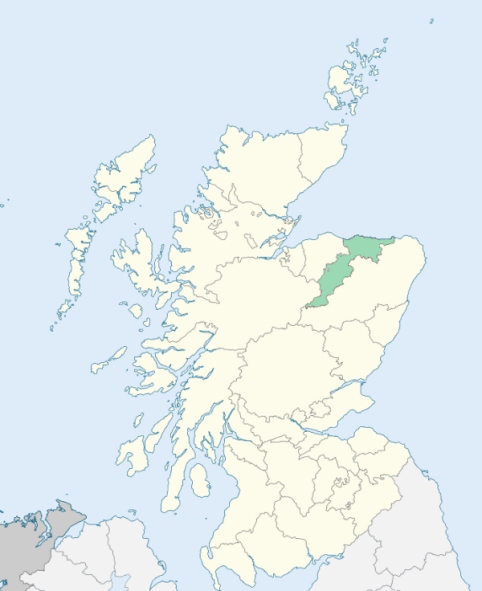
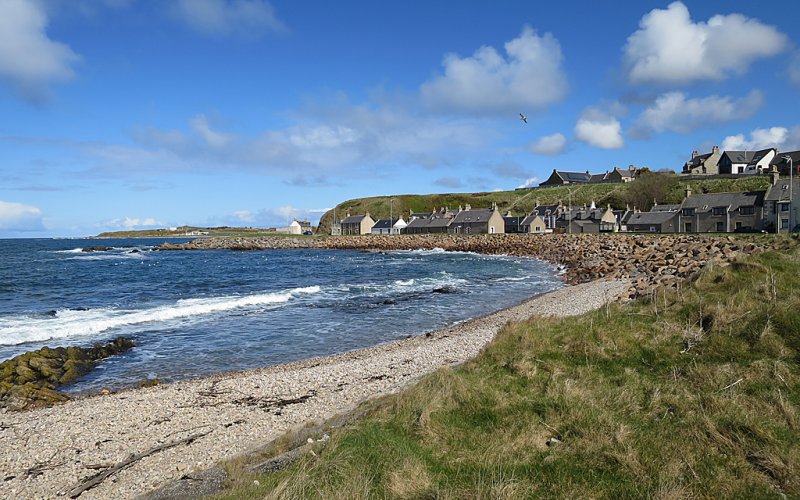
Rathven is a parish on the coast of Banffshire. It is bounded by the Moray Firth, and by the parishes of Cullen, Deskford, Keith, and Bellie. (1867: The Imperial Gazetteer of Scotland, by John Marius Wilson).
Arradoul, Broadley, Buckie, Clochan, Drybridge, Findochty or Findochtie, Fornoughty, Gordonsburgh, New Tannachie, Portessie, Portgordon or Port Gordon, Portknockie, Rathven, Yardie
Cainfield, Tannachy
PRE-REFORMATION GOVERNANCE:
POST-REFORMATION GOVERNANCE:
The church of Rathven was dedicated to St Peter. It belonged to St Mary's Collegiate Church at Cullen. There was at Rathven a leper hospital of St Peter. It was founded by John Bisset about 1224. At later times it was converted into a hospital of Bedesmen. A fair of St Peter was held at Rathven. There was also a Well of Our Lady near Rathven.
Didjoined Quoad Sacra Parishes:
Buckie. A chapel was built here in or about 1835. The parish of Buckie was disjoined from Rathven on 17 July 1876.
Includes ministers, licentiates, assistants, readers, and clerks.
Rathven (QO)
Buckie (QS)
(1928: Fasti Ecclesiæ Scoticanæ, by Hew Scott, D. D.)
Parish registers turned over to the Registrar-General, as a result of the Registration of Births, Deaths, and Marriages (Scotland) Act of 1854. The letters B. D. and M. indicate Births (or Baptisms), Deaths (or Burials), and Marriages (or Proclamations of Banns) respectively. Numbers indicate separate volumes or books. Note: These records are by no means complete or without damage; consult the Detailed List of the Old Parochial Registers of Scotland (1872) to learn more about the condition of the records.
| OPR and RD Numbers | |||
|---|---|---|---|
| Date Range | Name | Number | Type |
| 1710-1854 | Rathven | 164 | OPR |
| 1866-1925 | Rathven | 164 | RD |
| 1926-1953 | Rathven | 164-1 | RD |
| 1926-1936 | Enzie | 164-2 | RD |
| 1926-1936 | Seafield | 164-3 | RD |
| 1937-1953 | Seafield | 164-2 | RD |
| 1954-1967 | Rathven | 164 | RD |
| 1968-1971 | Buckie | 164 | RD |
| 1972-2005 | Buckie | 290 | RD |
| 2009 | Moray Council, Buckie | 290 | RD |
| 2026 | Moray Council; Buckie Community Council | ||
(2009: Parishes and Registration Districts of Scotland - Old and New, National Records of Scotland)
Local community councils (2026) are provided as a potential source of additional information for settlements within the original boundaries of the parish. (Source)
Statistics from informal and official censuses
Coull, Cowie, Flett, Geddes, Mair, Murray, Reid, Smith, Thomson, Wood
Note: Names appearing in research materials, other than censuses. Simple names (First name, surname only) have been omitted unless they appear associated with large properties. All women's names, and men's names with occupations, military ranks, or peerage titles are included.
By the Reverend Mr George Donaldson.
"There were found on an accurate investigation, finished about 3 months ago, 3019 persons in the parish, with 505 in the part annexed to Cullen. Among the inhabitants enumerated above, there are 14 merchants or shopkeepers, 6 millers, 12 masons, 19 tailors, 19 shoemakers, 70 weavers, 12 smiths, 21 carpenters, 6 shipmasters, 2 tidesmen, 1 dyer, 1 tobacconist, 2 butchers, 1 baker, 4 gardeners, 6 male domestic servants.
Female domestic servants, as well as the farm servants of both sexes, are extremely fluctuating, except in gentlemen's families. The common farmers are not opulent enough to afford wages to annual servants, whose termly demands are in a state of progression beyond all precedent. They must make their children, to the great prejudice of their education, and at too early a period of life, answer instead of servants.
To delinieate, in few words, the leading feature in the character of a people, different in their religious tenets, and consisting of natives and strangers, landmen and seamen, is no easy matter. In general, however, as far as my observation and experience go, they are sober, frugal and industrious; peaceable and friendly to neighbours and acquaintances; decent and exemplary in their attendance on the ordinances of religion. A taste for comfortable houses, both in the fisher-towns and in the country, is become prevalent; and a more fashionable manner of dress is making rapid progress. On the whole then, being well clothed, well fed, and decently lodged, they have, in a comparative degree, a reasonable share of the comforts and conveniences of life. Examples of natural sagacity, and a talent for information and enterprise, is by no means uncommon among those of every description."
(This section contains excerpts, at times restructured or paraphrased, from an article appearing in Statistical Account of Scotland, Sir John Sinclair, 1791-1799)
Primary Sources:
Statistical Account of Scotland (1791-1799), Volume 13, p. 392
New Statistical Account of Scotland (1834-1845), Volume 13, Section I, p. 245
See Parish Page Sources for all source information and links.