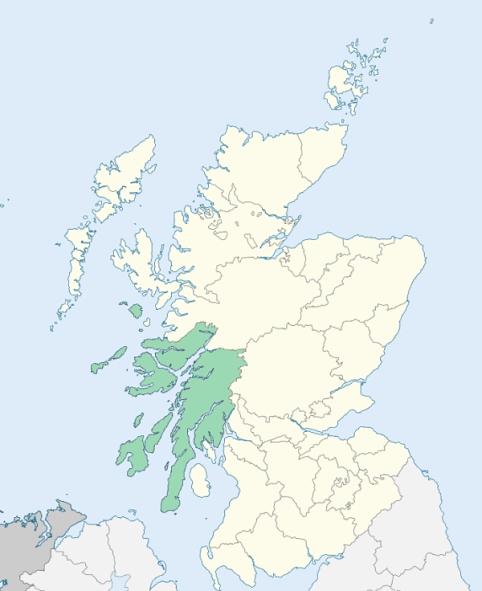
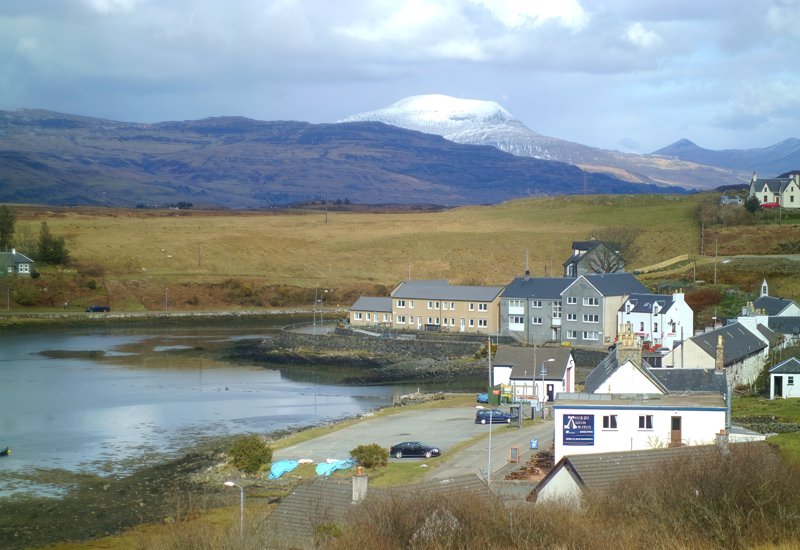
Kilfinichen and Kilvickeon is a parish in the Mull district of Argyleshire. It comprises the islands of Iona, Eorsa, and Inchkenneth, several small continguous islets, and the south-western part of the island of Mull. Its boundaries within Mull are Loch Na Keal, separating it from Kilninian, and a mountain watershed, separating it from Torosay, and its boundary everywhere else is the Atlantic Ocean. (1867: The Imperial Gazetteer of Scotland, by John Marius Wilson).
Ballachroy or Bellachroy, Bonessan or Bunessan, Kintra
The parish of Pennygown and Torosay had a detached part which was situated at Burg, on the north side of the entrance to Loch Scridain, and adjoined the parish of Kilfinichen and Kilvickeon. This detached part of the parish of Kilfinichen and Kilvickeon, situated on the west shore of Loch Buie, was in turn transferred to the parish of Pennygown and Torosay. See affected properties and landholders. (1892: Boundary of counties and parishes in Scotland as settled by the Boundary Commissioners under the Local Government Act, 1889, by Hay Shennan)
PRE-REFORMATION GOVERNANCE:
POST-REFORMATION GOVERNANCE:
The parishes of Kilfinichen, Kilvickeon, and Iona were united early in the seventeenth century. The parish of Iona was disjoined quoad sacra in 1845.
Kilfinichen. The church of Kilfinichen was dedicated to St Finichen, Abbot of Iona, in the tenth century. On the island of Iniskenneth, within the bounds, are the ruins of a small Tironesian priory of St Kenneth, a cell of Iona. There is now a mission chapel at Pennyghael.
Kilvicheoan, or Cill Mho Eoghain. The church of Kilvicheoan was dedicated to St Ewan of Ardstraw in Tyrone. It is located at Bunessan. There are some remains of a chapel at Pennycross.
Iona, or Icholumkill. In the year 563 St Columba came to this island, then called I or Hi, and here he founded his monastery. In later times Icholumkill formed a parish, with its church dedicated to St Ronan. Besides the ancient parish church, still known as Teampull Ronain, there were in Iona various other church buildings, most of which are now ruined. Near St Oran's stands the church of St Mary, given back to the Church of Scotland by George, Duke of Argyll. It was originally the church of the Tironesian Abbey of Icholumkill, founded near the end of the twelfth century by Ranald, Lord of the Isles. About 1506 this church came into the hands of the bishops of the Isles, and became the cathedral of their diocese. Close to it are the ruins of the nunnery of St Mary, founded about 1200 by the same Lord Ranald of the Isles. It was built for Benedictine nuns, but, after a time, passed into the possession of the Cistercian Order. In 1828 a parliamentary chapel was built in Iona. In the parish is included, along with the island of Icholumkill, the Ross of Mull, a considerable part of the mainland of that large island. The modern parish church of Iona occupies the site of an ancient chapel of St Kenneth. There is now within the bounds, in the Ross of Mull, a mission chapel of St Ernan.
Includes ministers, licentiates, assistants, readers, and clerks.
Kilfinichen and Kilvickeon (QO)
Iona (QO)
(1928: Fasti Ecclesiæ Scoticanæ, by Hew Scott, D. D.)
Parish registers turned over to the Registrar-General, as a result of the Registration of Births, Deaths, and Marriages (Scotland) Act of 1854. The letters B. D. and M. indicate Births (or Baptisms), Deaths (or Burials), and Marriages (or Proclamations of Banns) respectively. Numbers indicate separate volumes or books. Note: These records are by no means complete or without damage; consult the Detailed List of the Old Parochial Registers of Scotland (1872) to learn more about the condition of the records.
| OPR and RD Numbers | |||
|---|---|---|---|
| Date Range | Name | Number | Type |
| 1804-1854 | Kilfinichen and Kilvickeon | 542 | OPR |
| 1855-1971 | Kilfinichen and Kilvickeon | 542 | RD |
| 1972-2006 | Kilfinichen and Kilvickeon | 543 | RD |
| 2007-2008 | Kilfinichen and Kilvickeon, Argyll and Bute | 543 | RD |
| 2009 | Argyll and Bute, Kilfinichen and Kilvickeon | 543 | RD |
| 2026 | Argyll and Bute Council; Kilfinichen and Kilvickeon Community Council | ||
(2009: Parishes and Registration Districts of Scotland - Old and New, National Records of Scotland)
Local community councils (2026) are provided as a potential source of additional information for settlements within the original boundaries of the parish. (Source)
Statistics from informal and official censuses
Beaton, Bell, Black, Cameron, Campbell, Graham, Lamont, MacDonald, MacLean, Vass
Note: Names appearing in research materials, other than censuses. Simple names (First name, surname only) have been omitted unless they appear associated with large properties. All women's names, and men's names with occupations, military ranks, or peerage titles are included.
By the Reverend Mr Dugal Campbell.
"The incumbent got the inhabitants numbered in February 1791; the return was 3002. This return must have been exact, as the name of every person was written down. In the parish there are 6 brogue makers, 2 boat carpenters, 1 wheel-wright, 2 smiths, 2 millers, 6 who occasionally buy goods in the Low country, and retail them in the parish; and a great many weavers and tailors. There are 2 surgeons, but without farms, their practice would not maintain them one-third of the year. There are 6 houses for retailing of spirits. There are no lawyers.
A few families have emigrated to America within these few years, and several families went, in 1792, to the Low country to cotton works, &c. All of these left the country for want of employment. Most of the families that went to the Low country in 1792, returned back in 1793, for the same reason they left the country, want of employment. No people are more attached to their native country; and it is only necessity that obliges them to leave it.
The people, in general, are sober, industrious, humane, and ready enough to follow any branch of business that they see clearly is for their advantage. The ground they have to labour, and the method of labouring, show their industry and perseverance. The number of poor they support, shows their humanity. They are by no means superstitious, yet they still retain some opinions handed down by their ancestors perhaps from the times of the Druids. It is believed by them, that the spirit of the last person that was buried watches round the churchyard till another is buried, to whom he delivers his charge.
They are accustomed to the sea from their infancy; and many of them go to the Clyde, where they make expert and hardy seamen. Numbers also enlist in different Highland corps. In spring 1793, 56 left to the Argyllshire Fencibles, besides, a number of fine growing boys, were ready to go to the same corp, but could not be taken as they were not fit for immediate service."
(This section contains excerpts, at times restructured or paraphrased, from an article appearing in Statistical Account of Scotland, Sir John Sinclair, 1791-1799)
Primary Sources:
Statistical Account of Scotland (1791-1799), Volume 14, p. 170br />
New Statistical Account of Scotland (1834-1845), Volume 7, Section II, p. 296
See Parish Page Sources for all source information and links.