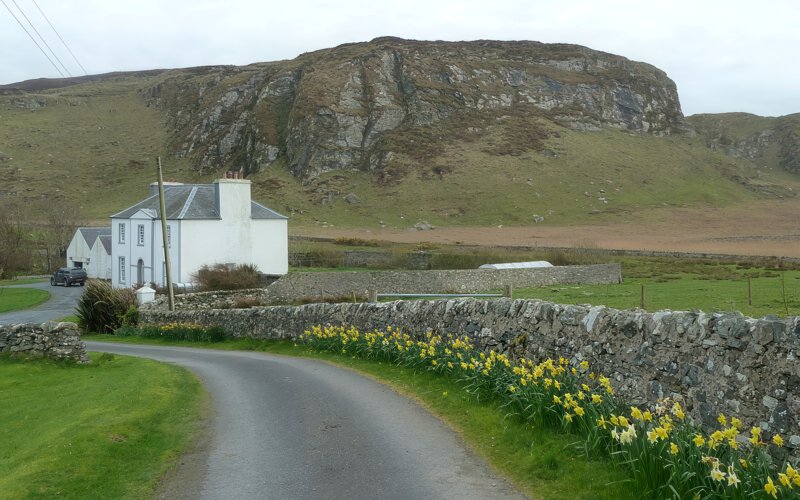
Trumpan
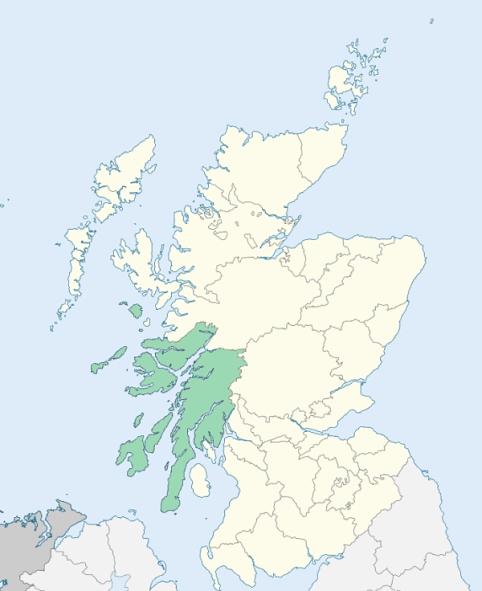
Kilchoman is a parish in the Islay district of Argyleshire. It comprises the south-western peninsula of the island of Islay, between Loch Gruinard and Loch Indall, two farms on the north side of that peninsula, the islets near the mouth of Loch Gruinard, and the islets adjacent to the Rhinns of Islay. (1867: The Imperial Gazetteer of Scotland, by John Marius Wilson).
Port Charlotte, Port Wemyss, Portnahaven,
PRE-REFORMATION GOVERNANCE:
POST-REFORMATION GOVERNANCE:
The church of this parish was dedicated to St Comman of Tyrconnel. In 1618 Kilchoman was united to Kilarrow, but their union was dissolved in 1769. At the north end of the parish are Eilean Naomh (The Holy Isle) and Aird Naomh (the Holy Headland). On Eilean Naomh there was from a very early time a small monastery. Near that, on the mainland of Islay, is the ruined chapel of Cill Naomh. Other ancient chapels stood at Gruinard and Cill Ronain, and at Bruachladaich in the old burial-ground beside the road to Conisby.
Includes ministers, licentiates, assistants, readers, and clerks.
(1928: Fasti Ecclesiæ Scoticanæ, by Hew Scott, D. D.)
Parish registers turned over to the Registrar-General, as a result of the Registration of Births, Deaths, and Marriages (Scotland) Act of 1854. The letters B. D. and M. indicate Births (or Baptisms), Deaths (or Burials), and Marriages (or Proclamations of Banns) respectively. Numbers indicate separate volumes or books. Note: These records are by no means complete or without damage; consult the Detailed List of the Old Parochial Registers of Scotland (1872) to learn more about the condition of the records.
| OPR and RD Numbers | |||
|---|---|---|---|
| Date Range | Name | Number | Type |
| 1821-1854 | Kilchoman | 540 | OPR |
| 1855-1969 | Kilchoman | 540 | RD |
| 1970-1971 | Islay | 540 | RD |
| 1972-2006 | Islay | 546 | RD |
| 2007-2008 | Islay, Argyll and Bute | 546 | RD |
| 2009 | Argyll and Bute, Islay | 546 | RD |
| 2026 | Argyll and Bute Council; Islay Community Council | ||
(2009: Parishes and Registration Districts of Scotland - Old and New, National Records of Scotland)
Local community councils (2026) are provided as a potential source of additional information for settlements within the original boundaries of the parish. (Source)
Statistics from informal and official censuses
Anderson, Bell, Brown, Cameron, Campbell, Currie, Dick, Ferguson, Gillespie, Turner
Note: Names appearing in research materials, other than censuses. Simple names (First name, surname only) have been omitted unless they appear associated with large properties. All women's names, and men's names with occupations, military ranks, or peerage titles are included.
By the Reverend Mr John M'Leish, Minister.
"By a late enumeration, the number of inhabitants in this parish amount to 2300. The inhabitants are all employed in the farming and grazing line, there being no manufactory established in the country; but they are well supplied with tradesmen, in the common and most necessary arts, who make a good livelihood of it. Traveling merchants gather our yarn, and bring home our flax-seed, grocery goods, and rather too many fineries.
The people are much more given to the making of linen, than woollen cloth, this being a flaxen country. Many of the genteel families keep weavers employed for themselves, all the year through. The Highland dress has not made such rapid progress among us, as with our neighbours to the North. We are more clad in the long coat, hat, and breeches, than the inhabitants of any of the Hebrides.
No objection can be made against their natural parts and abilities, which are subtle and ingenious. They are fond of their own country, and are not much addicted to enlisting in the army or navy. They marry young, and are greatly connected by intermarriages, which must always be the case with insular situations; and yet they are very kind to all strangers, who come to reside among them, or visit them. They are in general as contented with their situation as most people, as they have the comforts and conveniences of life in a reasonable degree.
The Gaelic is the general language of the common people; yet English is pretty well understood, and taught in all our schools. The dance and the song, with shinty and putting the stone, are their chief amusements. Numbers of them play well on the violin and bagpipe. The gentlemen, once a year, treat the ladies with a ball, where cheerfulness and propriety of conduct, always preside; and more elegance of manners are to be seen, than could well be expected in so remote a situation."
(This section contains excerpts, at times restructured or paraphrased, from an article appearing in Statistical Account of Scotland, Sir John Sinclair, 1791-1799)
Primary Sources:
Statistical Account of Scotland (1791-1799), Volume 11, p. 276
New Statistical Account of Scotland (1834-1845), Volume 7, Section II, p. 644
See Parish Page Sources for all source information and links.