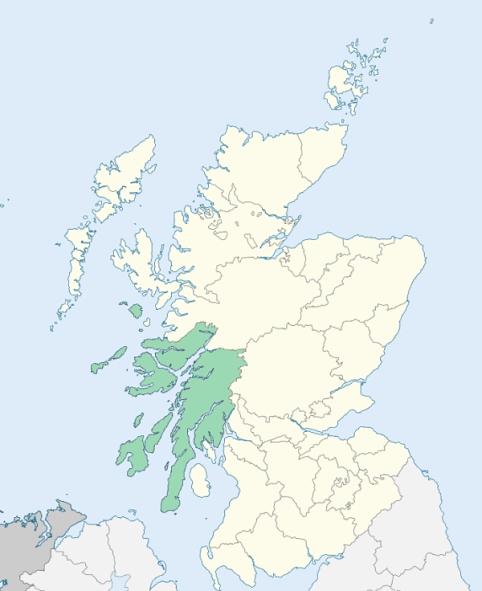
Kilmartin is a parish on the west coast of Argyleshire. It lies in the district of Argyle, opposite the north end of Jura, the gulf of Corryvreckan, and the island of Scarba, and is bounded on the south-west by Loch Crinan, on the north-west by Loch Craignish and the parish of Craignish, on the north-east by the parish of Dalavich, on the east by Loch Awe, and on the south-east and south by the parish of Glassary. (1867: The Imperial Gazetteer of Scotland, by John Marius Wilson).
Ardfern, Crinan or Port Crinan, Ford, Kilmartin
PRE-REFORMATION GOVERNANCE:
POST-REFORMATION GOVERNANCE:
The parish church was dedicated to St Martin. There is now a mission chapel at Ford of Loch Awe.
Includes ministers, licentiates, assistants, readers, and clerks.
(1928: Fasti Ecclesiæ Scoticanæ, by Hew Scott, D. D.)
Parish registers turned over to the Registrar-General, as a result of the Registration of Births, Deaths, and Marriages (Scotland) Act of 1854. The letters B. D. and M. indicate Births (or Baptisms), Deaths (or Burials), and Marriages (or Proclamations of Banns) respectively. Numbers indicate separate volumes or books. Note: These records are by no means complete or without damage; consult the Detailed List of the Old Parochial Registers of Scotland (1872) to learn more about the condition of the records.
| OPR and RD Numbers | |||
|---|---|---|---|
| Date Range | Name | Number | Type |
| 1746-1854 | Kilmartin | 521 | OPR |
| 1855-1969 | Kilmartin | 521 | RD |
| 2009 | Argyll and Bute, Lochgilphead | 533 | RD |
| 2026 | Argyll and Bute Council; Dunadd Community Council | ||
(2009: Parishes and Registration Districts of Scotland - Old and New, National Records of Scotland)
Local community councils (2026) are provided as a potential source of additional information for settlements within the original boundaries of the parish. (Source)
Statistics from informal and official censuses
Anderson, Brown, Campbell, Drummond, Ferguson, Gillies, Johnston, Leitch, Sinclair, Stewart
Note: Names appearing in research materials, other than censuses. Simple names (First name, surname only) have been omitted unless they appear associated with large properties. All women's names, and men's names with occupations, military ranks, or peerage titles are included.
By the Reverend Mr Hugh Campbell.
"The present number of souls (all of whom reside in the country), is as follows: There are 760 males, 777 females, total 1537, of whom 443 are under 10 years of age. There are 100 tenants, 24 crofters, 133 cotters or cottagers, 11 tailors, 16 weavers, 4 smiths, 3 house carpenters, 1 boat carpenter, 1 plough and cart maker, 1 wheel-wright, 6 shoemakers, 4 millers, 1 ferryman, 1 salmon fisher, 7 apprentices, 22 men servants, and 29 women servants.
The people, in general, are of a middling size, squat, and pretty strong made, though not very remarkable for extraordinary strength. They are from 5½ feet to 5 feet 10 inches, few of them 6 feet. In general, they are disposed to industry, if it were properly directed. They are little attached to a military life; but when induced to enter into the service, they have turned out good soldiers, and become even fond of the profession. The few gentry here, live genteelly, without being extravagant. The other class of the inhabitants, are economists from necessity; their only luxury being a little whisky occasionally, which excites some mirth and glee. Their general character, however, is sobriety. They complain of a difficulty in making up their rents, and consequently, they must pinch themselves in some of the comforts, or even necessaries, of life; yet, upon the whole, they seem cheerful and contented."
(This section contains excerpts, at times restructured or paraphrased, from an article appearing in Statistical Account of Scotland, Sir John Sinclair, 1791-1799)
Primary Sources:
Statistical Account of Scotland (1791-1799), Volume 8, p. 90
New Statistical Account of Scotland (1834-1845), Volume 7, Section II, p. 547
See Parish Page Sources for all source information and links.