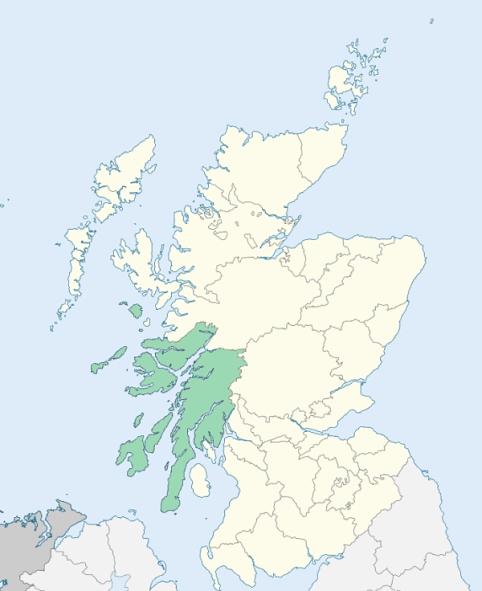
Kilcalmonell and Kilberry is a united parish in Kintyre and Knapdale, Argyleshire. Kilcalmonell is in Kintyre, and comprehends the whole breadth of that peninsula, from Loch Tarbert on the west to Loch Fyne on the east, till separated from the latter by the narrow but long parish of Skipness. Its western side extends the whole length of Loch Tarbert, which is about 12 miles, and stretches 4 miles beyond it, along the coast of the Atlantic Ocean. Kilberry is in Knapdale; it is bounded on the south by Loch Tarbert, on the west by the Atlantic Ocean, and on the north-east by South Knapdale. (1867: The Imperial Gazetteer of Scotland, by John Marius Wilson).
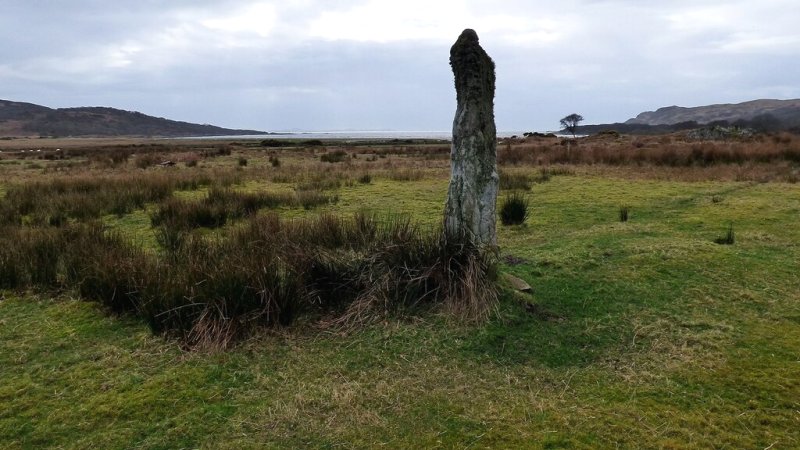
Clachan, Tarbert
The Kilberry district of the parish of Kilcalmonell and Kilberry formed a detached part of the parish, being separated from the main portion of the parish by the parish of South Knapdale and by West Loch Tarbert. The Kilberry district was transferred to the parish of South Knapdale, and it was directed that the remainder of the parish of Kilcalmonell and Kilberry should be called the parish of Kilcalmonell. See affected properties and landholders. (1892: Boundary of counties and parishes in Scotland as settled by the Boundary Commissioners under the Local Government Act, 1889, by Hay Shennan)
PRE-REFORMATION GOVERNANCE:
POST-REFORMATION GOVERNANCE:
The parishes of Kilcalmonell and Kilberry were united before 1560. Each parish has still its own church.
Kilcalmonell. The church of Klcalmonell, a prebend of Lismore, belonged to the Abbey of Paisley. It was dedicated to St Colman of Lan Eala.
Kilberry. The ancient church of Kilberry was dedicated to St Bearach of Kilbarry in Roscommon. A later parish church bore the name of St Mary. Kilberry was a prebend of Lismore, and a mensal church belonging to the Bishop of Argyll. There was in the parish a chapel of St Luag.
Includes ministers, licentiates, assistants, readers, and clerks.
(1928: Fasti Ecclesiæ Scoticanæ, by Hew Scott, D. D.)
Parish registers turned over to the Registrar-General, as a result of the Registration of Births, Deaths, and Marriages (Scotland) Act of 1854. The letters B. D. and M. indicate Births (or Baptisms), Deaths (or Burials), and Marriages (or Proclamations of Banns) respectively. Numbers indicate separate volumes or books. Note: These records are by no means complete or without damage; consult the Detailed List of the Old Parochial Registers of Scotland (1872) to learn more about the condition of the records.
| OPR and RD Numbers | |||
|---|---|---|---|
| Date Range | Name | Number | Type |
| 1777-1854 | Kilcalmonell and Kilberry | 516 | OPR |
| 1855-1892 | Kilcalmonell | 516-1 | RD |
| 1855-1892 | Kilberry | 516-2 | RD |
| 1893-1959 | Kilcalmonell | 516 | RD |
| 1893-1969 | Kilberry | 533-2 | RD |
| 2009 | Argyll and Bute | 534 | RD |
| 2026 | Argyll and Bute Council; South Knapdale Community Council | ||
(2009: Parishes and Registration Districts of Scotland - Old and New, National Records of Scotland)
Local community councils (2026) are provided as a potential source of additional information for settlements within the original boundaries of the parish. (Source)
Statistics from informal and official censuses
Kilcalmonell: Black, Blair, Bruce, Campbell, Carmichael, Galbraith, Johnston, Sinclair, Smith, Thomson
Kilberry: Campbell, Crawford, Dewar, Galbraith, Kennedy, Leitch, Mathieson, Morrison, Thomson, Walker
Note: Names appearing in research materials, other than censuses. Simple names (First name, surname only) have been omitted unless they appear associated with large properties. All women's names, and men's names with occupations, military ranks, or peerage titles are included.
By the Reverend Alexander Campbell, A. M..
"The total population in 1792 was 2448, of whom there were 1196 males, and 1252 females; there were 736 persons under 10 years of age, 562 families, 604 inhabitants in villages, 2448 members of the Established Church.
There were 142 farmers, 5 shopkeepers, 2 innkeepers, 5 licensed distillers, 20 private retailers of whisky, 7 masons, 6 smiths, 1 clockmaker, 5 millers, 11 carpenters, 4 coopers, 44 weavers, 13 shoemakers, 22 tailors, 4 gardeners, 138 farm-servants including herds, 184 female farm servants, 40 male day labourers, 5 male domestic servants, 18 female domestic servants, and 120 seamen, including fishermen.
The people are, in general, mild and docile, punctual in their observance of religious ordinances, and regular in their lives. At a distance from the public road and from strangers, clothes, when washing, are exposed at night without being watched. And it is to be doubted whether any parish in Scotland can produce so long a list of people, with so few instances of crimes.
The most unaccountable part of the conduct of the lower classes in this and in other parishes, and that which can be least easily reconciled to the hardships of their situation, is their fondness for dogs. Almost every family has one; and, in some families, there are two or three. Even paupers were found to have so unwarrantable an attachment to these animals, that threats to strike them off the poor's roll were obliged to be used before they could be prevailed upon to part with them. There are 400 dogs in the parish."
(This section contains excerpts, at times restructured or paraphrased, from an article appearing in Statistical Account of Scotland, Sir John Sinclair, 1791-1799)
Primary Sources:
Statistical Account of Scotland (1791-1799), Volume 10, p. 53
New Statistical Account of Scotland (1834-1845), Volume 7, Section II, p. 408
See Parish Page Sources for all source information and links.