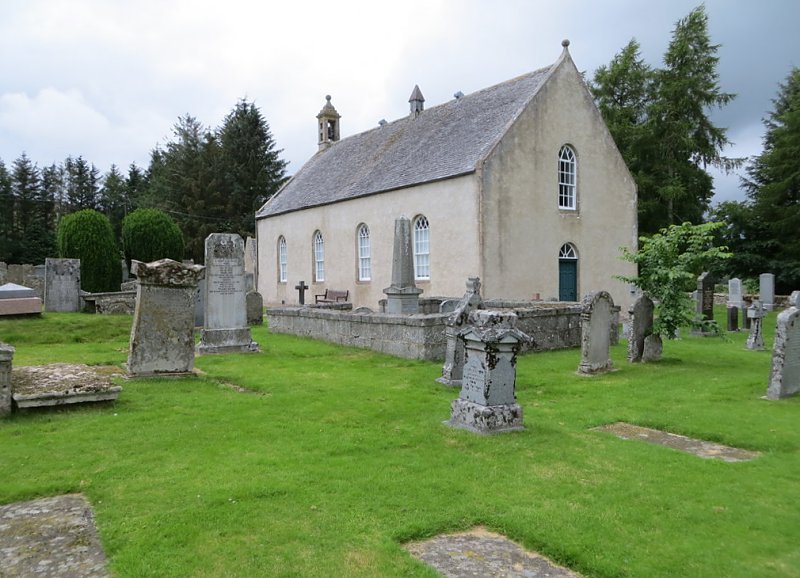
Kinbathoch
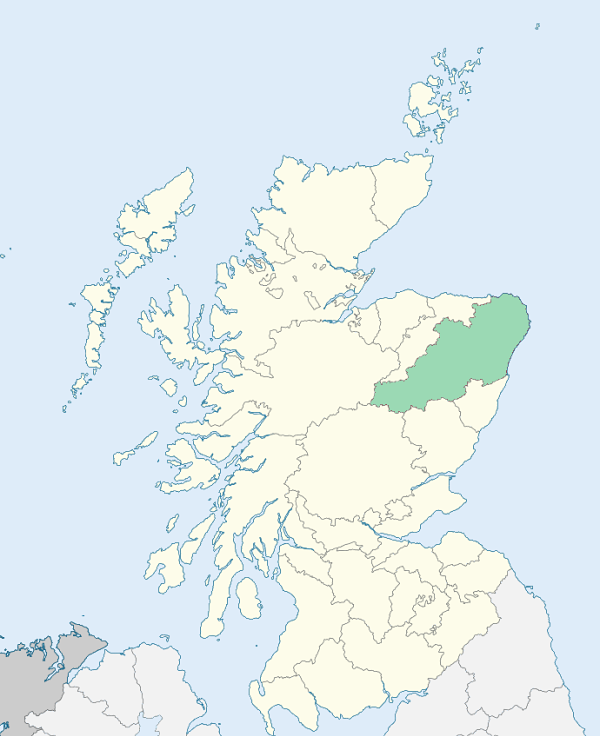
Towie is a parish in the Alford district of Aberdeenshire. It is bounded by Cabrach, Kildrummie, Cushnie, Logie Coldstone, Migvie, Strathdon, and Glenbucket. (1867: The Imperial Gazetteer of Scotland, by John Marius Wilson).
Inverkindie or Inverkindy
Colquoich, Glenkindie
These four parishes (Logie Coldstone, Strathdon, Tarland and Migvie, and Towie) form a group, and can best be dealt with together.
The parish of Strathdon had a detached part in Glenkindie, bounded on the east by the parish of Towie and on the west by the parish of Glenbucket. This detached part was so situated as to separate a part of the parish of Towie at Glencuie from the rest of that parish. In the case of these two detached parts these defects have been cured by transferring the detached part of Strathdon to Towie, thus uniting the detached part of Towie with the main portion of that parish.
The parish of Tarland and Migvie had three detached parts. Tarland and Migvie detached No. 1 was situated at Deskry, and had the parish of Strathdon on the west and the parish of Towie on the east. Tarland and Migvie detached No. 2, situated at Migvie, was bounded on the north by the parish of Towie and elsewhere by the parish of Logie-Coldstone. Tarland and Migvie detached No. 3 was almost entirely surrounded by the parish of Strathdon. Detached No. 3 was transferred to Strathdon; Tarland and Migvie detached No. 1 was divided between Strathdon and Towie, Strathdon receiving the part situated on the left bank of the Deskry, and Towie receiving the remainder; and Tarland and Migvie detached No. 2 was transferred to the parish of Logie-Coldstone. The north-east corner of Logie-Coldstone was transferred to Tarland and Migvie.
See affected properties and landholders. (1892: Boundary of counties and parishes in Scotland as settled by the Boundary Commissioners under the Local Government Act, 1889, by Hay Shennan)
PRE-REFORMATION GOVERNANCE:
POST-REFORMATION GOVERNANCE:
There were in old times five chapels in the parish of Kinbathock, at Nether Towie, Kinbatoch, Ley, Balnaboth, and Sinnahard. The church was renovated in 1891.
Includes ministers, licentiates, assistants, readers, and clerks.
(1928: Fasti Ecclesiæ Scoticanæ, by Hew Scott, D. D.)
Parish registers turned over to the Registrar-General, as a result of the Registration of Births, Deaths, and Marriages (Scotland) Act of 1854. The letters B. D. and M. indicate Births (or Baptisms), Deaths (or Burials), and Marriages (or Proclamations of Banns) respectively. Numbers indicate separate volumes or books. Note: These records are by no means complete or without damage; consult the Detailed List of the Old Parochial Registers of Scotland (1872) to learn more about the condition of the records.
| OPR and RD Numbers | |||
|---|---|---|---|
| Date Range | Name | Number | Type |
| 1751-1854 | Towie | 245 | OPR |
| 1855-1967 | Towie | 245 | RD |
| 2009 | Aberdeenshire, Alford | 326 | RD |
| 2026 | Aberdeenshire Council; Donside Community Council | ||
(2009: Parishes and Registration Districts of Scotland - Old and New, National Records of Scotland)
Local community councils (2026) are provided as a potential source of additional information for settlements within the original boundaries of the parish. (Source)
Statistics from informal and official censuses
Anderson, Beattie, Begg, Forbes, Gordon, Ross, Smith, Strachan, Taylor, Thomson
Note: Names appearing in research materials, other than censuses. Simple names (First name, surname only) have been omitted unless they appear associated with large properties. All women's names, and men's names with occupations, military ranks, or peerage titles are included.
By the Reverend Mr Alexander Mearns.
"The parish seems to have been more populous formerly than at present. There are now about 550 inhabitants, of whom 282 are males, 268 females. The parishioners here consist, in general, of farmers and their families. There are very few mechanics; the farmers here, as is generally the case at such a distance from towns, uniting in their person, along with their own profession, that of mason, carpenter, and shoemaker, are, of course, remarkable for a degree of ingenuity and knowledge, to which the common people near the sea-coast, and where the division of labour is established, are strangers.
The people in this corner are very agile and well-shaped, industrious and humane. They have no dislike to a military life, especially when any of the heritor's sons gets a commission. Luxury is a vice not known in this corner. The people here are not remarkably given to complaints; but they are not insensible to their grievances."
(This section contains excerpts, at times restructured or paraphrased, from an article appearing in Statistical Account of Scotland, Sir John Sinclair, 1791-1799)
Primary Sources:
Statistical Account of Scotland (1791-1799), Volume 4, p. 547
New Statistical Account of Scotland (1834-1845), Volume 12, p. 416
See Parish Page Sources for all source information and links.