Midmar and Kinairney
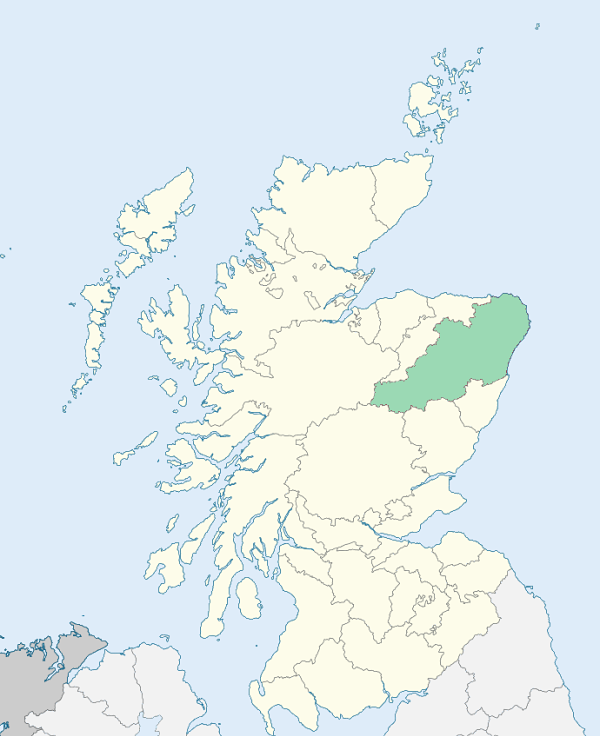
Midmar is a parish in the Kincardine-O'Neil district of Aberdeenshire. It is bounded on the south by Kincardineshire, and on other sides by the parishes of Kincardine-O'Neil, Cluny, and Echt. (1867: The Imperial Gazetteer of Scotland, by John Marius Wilson).
Aucharrie, Auchintoul, Banteith, Dalherrick,Kinnernie, Marionburgh, Midmar, Slydie, Tillybirloch, Tillydaff, Woodend, Woodside
Cairndaie, Littleton, Lyne, Corsindae, Kebbary, Shiels, Arnhill, Baudyground, Corrennie, Corsindae, Greencrook, Kinnernie, Leggerdale, Ordhill, Rowanbush
The parish of Cluny had a detached part separated from the remainder of the parish by an intervening portion of the parish of Midmar. An exchange of territory was effected between these parishes, with the result of connecting the detached part of Cluny with the main portion of the parish, and of transferring to Midmar an intrusive peninsula of the parish of Cluny. In order to equalise the exchange, Cluny received an additional portion of Midmar, taken from the north-east corner of the latter parish. See affected properties and landholders. (1892: Boundary of counties and parishes in Scotland as settled by the Boundary Commissioners under the Local Government Act, 1889, by Hay Shennan)
PRE-REFORMATION GOVERNANCE:
POST-REFORMATION GOVERNANCE:
The parishes of Midmar and Kinairney were united on 6 February 1740.
Midmar. The church of Midmar was dedicated to St Nidan of Llanedan in Wales. It belonged to the Priory of St Andrews.
Kinairney. The church of Kinairney was dedicated to St Mary. It belonged to the Abbey of Arbroath.
Includes ministers, licentiates, assistants, readers, and clerks.
Midmar (QO)
Kinairney (QO)
(1928: Fasti Ecclesiæ Scoticanæ, by Hew Scott, D. D.)
Parish registers turned over to the Registrar-General, as a result of the Registration of Births, Deaths, and Marriages (Scotland) Act of 1854. The letters B. D. and M. indicate Births (or Baptisms), Deaths (or Burials), and Marriages (or Proclamations of Banns) respectively. Numbers indicate separate volumes or books. Note: These records are by no means complete or without damage; consult the Detailed List of the Old Parochial Registers of Scotland (1872) to learn more about the condition of the records.
| OPR and RD Numbers | |||
|---|---|---|---|
| Date Range | Name | Number | Type |
| 1717-1854 | Midmar | 222 | OPR |
| 1855-1863 | Midmar | 222 | RD |
| 1864-1967 | Midmar | 222a | RD |
| 1864-1963 | Millbrex | 222b | RD |
| 2009 | Aberdeenshire, Turriff | 314 | RD |
| 2026 | (Midmar) Aberdeenshire Council; Cluny, Midmar, and Monymusk Community Council | ||
| 2026 | (Millbrex) Aberdeenshire Council; Fyvie, Rothienorman and Monquhitter Community Council | ||
(2009: Parishes and Registration Districts of Scotland - Old and New, National Records of Scotland)
Local community councils (2026) are provided as a potential source of additional information for settlements within the original boundaries of the parish. (Source)
Statistics from informal and official censuses
Adam, Allan, Anderson, Christie, Donald, Duncan, Reid, Sharp, Strachan, Thomson
Note: Names appearing in research materials, other than censuses. Simple names (First name, surname only) have been omitted unless they appear associated with large properties. All women's names, and men's names with occupations, military ranks, or peerage titles are included.
By John Ogilvie, D. D., F. R. S. E.*.
"The number of inhabitants at present is 945. Many of the men exceed 6 feet in stature; from 5 feet 8 inches to 6 feet, may be the ordinary height of the men, and 3 feet 4 inches, to 5 feet 8 inches, that of the women.
The people follow, in general, the occupation of husbandry. There are, at the same time, blacksmiths, carpenters, tailors, shoemakers, and other necessary tradesmen, sufficient for the exigencies of the parish, some of whom are excellent workmen: there are likewise a few shopkeepers. They live together in scattered villages, in houses thatched with straw; those of the principal farmers are not incommodious, in which they entertain with becoming hospitality.
The lower ranks are sober and decent in their manners, intelligent and tractable; and, with their wealthier neighours, abundantly ready to contribute, according to their ability, to the relief of the necessitous poor. The whole parish are members of the established church, two families of Seceders excepted.
The chief manufacture, is that of stockings, which are knit by the women, by which they can earn 2s. a week. The only language spoken here, is that dialect of the English, common in the north of Scotland."
* D. D., F. R. S. E.: Doctor of Divinity, Fellow of the Royal Society of Edinburgh
(This section contains excerpts, at times restructured or paraphrased, from an article appearing in Statistical Account of Scotland, Sir John Sinclair, 1791-1799)
Primary Sources:
Statistical Account of Scotland (1791-1799), Volume 2, p. 516
New Statistical Account of Scotland (1834-1845), Volume 12, p. 629
See Parish Page Sources for all source information and links.