Bras, Brass
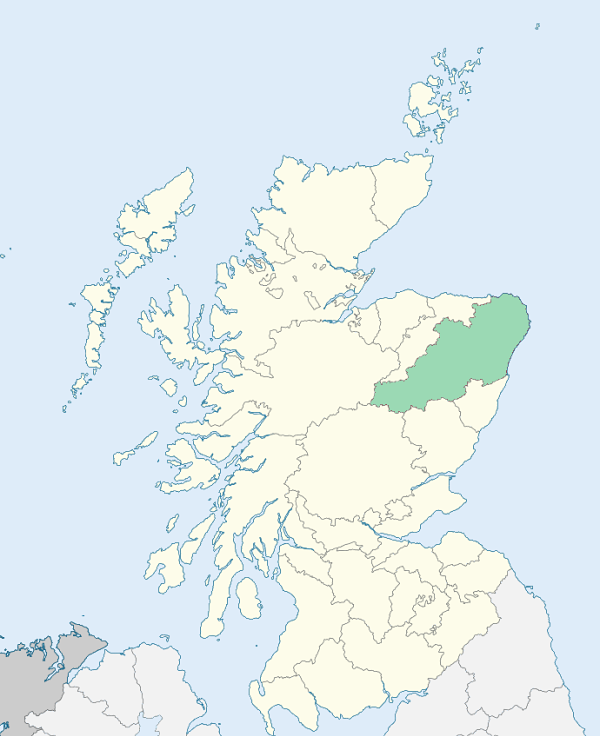
Birse is a parish on the southern border of the highland district of Aberdeenshire. It is bounded by the counties of Kincardine and Forfar, and by the parishes of Aboyne, Lumphanan, and Kincardine-O'Neil. The parish is about 10 miles long and 10 miles broad. It may be divided into three large straths or districts. The largest, in the south-east part of the parish, is called Feughside. The middle strath or district is called Glenchatt. The most northerly district is along the south side of the Dee; through it runs the burn of Birse. It is vulgarly called the Six Towns. (1867: The Imperial Gazetteer of Scotland, by John Marius Wilson).
Birse, Marywell
Dalsack, Finzean, Percie, South Lodge
The parish of Aboyne & Glentanner had one detached part, which was wholly surrounded by the parish of Birse. This detached part was transferred to the parish of Birse. See affected properties and landholders. (1892: Boundary of counties and parishes in Scotland as settled by the Boundary Commissioners under the Local Government Act, 1889, by Hay Shennan)
PRE-REFORMATION GOVERNANCE:
POST-REFORMATION GOVERNANCE:
The church of Birse was dedicated to St Michael. The parish was a prebend of Aberdeen. There were within the bounds wells of St Colm and St Michael.
Disjoined Quoad Sacra Parishes:
Finzean. There was here an ancient dedication to St Finan. A mission chapel was erected at Finzean about 1865. The parish was disjoined from Birse on 20 March 1903.
Includes ministers, licentiates, assistants, readers, and clerks.
Birse (QO)
Finzean (QS)
(1928: Fasti Ecclesiæ Scoticanæ, by Hew Scott, D. D.)
Parish registers turned over to the Registrar-General, as a result of the Registration of Births, Deaths, and Marriages (Scotland) Act of 1854. The letters B. D. and M. indicate Births (or Baptisms), Deaths (or Burials), and Marriages (or Proclamations of Banns) respectively. Numbers indicate separate volumes or books. Note: These records are by no means complete or without damage; consult the Detailed List of the Old Parochial Registers of Scotland (1872) to learn more about the condition of the records.
| OPR and RD Numbers | |||
|---|---|---|---|
| Date Range | Name | Number | Type |
| 1758-1854 | Birse | 175 | OPR |
| 1855-1965 | Birse | 175 | RD |
| 2009 | Aberdeenshire, Aboyne | 330 | RD |
| 2026 | Aberdeenshire Council; Birse and Ballogie Community Council | ||
(2009: Parishes and Registration Districts of Scotland - Old and New, National Records of Scotland)
Local community councils (2026) are provided as a potential source of additional information for settlements within the original boundaries of the parish. (Source)
Statistics from informal and official censuses
Anderson, Begg, Cattanach, Coutts, Grant, Harper, Milne, Ross, Smith, Young
Note: Names appearing in research materials, other than censuses. Simple names (First name, surname only) have been omitted unless they appear associated with large properties. All women's names, and men's names with occupations, military ranks, or peerage titles are included.
By the Reverend Mr Joseph Smith.
"At the end of the year 1791, by an accurate survey, the population was 1253 individuals, of which 607 were male, and 646 were female. There are 273 houses and families. Among the tenants, and especially the subtenants, are included all the mechanics or tradesmen, specified by themselves as follows: 18 wrights and coopers and 5 apprentices, 4 sawyers and wrights, 3 masons, 2 slaters, 2 quarriers of limestone, 5 merchants or retailers, 4 traveling peddlers, 10 weavers and apprentices, 10 tailors and 3 apprentices, 3 shoemakers, 5 blacksmiths and 1 apprentice, 6 meal millers, 3 gardeners and 1 apprentice, 1 ferryman, 2 sheriff-officers, 12 day labourers, 56 men servants above 18 years, 55 female servants above 18 years, 8 house or family servants.
The people are active and industrious, supporting themselves and family comfortably, and seem in general contented with their lot. At church, and at all public occasions, they are clean and decent; punctual in their attendance on public worship, and the ordinances of religion, though many of them are at a great distance from church; far more expensive in their mode of dress and living than their forefathers, but can afford it. They are fond of social and convivial meetings; yet less addicted to drinking than they were some years ago. Indeed the young people squander much of their cash and their time in frequenting markets, marriages, and other merry meetings; so that often they have not a great deal to begin with when they take up house, notwithstanding their extravagant wages."
(This section contains excerpts, at times restructured or paraphrased, from an article appearing in Statistical Account of Scotland, Sir John Sinclair, 1791-1799)
Primary Sources:
Statistical Account of Scotland (1791-1799), Volume 9, p. 103
New Statistical Account of Scotland (1834-1845), Volume 12, p. 786
See Parish Page Sources for all source information and links.