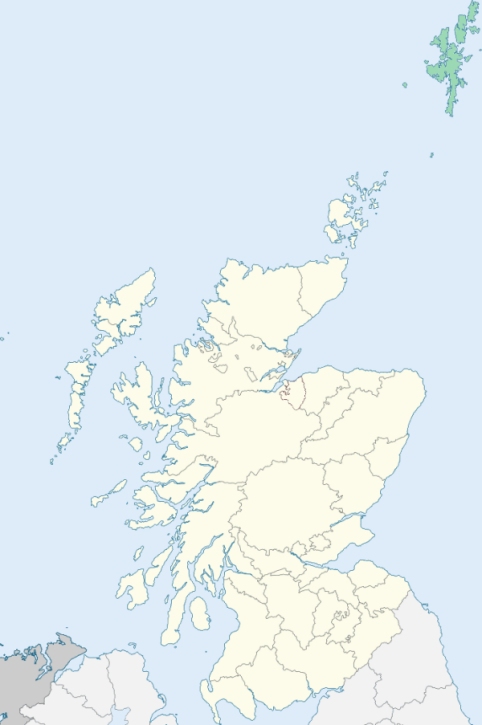
Unst is a parish in the extreme north of Shetland. It consists mainly of the island of Unst, but comprehends also the isles of Uyea and Balta, the islets of Hafgruna and Hume, and the holms of Ska, Burra-frith, Woodwick, Newgord, Hogoland, and Weatherholm. (1867: The Imperial Gazetteer of Scotland, by John Marius Wilson).
Baltasound, Buness or Bunness, Burrafirth, Colindale, Haraldswick or Haroldswick, Norwick, Nyeasound
PRE-REFORMATION GOVERNANCE:
POST-REFORMATION GOVERNANCE:
The island of Unst formed three separate parishes. They were united in the 16th century.
Norwick. The north of Unst forms the parish of Norwick. Its church was dedicated to St John the Baptist. Within the bounds were a good many chapels - St Bartholmew's near Norwick, the chapel of the Holy Rood at Haraldswick, that of St John the Evangelist also at Haraldswick, and Clibberswick Chapel.
Baliasta. Baliasta is the central parish of Unst. Its church was dedicated to St John the Evangelist. Within the bounds were a chapel on the island of Balta, dedicated to St Sunnifa of Bergen, in Norway, a chapel of St John at Colindale, and others.
Lund. The parish of Lund contains all the south of Unst. Its church was dedicated to St Olaf. There were chapels in this parish at Uyea, Sandwick, and elsewhere. The present parish church was built at Baltasound in 1825.
Includes ministers, licentiates, assistants, readers, and clerks.
(1928: Fasti Ecclesiæ Scoticanæ, by Hew Scott, D. D.)
Parish registers turned over to the Registrar-General, as a result of the Registration of Births, Deaths, and Marriages (Scotland) Act of 1854. The letters B. D. and M. indicate Births (or Baptisms), Deaths (or Burials), and Marriages (or Proclamations of Banns) respectively. Numbers indicate separate volumes or books. Note: These records are by no means complete or without damage; consult the Detailed List of the Old Parochial Registers of Scotland (1872) to learn more about the condition of the records.
| OPR and RD Numbers | |||
|---|---|---|---|
| Date Range | Name | Number | Type |
| 1776-1854 | Unst | 11 | OPR |
| 1855-1971 | Unst | 11 | RD |
| 1972-2006 | Unst | 100 | RD |
| 2009 | Shetland Islands, Unst | 100 | RD |
| 2026 | Shetland Islands Council; Unst Community Council | ||
(2009: Parishes and Registration Districts of Scotland - Old and New, National Records of Scotland)
Local community councils (2026) are provided as a potential source of additional information for settlements within the original boundaries of the parish. (Source)
Statistics from informal and official censuses
Note: Names appearing in research materials, other than censuses. Simple names (First name, surname only) have been omitted unless they appear associated with large properties. All women's names, and men's names with occupations, military ranks, or peerage titles are included.
By the Reverend Mr James Barclay.
"Almost every woman in the island manufactures fine woollen stockings. These are much valued for softness and warmth. Considerable quantities of them are sent every year to Edinburgh. Articles of finery for female dress are chiefly received in return. Some coarse cloth for the inner clothing of the common people is likewise manufactured here. But of this the quantity is but small. Few of the inhabitants have been regularly bred to any mechanic art. Yet there are a number of self-taught builders, slaters, wrights, carpenters, tanners, shoemakers, weavers, and tailors, whose proficiency in these different arts is wonderful, when compared with their opportunities of improvement."
(This section contains excerpts, at times restructured or paraphrased, from an article appearing in Statistical Account of Scotland, Sir John Sinclair, 1791-1799)
Primary Sources:
Statistical Account of Scotland (1791-1799), Volume 5, p. 182
New Statistical Account of Scotland (1834-1845), Volume 15, Section IV, p. 36
See Parish Page Sources for all source information and links.