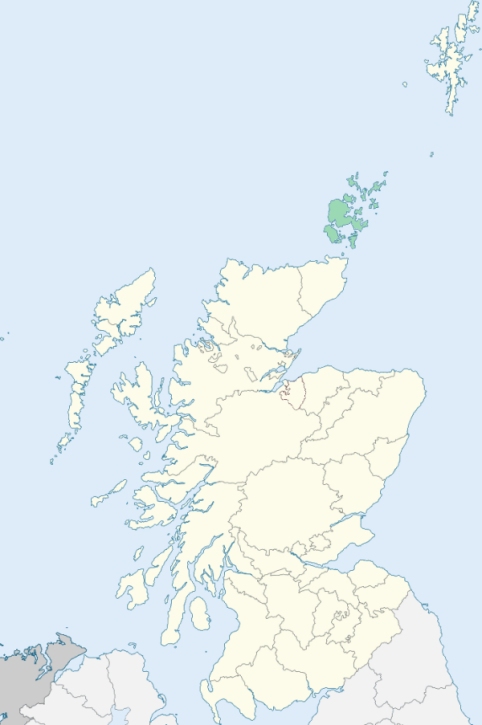
South Ronaldsay and Burray is a parish in the south-east of Orkney. It comprehends the inhabited islands of South Ronaldsay, Burray, Swona, Hunda, and Pentland Skerries, and the uninhabited island of Glimsholm. Three ancient parishes are comprehended in the present parish, and are all believed to be original. South Ronaldsay, or St. Mary's parish, includes Swona, the Pentland Skerries, and the south end of South Ronaldsay. The North, or St Peter's parish, includes the north end of South Ronaldsay. Burray parish includes Burray, Hunda, and Glimsholm. (1867: The Imperial Gazetteer of Scotland, by John Marius Wilson).
Burwick, Elsness, Grimness, Halcro, Herston, Haveton, Hopey, Northwall, Russness, St Margaret's Hope, Stow, Widewall, Windwick
PRE-REFORMATION GOVERNANCE:
POST-REFORMATION GOVERNANCE:
South Ronaldsay, or St Peter's, parish forms the southern part of the Island of Ronaldsay. Its church was dedicated to St Peter. St Peter's was a prebend of Kirkwall. In the sixteenth century the parishes of St Mary's (or Ladykirk) and Burray were united to St Peter's. Within the bounds of the parish were the following chapels: St Mary's at Halcro, St Margaret's at St Margaret's Hope, St Ninian's at Stow, St Columba's at Burwick, and St Andrew's at Windwick. There is now a mission chapel at Herston.
Burray. Burray was one of the prebends of the Cathedral of Kirkwall. Its church was dedicated to St Laurence. On 4 Mar 1894 Burray was disjoined quoad sacra from St Peter's.
St Mary's, or The Lady Kirk of Ronaldsay. St Mary's in Ronaldsay was a prebend belonging to the Dean of Kirkwall. Within the bounds were the following chapels: St Columba's at Grimness, The Holy Rood at Sandwick, St Columba's at Hopey, and St Olaf's at Widewall. The parish of St Mary's was was disjoined from St Peter's and Burray quoad sacra on 24 May 1875. There is now a mission chapel in the parish in the island of Swona.
Includes ministers, licentiates, assistants, readers, and clerks.
South Ronaldsay, or St Peter's (QO)
Burray (QO)
St Mary's, or Lady Kirk of Ronaldsay (QO)
(1928: Fasti Ecclesiæ Scoticanæ, by Hew Scott, D. D.)
Parish registers turned over to the Registrar-General, as a result of the Registration of Births, Deaths, and Marriages (Scotland) Act of 1854. The letters B. D. and M. indicate Births (or Baptisms), Deaths (or Burials), and Marriages (or Proclamations of Banns) respectively. Numbers indicate separate volumes or books. Note: These records are by no means complete or without damage; consult the Detailed List of the Old Parochial Registers of Scotland (1872) to learn more about the condition of the records.
| OPR and RD Numbers | |||
|---|---|---|---|
| Date Range | Name | Number | Type |
| 1657-1854 | South Ronaldsay and Burray | 29 | OPR |
| 1855-1971 | South Ronaldsay and Burray | 29 | RD |
| 1972-2003 | South Ronaldsay | 152 | RD |
| 2009 | Orkney Islands, South Ronaldsay | 152 | RD |
| 2026 | Orkney Islands Council; South Ronaldsay and Burray Community Council | ||
(2009: Parishes and Registration Districts of Scotland - Old and New, National Records of Scotland)
Local community councils (2026) are provided as a potential source of additional information for settlements within the original boundaries of the parish. (Source)
Statistics from informal and official censuses
Annal, Brown, Budge, Duncan, Laird, Rosie, Sinclair, Sutherland, Thomson, Wylie
Note: Names appearing in research materials, other than censuses. Simple names (First name, surname only) have been omitted unless they appear associated with large properties. All women's names, and men's names with occupations, military ranks, or peerage titles are included.
By the Reverend Mr James Watson.
"There are 3 or 4 merchants at the village of St Margarets Hope, in South Ronaldsay. There is one Robert Cromarty, an excellent weaver of tablecloths and fine linen: There are 6 other weavers of coarse stuff: There are four blacksmiths, and 6 or 7 cobblers. But the employers of the former must furnish iron and coal, and of the latter, hemp and leather. There are in these parishes 2 indifferent, and 2 tolerably good inns; the houses for selling ale and spirits are by far too numerous. There are also one good square wright, and 3 or four of inferior skill: There are 2 fiddlers, and one piper, who professes by means of his music, to banish the rats from their habitations.
There are few or no instances of any persons being convicted of capital crimes; but petty theft is very frequent. There are no Justices of Peace to punish this vice; and if there were, it would be extremely difficult to convict the delinquent; because there is a very general belief, that whosoever is concerned in bringing the guilty to punishment, will never thrive.
No couple chooses to marry except with a growing moon, and some even wish for a flowing tide. The existence of fairies and witches is seriously believed by some, who, in order to protect themselves from their attacks, draw imaginary circles, and place knives in the walls of houses. The worst consequence of this superstitious belief is, that when a person loses a horse or cow, it sometimes happens that a poor woman in the neighbourhood is blamed, and knocked in some part of the head, above the breath, until the blood appears. But in these parishes there are many decent, honest, and sensible people, who laugh at such absurdities, and treat them with deserved contempt."
(This section contains excerpts, at times restructured or paraphrased, from an article appearing in Statistical Account of Scotland, Sir John Sinclair, 1791-1799)
Primary Sources:
Statistical Account of Scotland (1791-1799), Volume 15, p. 298
New Statistical Account of Scotland (1834-1845), Volume 15, Section III, p. 191
See Parish Page Sources for all source information and links.