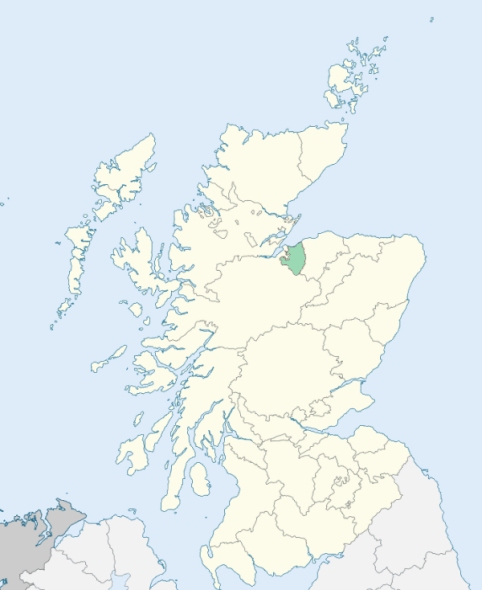
Auldearn is a parish in the north-east corner of Nairnshire. It is bounded on the north by the Moray Firth, on the east by Morayshire, on the south by the parish of Ardclach, and on the west by the parish of Nairn. (1867: The Imperial Gazetteer of Scotland, by John Marius Wilson).
Auldearn, Laken, Moraylaws, Moyness, Pennick, Whitemire
PRE-REFORMATION GOVERNANCE:
POST-REFORMATION GOVERNANCE:
The church of Auldearn was dedicated to St Columba. There were chapels in this parish at Ferness and Lethen. The prebend of Auldearn, in the Cathedral of Elgin, was held by the dean of Moray. A fair of St Columba was held at Auldearn.
Includes ministers, licentiates, assistants, readers, and clerks.
(1928: Fasti Ecclesiæ Scoticanæ, by Hew Scott, D. D.)
Parish registers turned over to the Registrar-General, as a result of the Registration of Births, Deaths, and Marriages (Scotland) Act of 1854. The letters B. D. and M. indicate Births (or Baptisms), Deaths (or Burials), and Marriages (or Proclamations of Banns) respectively. Numbers indicate separate volumes or books. Note: These records are by no means complete or without damage; consult the Detailed List of the Old Parochial Registers of Scotland (1872) to learn more about the condition of the records.
| OPR and RD Numbers | |||
|---|---|---|---|
| Date Range | Name | Number | Type |
| 1687-1854 | Auldearn | 121 | OPR |
| 1855-1967 | Auldearn | 121 | RD |
| 2009 | Highland, Nairn | 270 | RD |
| 2026 | Highland Council; Auldearn Community Council | ||
(2009: Parishes and Registration Districts of Scotland - Old and New, National Records of Scotland)
Local community councils (2026) are provided as a potential source of additional information for settlements within the original boundaries of the parish. (Source)
Statistics from informal and official censuses
Anderson, Cameron, Campbell, Davidson, Fraser, Grant, Murray, Robertson, Ross, Stewart
Note: Names appearing in research materials, other than censuses. Simple names (First name, surname only) have been omitted unless they appear associated with large properties. All women's names, and men's names with occupations, military ranks, or peerage titles are included.
By the Reverend Mr John Paterson.
"In an accurate list taken Spring last year (1796), the parish was found to contain 1406 inhabitants; 661 males, and 745 females. The total of those who follow the profession of agriculture is 127. Several mechanics and tradesmen possess small crofts, in order to augment the means of susbsistence for themselves and families. Of day-labourers there are 43; 11 shoemakers, 7 smiths, 15 weavers, 8 tailors, 7 millers, 11 masons, and 9 square-wrights; and there are 3 inns, and 4 merchants, in the village of Auldearn, which contains 41 houses, and 185 inhabitants.
The inhabitants are sufficiently turned to the devout virtues; but their zeal not being of that sort which is founded in knowledge, and which adds strength and stability to virtue, is conceived by them to imply such a degree of merit as to emancipate them in some measure from the restraints of morality. They are not wanting instances of petty thefts, yet they have never been disgraced by any crime of so flagrant a nature as to subject them to a trial before a criminal court; and their faults are in general the offspring of ignorance and illiberal prejudice, rather than of a corrupted heart."
(This section contains excerpts, at times restructured or paraphrased, from an article appearing in Statistical Account of Scotland, Sir John Sinclair, 1791-1799)
Primary Sources:
Statistical Account of Scotland (1791-1799), Volume 19, p. 616
New Statistical Account of Scotland (1834-1845), Volume 13, Section III, p. 9
See Parish Page Sources for all source information and links.